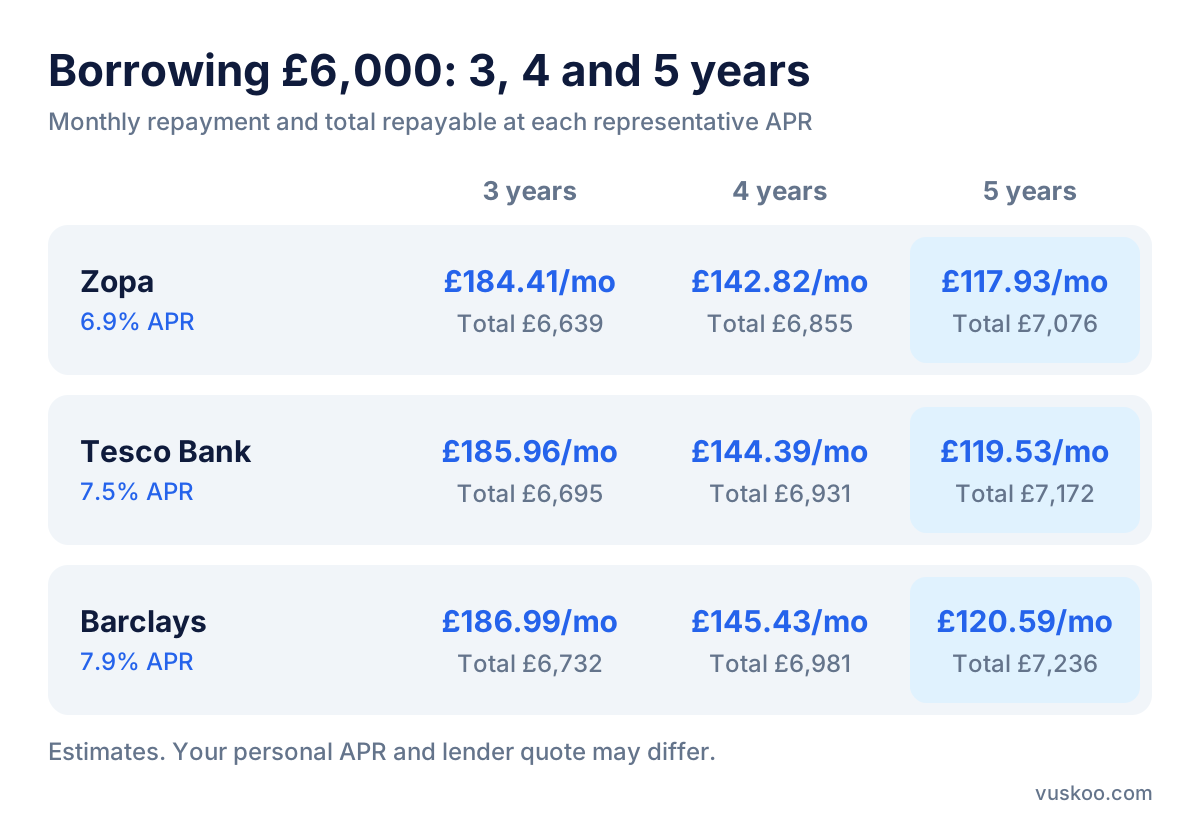
A £6,000 loan over 5 years (60 months) works out at roughly £118 to £121 a month if you get a representative APR between 6.9% and 7.9%. Over the full term you would repay about £7,076 to £7,236, meaning around £1,076 to £1,236 in interest. Choosing 3 or 4 years instead raises the monthly payment but cuts the total interest noticeably.
The figures below use the representative APRs currently listed by Zopa (6.9%), Tesco Bank (7.5%) and Barclays (7.9%). Bear in mind that the rate you are actually offered depends on your credit profile, and that headline rates are often tied to a specific borrowing band.
How much is a £6,000 loan over 5 years per month?
These are estimates for borrowing £6,000 over 60 months with fixed monthly repayments. Lenders round and calculate slightly differently, so their own quotes may vary by a few pence.
- Zopa, 6.9% APR: about £117.93 a month, £7,076 repaid in total (around £1,076 interest)
- Tesco Bank, 7.5% APR: about £119.53 a month, £7,172 repaid in total (around £1,172 interest)
- Barclays, 7.9% APR: about £120.59 a month, £7,236 repaid in total (around £1,236 interest)
A one-point difference in APR changes the monthly payment by less than £3, but over 60 months it adds up to roughly £160. That is why the total amount repayable is a more useful comparison than the monthly figure alone.
5 years vs 3 or 4 years: what changes?
A longer term spreads the £6,000 over more payments, so each one is smaller. The trade-off is that you pay interest for longer.
At 7.5% APR, for example:
- 3 years (36 months): about £185.96 a month, £6,695 in total
- 4 years (48 months): about £144.39 a month, £6,931 in total
- 5 years (60 months): about £119.53 a month, £7,172 in total
Moving from 3 to 5 years lowers the monthly payment by around £66 but adds roughly £477 in interest. If a 3- or 4-year payment fits your budget comfortably, it is the cheaper option overall. If it would leave you stretched, the 5-year term gives more breathing room, and you can still look at overpaying later (see the section on early repayment below).
Questions to ask yourself about the term
- Will the monthly payment still be affordable if your income or bills change?
- Is the thing you are paying for likely to last longer than the loan?
- Would you prefer a lower fixed payment with the option to overpay, or a higher payment that ends sooner?
Why loans under £7,500 often cost more
Many UK lenders price personal loans in bands. The lowest representative APRs are commonly reserved for amounts in a middle band, often starting around £7,500, while smaller loans sit in a band with a higher rate. The reason is largely fixed costs: setting up and administering a £6,000 loan costs the lender about the same as a £7,500 one, but it earns less interest on the smaller sum.
This has two practical consequences:
- Check which band a headline APR applies to. The rate shown on a comparison page may not be the rate for £6,000. Look at the lender's own loan calculator for your exact amount and term.
- Sometimes borrowing slightly more costs less. If the rate for £7,500 is much lower, the total interest can occasionally be similar or even lower than for £6,000. This only makes sense if you would repay the extra £1,500 immediately or genuinely need it. Borrowing more than you need just to reach a lower rate adds risk and, in most cases, cost.
Run the numbers both ways using the total amount repayable before deciding.
Representative APR vs personal APR
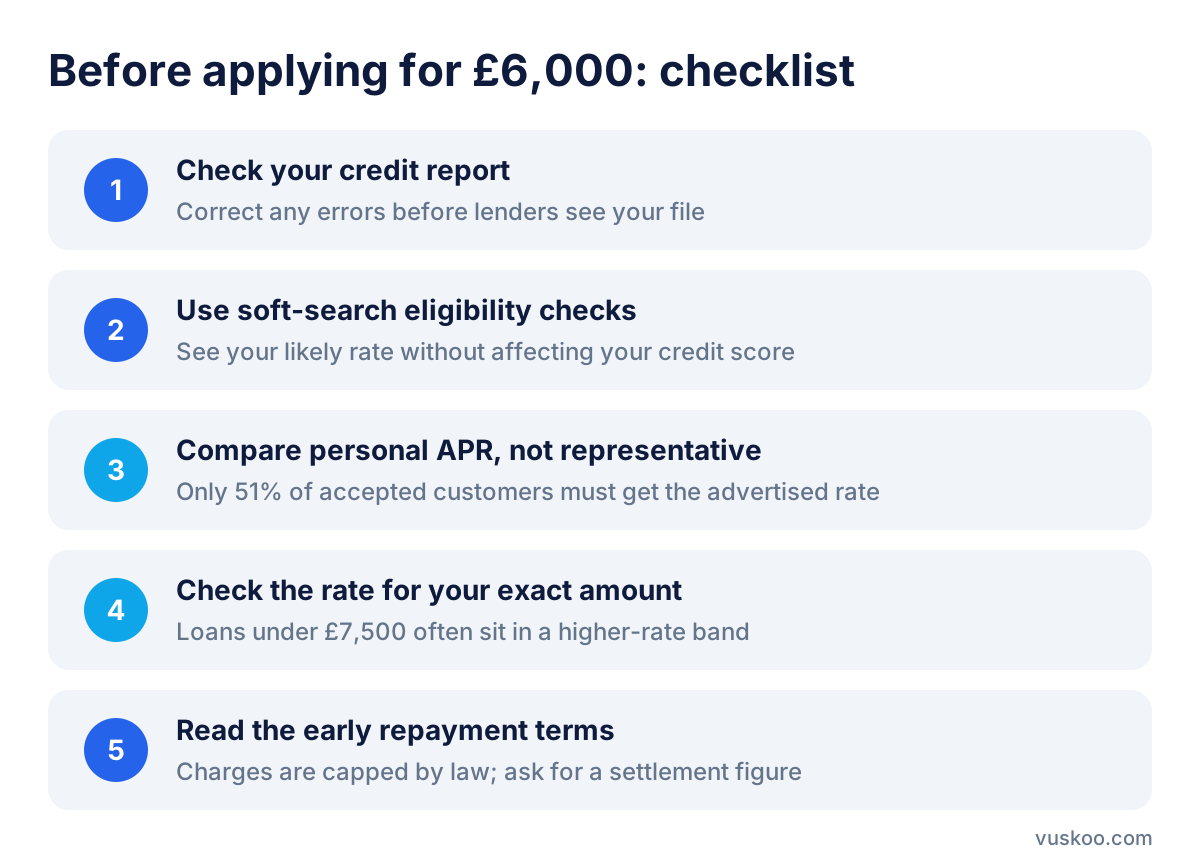
The APR in an advert is a representative APR. Under the Financial Conduct Authority's consumer credit rules, at least 51% of customers who are accepted must receive that rate or lower. Up to 49% can be offered something higher. The FCA consulted in 2026 on whether this threshold is still appropriate, so the rules may change; check the current position on the FCA's website if it matters to your decision.
Your personal APR is the rate you are actually offered after the lender assesses your application. It depends on factors such as your credit history, income, existing debts and how stable your circumstances look. Only the personal APR tells you what you will pay.
Use soft-search eligibility checks first
Most mainstream lenders, including those listed here, offer an eligibility or quote tool that uses a soft search. A soft search lets the lender see enough of your credit file to give you an indication of your likely rate and approval chances, but it is not visible to other lenders and does not affect your credit score.
A full application uses a hard search, which is recorded on your file. Several hard searches in a short period can make lenders more cautious. A sensible order is:
- Check your credit report with a credit reference agency and correct any errors.
- Get soft-search quotes from a few lenders for £6,000 over your chosen term.
- Compare personal APRs and the total amount repayable, not just the monthly payment.
- Apply in full to one lender only once you are reasonably confident of acceptance.
Early repayment charges
You have a legal right to repay a personal loan early, in full or in part. Lenders can charge a fee for this, but it is capped. For loan agreements made since February 2011, the charge cannot exceed 1% of the amount repaid early if more than 12 months of the term remain, or 0.5% if 12 months or less remain. In addition, no charge applies if your early repayments total £8,000 or less in any 12-month period, which covers a £6,000 loan.
Some lenders instead express the cost as up to 58 days' interest (or 28 days' if less than a year remains). In practice, the charge is usually small compared with the interest you save. Before repaying, ask your lender for a settlement figure and read the early repayment section of the agreement, as some lenders charge nothing at all.
Ways to get a lower rate on £6,000
- Improve your credit profile: register on the electoral roll, keep credit card balances low and avoid missed payments in the months before applying.
- Compare by total cost: two loans with similar monthly payments can differ by over £100 in total.
- Consider a shorter term: if affordable, 3 or 4 years reduces total interest.
- Check existing-customer offers: some banks and retailers price loans differently for their own customers, for example Tesco Bank for Clubcard holders. Confirm the terms on the lender's quote.
- Avoid unnecessary add-ons: payment protection or other extras can raise the overall cost.
Frequently asked questions
What is the monthly repayment on a £6,000 loan over 5 years?
At representative APRs of 6.9% to 7.9%, it is roughly £118 to £121 a month. At a higher personal APR, the payment will be higher.
How much interest will I pay on £6,000 over 60 months?
Around £1,076 at 6.9% APR, £1,172 at 7.5% APR and £1,236 at 7.9% APR, assuming you keep the loan for the full term.
Is 5 years too long for a £6,000 loan?
Not necessarily. It keeps payments low, but costs more in interest than 3 or 4 years. If you can afford a shorter term, it will be cheaper overall.
Will checking my eligibility affect my credit score?
Eligibility checkers that use a soft search do not affect your credit score. Only a full application, which uses a hard search, is recorded in a way other lenders can see.
Can I pay off a £6,000 loan early?
Yes. You have a legal right to settle early. Any charge is capped by law, and for agreements made since February 2011 no charge applies if you repay £8,000 or less early within a 12-month period.
Photo: Picsues / Pixabay