Yes, you can get a £30,000 personal loan in the UK without securing it against your home. Only some lenders go this high, though, and approval depends on your income, your existing debts and your credit history. At the advertised rates in our comparison (6.9% to 7.9% APR), a £30,000 loan costs roughly £922 to £935 a month over 3 years, £590 to £603 over 5 years, or £448 to £462 over 7 years. Below we explain who lends this amount, what it costs in total and how lenders decide whether to approve you.
Which lenders offer a £30,000 personal loan?
Many unsecured loans stop at £25,000, so £30,000 is towards the top of what you can borrow without security. The lenders that go this high are mainly high street banks, online banks and some supermarket banks. Of the providers in our comparison:
- Zopa advertises personal loans of up to £35,000, repayable over one to seven years. Its advertised rate in our list is 6.9% APR.
- Tesco Bank offers loans of up to £35,000, with terms based on the amount and what the loan is for. Its advertised rate in our list is 7.5% APR.
- Barclays offers larger personal loans, usually to people who already bank with it. Its advertised rate in our list is 7.9% APR.
Maximum amounts, terms and eligibility rules change, so check each lender's current limits before you apply. Asking for less than a lender's maximum doesn't guarantee you'll be offered the full amount. That depends on how the lender assesses your application.
What a representative APR really means
The rates above are representative APRs. UK advertising rules say at least 51% of successful applicants must get the advertised rate or a lower one. Everyone else can be offered a higher rate. A lender may also quote a different rate for £30,000 than for the loan size used in its advert. Use the figures in this article as a guide, and use each lender's eligibility checker to see the rate you would personally get.
Monthly repayments on a £30,000 loan over 3, 5 and 7 years
The length of the loan changes your monthly payment far more than the gap between the three rates does. A longer term lowers the monthly payment but means you pay more interest overall.
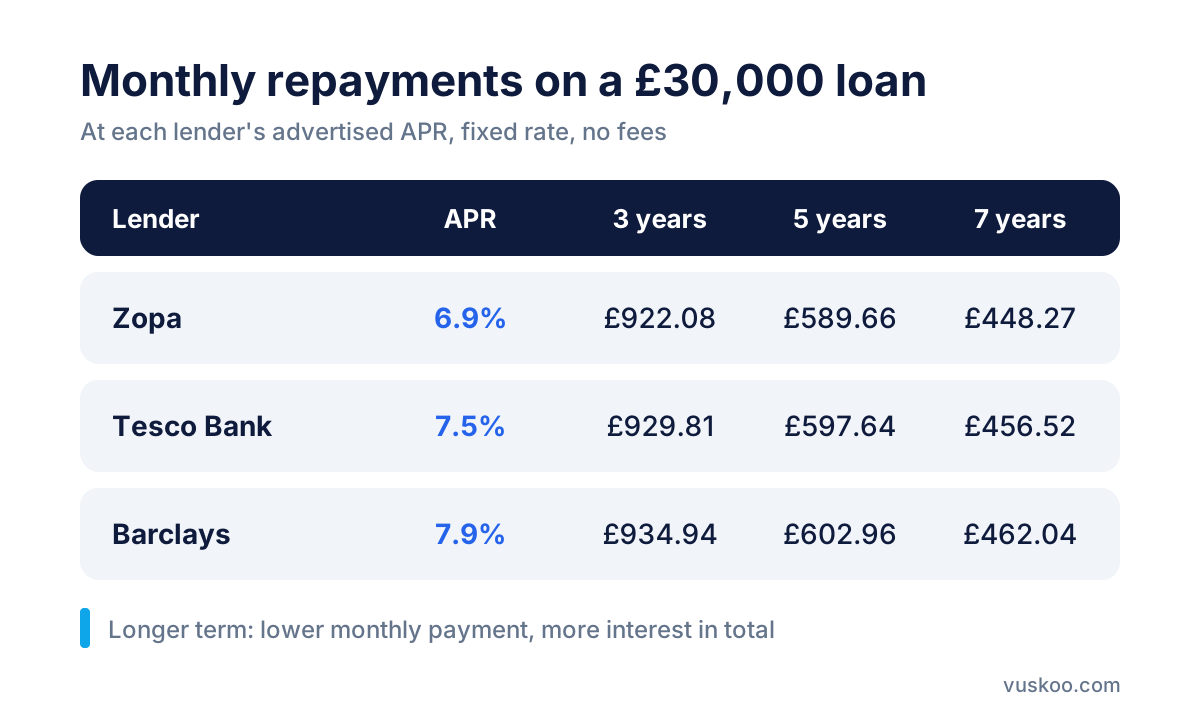
Using Zopa's advertised 6.9% APR as an example:
- 3 years: about £922.08 a month and £33,195 repaid in total, so around £3,195 in interest.
- 5 years: about £589.66 a month and £35,380 in total, so around £5,380 in interest.
- 7 years: about £448.27 a month and £37,655 in total, so around £7,655 in interest.
Spreading the loan over 7 years instead of 3 cuts the monthly payment by more than half but more than doubles the interest. At Barclays' advertised 7.9% APR, the 7-year total rises to about £38,811. At Tesco Bank's 7.5% APR, the monthly payment falls between the other two, at about £930 over 3 years, £598 over 5 years and £457 over 7 years. All these figures assume a fixed rate, no fees and that every payment is made on time.
How to choose the term
- Choose the shortest term with a monthly payment you can comfortably afford, while still leaving room for unexpected costs.
- Match the term to what you are buying. If you repay a car over longer than you expect to keep it, you could still be paying for something you no longer own.
- Check the early repayment terms. You have a legal right to repay a regulated loan early. The lender can charge up to 28 days' interest, or up to 58 days' interest if more than 12 months of the loan are left.
How to qualify for a £30,000 loan
Lenders have to check that you can afford the loan, not just that you're likely to repay it. For a loan this size, expect closer checks than you would get for a small loan.
Income and affordability
Lenders compare your take-home pay with your regular outgoings, including rent or mortgage payments, other credit repayments and household bills. They may confirm your income using your bank account data, your payslips or records held by credit reference agencies. A payment of around £600 a month on a 5-year term should fit comfortably within your budget. It is not enough that you could only just manage it.
Credit history
Lenders usually want to see that you have borrowed before and repaid on time. These things tend to help:
- Being on the electoral roll at your current address.
- Having no recent missed payments, defaults or county court judgments.
- Using only a small part of your available credit card limits.
- Having made few recent credit applications.
Debt consolidation applications
If you want the £30,000 to pay off other debts, the lender will check that the new loan really does replace them. Some lenders pay your other creditors directly. Once the old debts are paid off, close those credit accounts or lower their limits. Otherwise your total debt can build up again.
Steps to apply
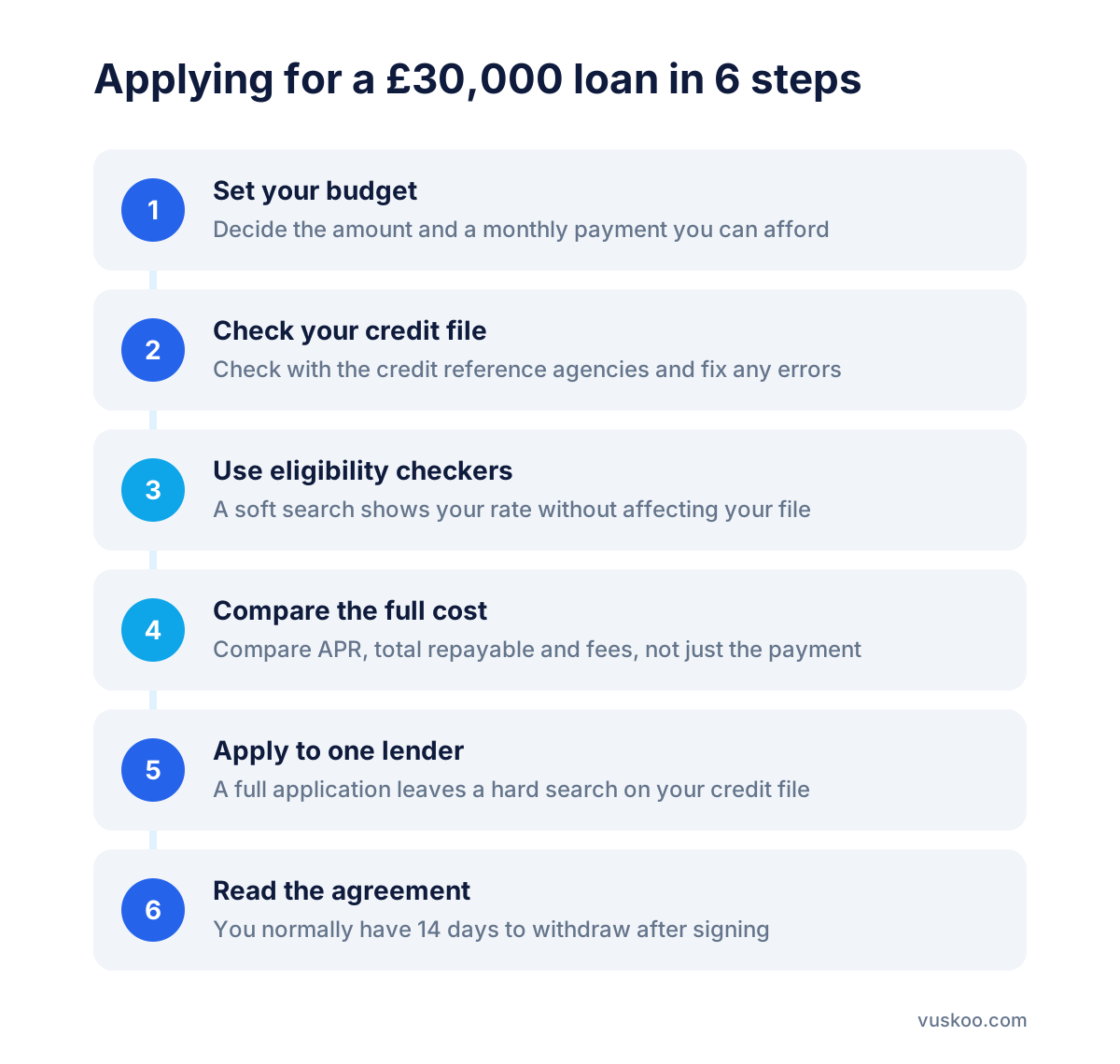
- Work out exactly how much you need to borrow and how much you can afford to repay each month.
- Check your credit file with the credit reference agencies and correct any mistakes.
- Compare the rates you would personally get using eligibility checkers. They use a soft search, which other lenders can't see.
- Compare the APR, the total amount you'll repay and any fees, not just the monthly payment.
- Apply to one lender. A full application leaves a hard search on your credit file, so don't make several applications close together.
- Read the credit agreement. After signing, you normally have 14 days to withdraw, as long as you repay the money and any interest within 30 days.
When a secured loan or a smaller loan makes more sense
Secured loan
A secured (homeowner) loan uses your property as security. It can suit homeowners who are turned down for an unsecured £30,000 loan or who need longer to repay. The downside is serious: if you fall behind on payments, your home could be repossessed. Secured loans can also come with arrangement or broker fees, so compare the total cost as well as the rate.
A smaller loan
If you only just pass affordability checks, borrowing less can make approval more likely and cut the total interest. Options include:
- Paying for part of the cost from savings and borrowing the rest.
- Doing home improvements in stages.
- Choosing a cheaper car, or comparing dealer finance with a personal loan.
Borrowing only what you need is usually cheaper than borrowing a bigger round sum and keeping what's left over.
Frequently asked questions
What is the monthly repayment on a £30,000 personal loan?
At the advertised rates in our comparison, it is roughly £922 to £935 a month over 3 years, £590 to £603 over 5 years and £448 to £462 over 7 years. The rate you're offered may be different.
Can I get a £30,000 loan with bad credit?
It's harder. Mainstream lenders usually keep large unsecured loans for people with a good credit record and enough income. If your record is weaker, you may be offered a smaller amount or a higher rate, or the lender may suggest a secured loan.
Does checking my eligibility affect my credit score?
No. Eligibility checkers use a soft search, which other lenders can't see. Only a full application leaves a hard search.
Can I repay a £30,000 loan early?
Yes. You have a legal right to pay off a regulated loan early, either in full or in part. The lender can charge up to 58 days' interest if more than a year is left, or up to 28 days' interest if less is left.
Is 7 years too long for a £30,000 loan?
It depends on your budget. A 7-year term keeps your monthly payments lower, but you'll pay several thousand pounds more in interest than over 3 years. Choose the shortest term you can afford.
Photo: loufre / Pixabay