VoIP and IP telephony: what it is, how it works and how to save
A guide to IP telephony (VoIP) in the UK: what it is, how it works, its pros and cons, and how to compare broadband and phone deals to keep costs down.
What is IP telephony and why is it replacing the traditional landline?
IP telephony, also called VoIP (Voice over Internet Protocol), lets you make and receive phone calls over the internet instead of the traditional copper telephone network. Your voice is not carried down a dedicated line. It is turned into small packets of digital data that travel over the same fibre or broadband connection you use to go online. This usually makes calls cheaper and more flexible, and gives you features that a conventional landline doesn't have.
In the UK, the old analogue phone network is being retired, and landlines are moving to digital services that run over broadband. As full fibre reaches more homes, more households and businesses can get a reliable IP phone service. Large broadband providers such as BT, Sky, Virgin Media and TalkTalk already deliver home phone lines digitally over broadband in many areas, even when they don't use the term "VoIP" in their marketing.
How IP telephony works, step by step
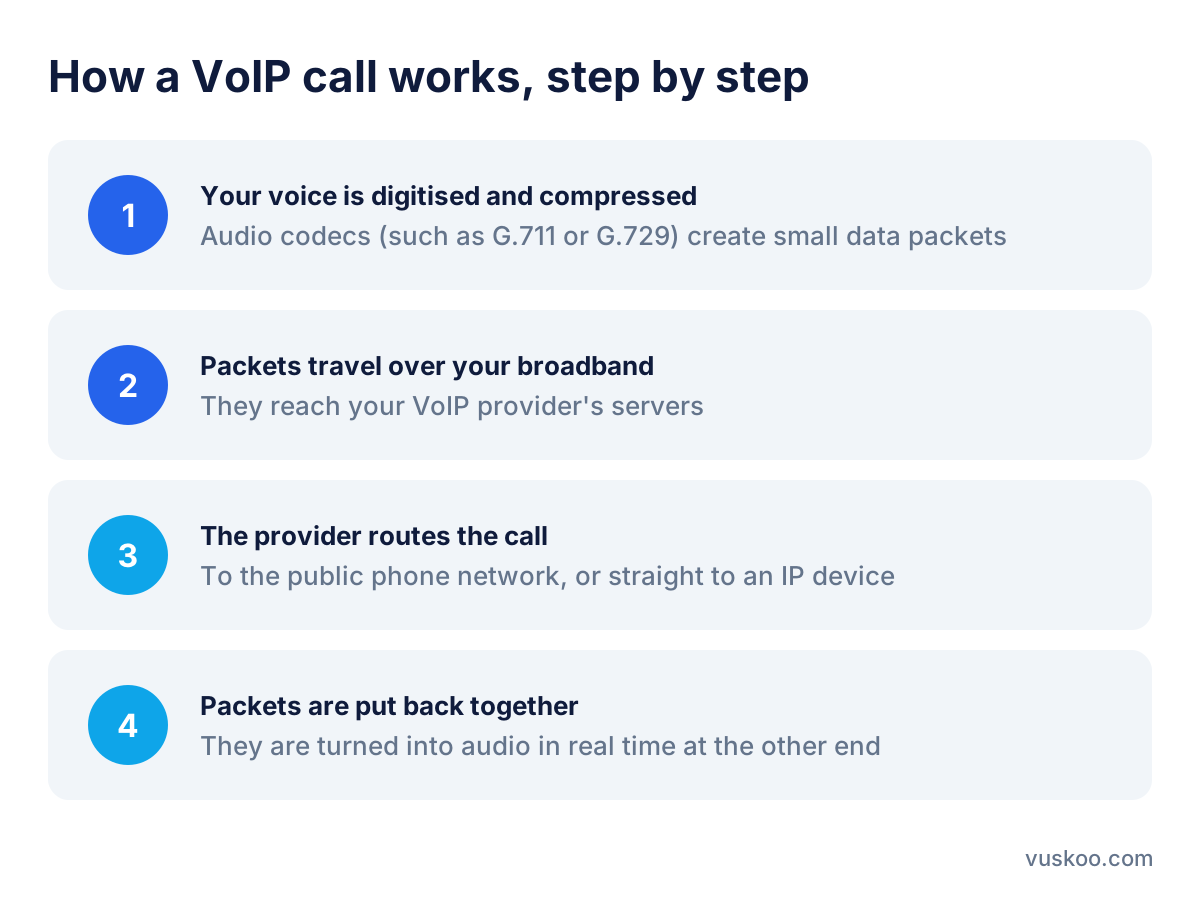
The process is simpler than it sounds. When you speak on an IP phone system, this happens in a fraction of a second:
- Your voice is digitised and compressed into small data packets by audio codecs (G.711 and G.729 are common examples).
- The packets travel over the internet to your VoIP provider's servers.
- The provider passes them on to the public telephone network if the person you are calling uses a traditional line, or straight to their IP device if they are on a compatible system.
- At the other end, the packets are put back together and turned into audio in real time.
You need three things for this to work:
- a stable broadband connection
- a VoIP provider
- a compatible device: a physical IP phone, a softphone (an app on your computer or mobile), or an ordinary analogue handset connected through an adapter (ATA) or a router with a phone socket.
IP telephony vs traditional landline: a comparison
The differences go beyond price. Here are the main points to help you decide.
Traditional landline
- Line rental: often a fixed monthly charge on top of calls.
- International calls: usually charged per minute, and can be expensive.
- Mobility: tied to one physical address.
- Installation: may need an engineer visit and a wait of several days.
- Scalability: extra lines need additional wiring.
- Features: basic, such as call diversion and call waiting.
- Call quality: standard.
- Power cuts: analogue lines generally keep working without mains electricity.
IP telephony / VoIP
- Line cost: often lower, and sometimes included with broadband.
- International calls: typically cheaper, or included in a bundle of minutes.
- Mobility: works anywhere with an internet connection.
- Installation: sign up online and start using it quickly.
- Scalability: new lines can be added straight away.
- Features: call menus (IVR), call recording, analytics, CRM integration and more.
- Call quality: HD voice is possible with a good connection.
- Power cuts: needs a working router and electricity.
IP telephony has the advantage in most areas, with one important exception: if the power goes off or the broadband connection drops, the service stops. To reduce the impact, many providers let you forward calls automatically to a mobile. If you rely on your landline, for example for a telecare alarm, ask your provider about battery backup options before switching.
Benefits of IP telephony for businesses and sole traders
Businesses tend to gain the most from this technology. These are the main benefits:
- Lower line costs: a business with several extensions can often cut its monthly phone bill noticeably compared with traditional lines.
- Cloud-based virtual switchboard: without buying expensive hardware, you get a full system with welcome menus (IVR), call queues, call recording, extensions and opening-hours routing.
- Remote and hybrid working: the business number goes with the employee, not the office. A salesperson can take calls at home, in a café or at a client's premises using the same London or Manchester number.
- Integration with CRM and productivity tools: many VoIP services connect with common CRM and collaboration software, so calls can be logged automatically and customer details shown before you answer.
- Instant scalability: if you hire five new staff this week, you can set up five new extensions in minutes. With traditional lines, you might need an engineer and several days.
IP telephony at home: is it worth it?
Although the business market dominates VoIP, home users can benefit too. Many UK broadband providers now supply the home phone digitally, so customers often use IP telephony without noticing any difference.
There are also providers offering virtual geographic numbers. These suit people who want a landline number without any extra infrastructure, or people living abroad who want to keep a UK number. Free apps that use the same technology can cover basic calling needs, although they don't offer the same service guarantees or support as a dedicated phone provider.
How much does IP telephony cost in the UK?
Prices vary a lot depending on who you are and which features you need. As a general guide:
- Households: a digital home phone is often bundled with broadband, sometimes with a call package as an optional extra. The main cost is the broadband itself.
- Sole traders and small businesses: VoIP is usually priced per user per month, with features such as a virtual switchboard, call recording and support included or added on.
- Medium and large organisations: tailored solutions with SIP trunking, CRM integration and a guaranteed service level agreement (SLA), usually quoted individually.
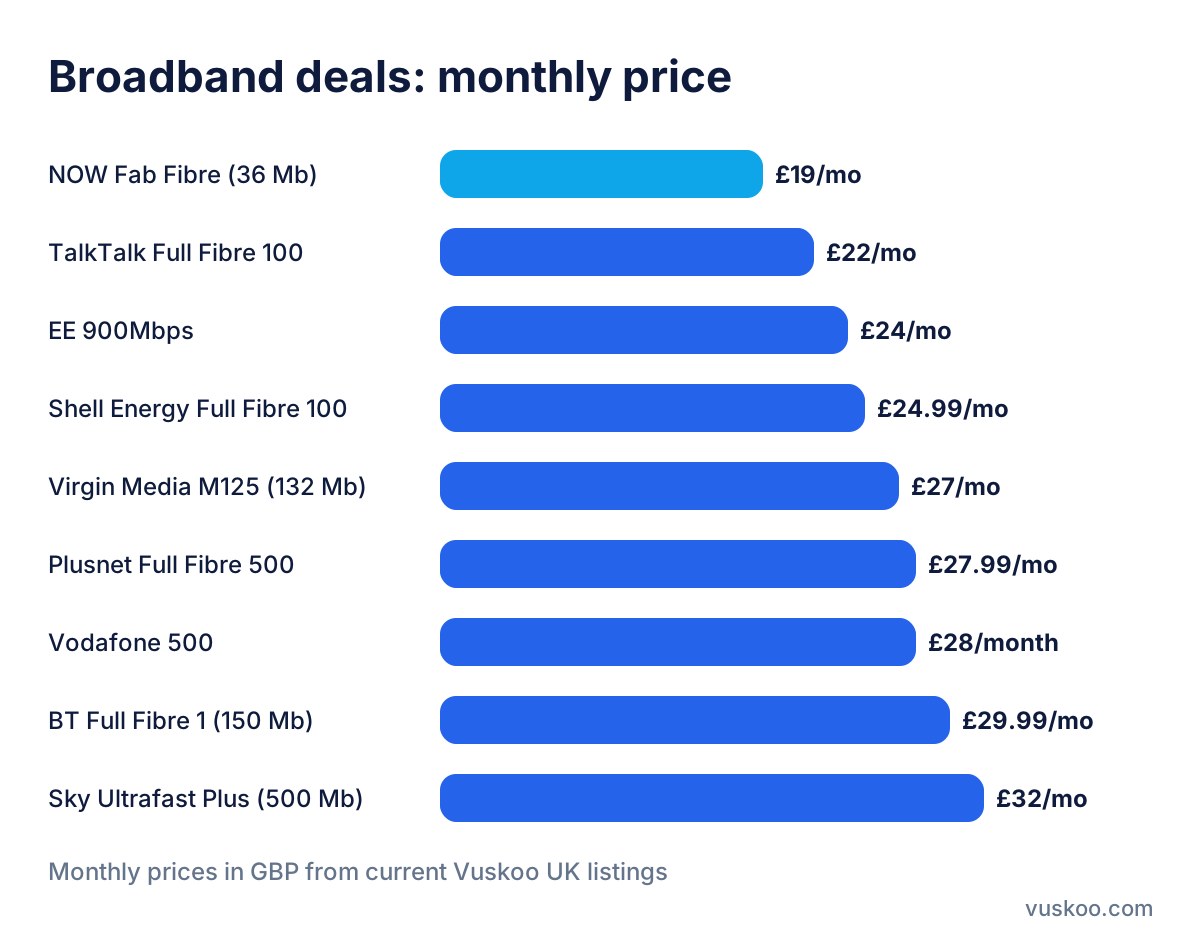
Because VoIP runs over your broadband, it is worth checking that your connection is stable before you switch. For reference, these are some broadband deals in our current UK listings:
- NOW Broadband NOW Fab Fibre (36 Mb): £19/mo
- TalkTalk Full Fibre 100: £22/mo
- EE 900Mbps: £24/mo
- Shell Energy Full Fibre 100: £24.99/mo
- Virgin Media M125 (132 Mb): £27/mo
- Plusnet Full Fibre 500: £27.99/mo
- Vodafone 500 Most Popular Speed: £28/month
- BT Full Fibre 1 (150 Mb): £29.99/mo
- Sky Ultrafast Plus (500 Mb): £32/mo
Savings from switching to VoIP depend on your starting point. They are usually largest for people who make a lot of international calls or who pay separately for several traditional lines.
What to check before signing up for an IP phone service
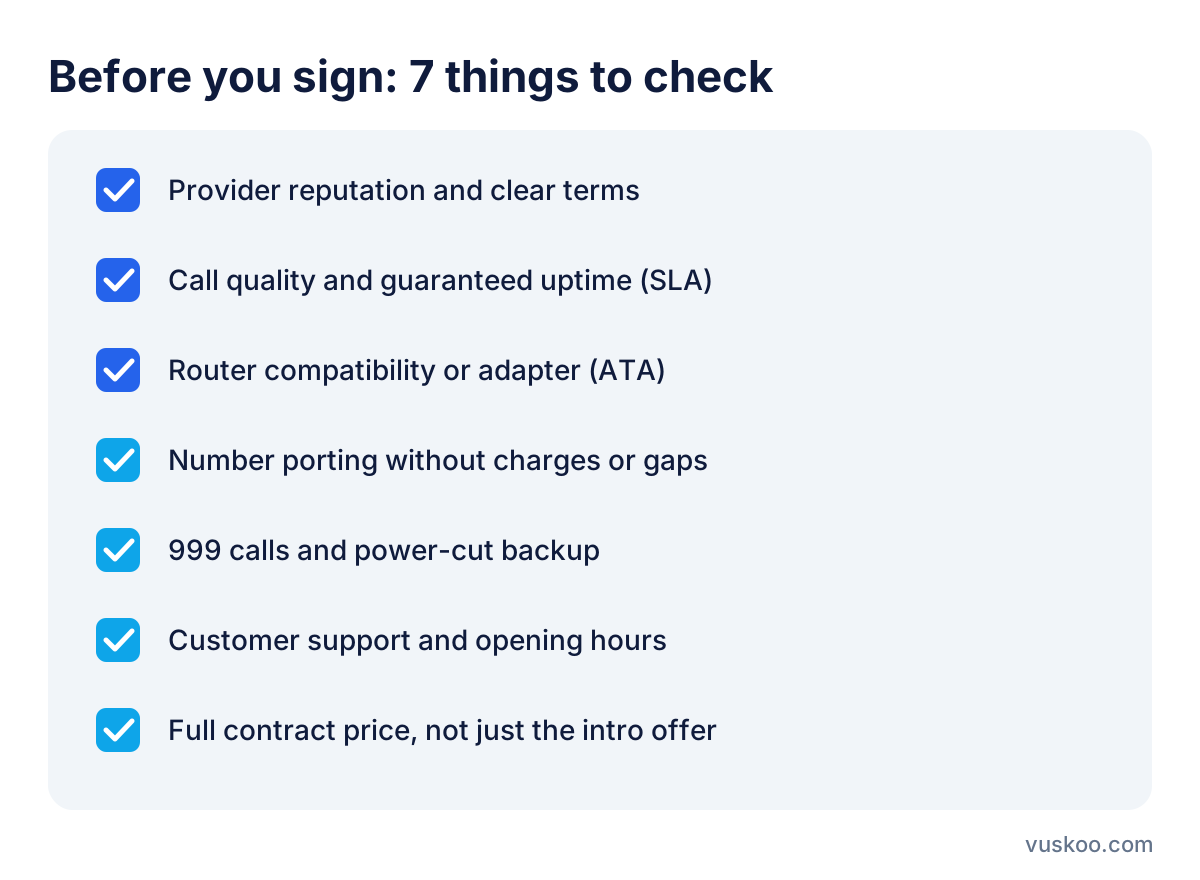
Not all providers are the same. Before you sign, check the following:
- Provider reputation: look at reviews, how long the company has been operating and whether its terms are clear.
- Call quality and guaranteed uptime: for business use, ask for an SLA with a stated availability level. Some low-cost providers don't offer one.
- Equipment compatibility: ask whether your current router supports phone calls or whether you need an adapter (ATA). Some providers include one at no extra cost.
- Number porting: if you already have a landline number, make sure the provider can transfer it without extra charges and without a break in service.
- Emergency calls and power cuts: check how calls to 999 are handled and what backup options are available if you lose power.
- Customer support and opening hours: particularly important if you use the service for your business.
- Full contract price vs introductory price: some providers offer discounts for the first months, and many contracts include annual price rises. Always work out the total cost over the full contract.
Compare broadband and phone deals on Vuskoo
The UK broadband and phone market changes often: new deals, limited-time offers and price changes mean the right deal today may not be the right one next year. On Vuskoo you can compare broadband deals from providers such as BT, Sky, Virgin Media, TalkTalk, Vodafone, Plusnet, EE, NOW Broadband and Shell Energy, filter by speed and price, and find an option that suits your needs. Before you sign up or renew, take a few minutes to compare. Choosing the right deal can lower your bills from the first month.
Frequently asked questions about IP telephony
Are IP telephony and VoIP the same thing?
They are closely related, with a small technical difference. VoIP (Voice over Internet Protocol) is the underlying technology that carries voice over the internet. IP telephony is the complete service, including VoIP plus phone numbers, call management and connection to the public phone network. In practice, the two terms are used interchangeably.
Do I need a special connection to use IP telephony?
No. Any current fibre or standard broadband connection is normally enough. A VoIP call uses only a small amount of bandwidth, typically somewhere between 30 and 90 kilobits per second, so even a modest connection can handle several calls at once. A stable connection with low latency matters more than top speed.
Can I keep my landline number if I switch to IP telephony?
In most cases, yes. UK phone numbers can usually be transferred between providers. Ask your new provider to arrange the transfer and confirm how long it will take and whether there will be any break in service.
Does IP telephony work during a power cut or broadband outage?
This is the main limitation: if the electricity or internet connection fails, the service stops. The usual solution is to set up automatic call forwarding to a mobile, which many providers offer. If you depend on your landline, ask your provider about battery backup before you switch.
Is IP telephony secure? Can my calls be intercepted?
Reputable providers use encryption protocols such as TLS and SRTP, similar to the protection used for online banking. With these in place, calls travel encrypted and are very difficult to intercept. Choose providers that state clearly which security protocols they use.
How much can I save by switching to IP telephony?
It depends on what you pay now and how you use your phone. Businesses that make many international calls, or that pay for several traditional lines, usually see the biggest savings, because these are the areas where VoIP pricing tends to be most competitive.
← Back to blog
Subscribe to our newsletter
The best deals and money-saving tips, straight to your inbox. No spam.