
In this article
Annual multi-trip travel insurance covers every trip you take over 12 months under one policy. It usually pays off once you would otherwise buy two or more single-trip policies in a year. To check, add up what those single-trip quotes would cost and compare the total with one annual quote for the same cover. Before you buy, look at how long each trip is allowed to last, which region you are covered for, any winter sports or cruise add-ons, and the date cancellation cover starts. Any one of these can make an annual policy a poor fit, even when the headline price looks good.
How does annual multi-trip travel insurance work?
You buy one policy that runs for a year. Every trip you take during that year is covered, as long as each trip stays within the policy's limits. You don't have to tell the insurer about each holiday in advance. If a trip goes beyond the limits, though, it may not be covered at all.
Single-trip cover protects one journey, from the day you leave until the day you get back. It suits a single long holiday, a gap year or a one-off trip that annual policies won't take on.
What usually comes with both types
- Emergency medical treatment abroad and getting you home for medical reasons
- Cancellation and cutting a trip short, up to a set limit
- Lost, stolen or delayed baggage, money and passports
- Personal liability and legal expenses, on many policies
The amounts covered and the excess you pay on a claim vary from policy to policy and from tier to tier, so compare the policy wording, not just the type of policy.
When does annual cover pay off?
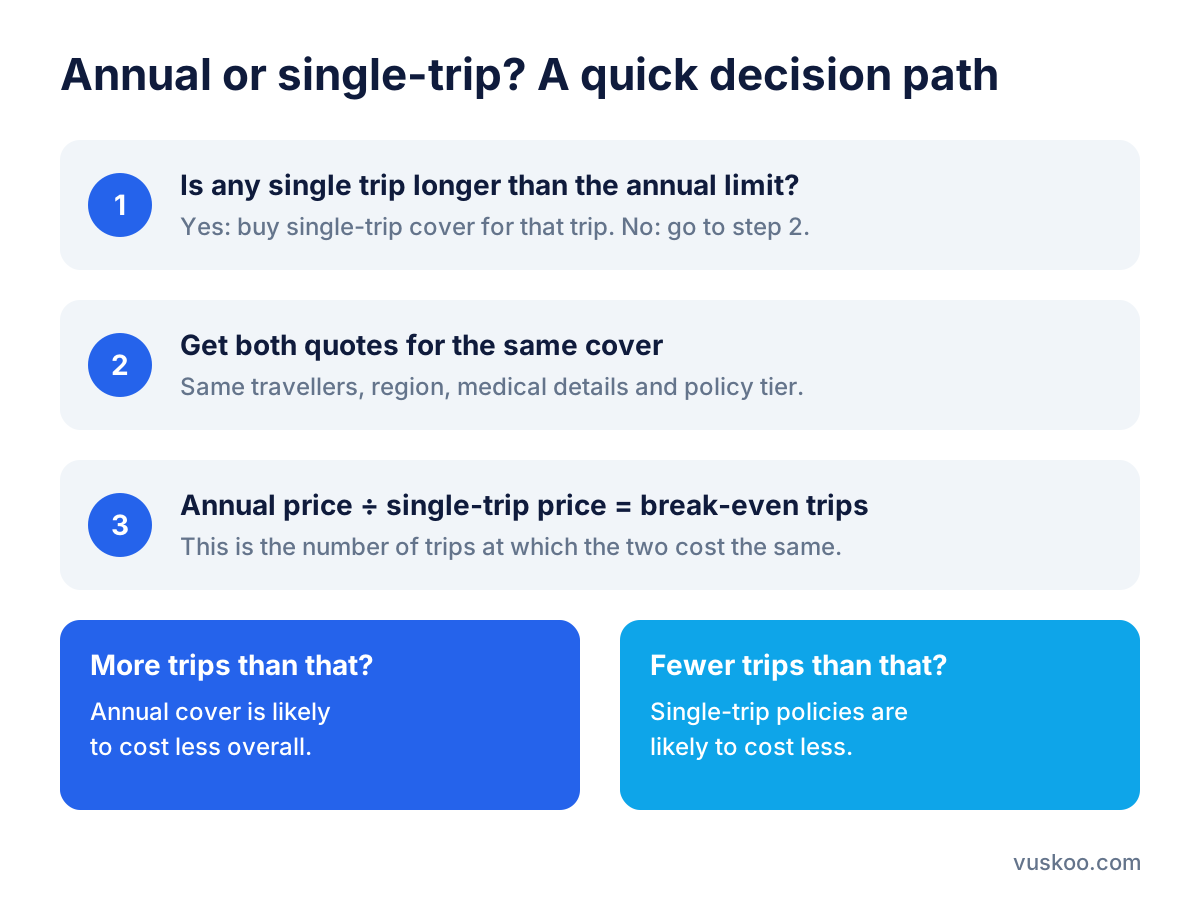
It comes down to how many trips you take and how much a single-trip policy would cost for each one. A quick way to work it out:
- List the trips you expect to take in the next 12 months, including short breaks and UK trips with a pre-booked stay, if the policy covers them.
- Get a single-trip quote for a typical trip, with the same destination, travellers and level of cover.
- Get an annual multi-trip quote for the same people, region and level of cover.
- Divide the annual price by the single-trip price. The answer is how many trips it takes for annual cover to break even.
If you expect more trips than that number, annual cover is likely to cost less overall. It also helps with last-minute plans, because you're already covered when you book. On the other hand, if a single trip is longer than the annual policy allows, a single-trip policy may be the only suitable option for that journey.
Trip-length limits: how long can each trip last?
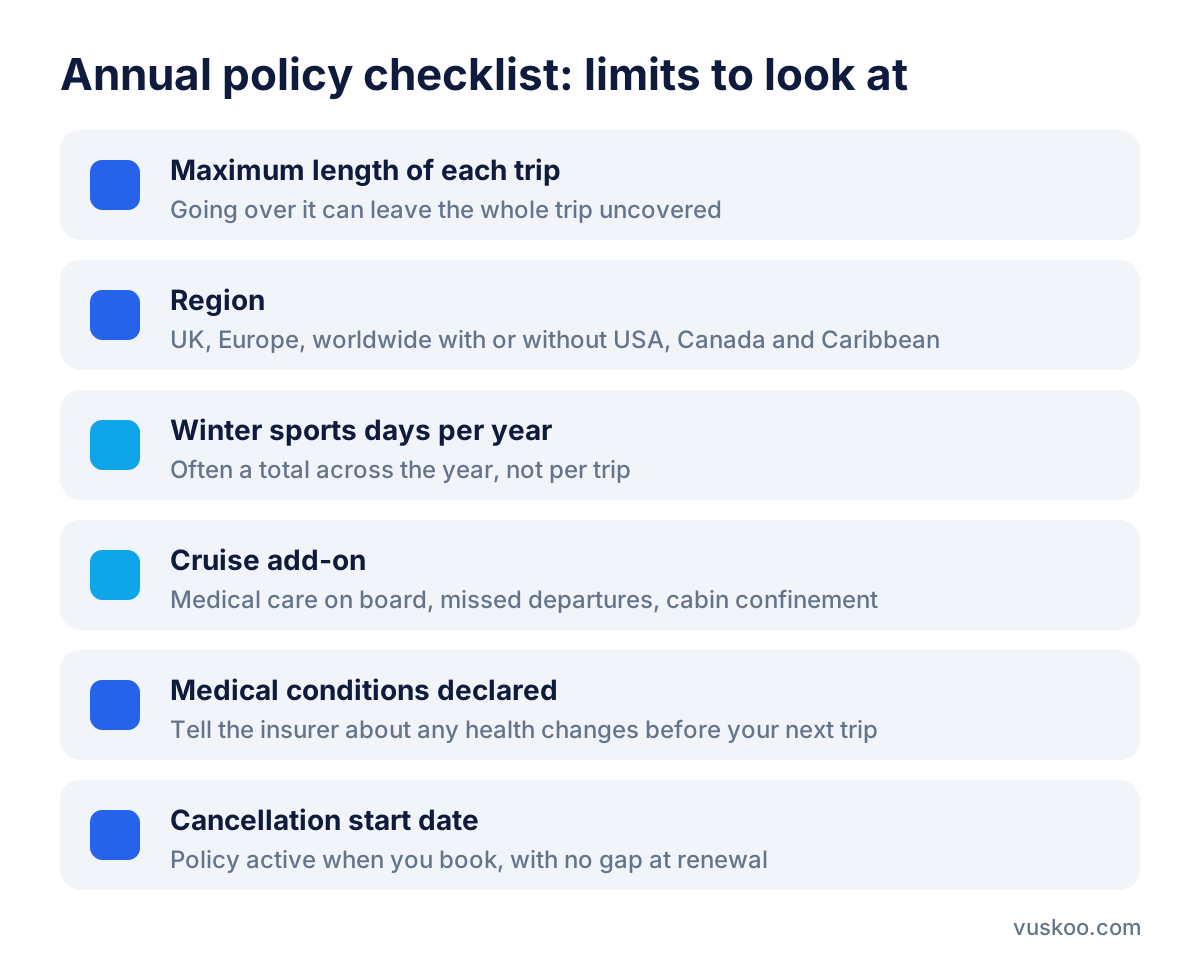
Every annual policy limits how long a single trip can last. MoneySavingExpert says per-trip limits usually fall somewhere between 17 and 30 days, and some insurers sell longer limits as an option. Some policies also cap the total number of days you can spend abroad over the whole year.
The key thing is that the limit usually applies to the whole trip. If your policy allows 31 days and you go away for 35, insurers often won't cover any part of that trip, not just the extra four days. Check this before booking long stays, visits to family or a run of trips back to back.
Region options: Europe or worldwide
Annual policies are priced by region. The usual choices are:
- UK only, for trips within the UK, usually with a minimum number of nights booked
- Europe, and insurers decide which countries count as Europe. Some include popular Mediterranean destinations outside the EU and some don't.
- Worldwide excluding the USA, Canada and the Caribbean
- Worldwide including the USA, Canada and the Caribbean, which usually costs more because medical treatment there tends to be expensive
Choose the region for the furthest trip you're likely to take this year. A Europe policy won't cover a long-haul trip that comes up later, unless the insurer lets you upgrade part way through.
Winter sports and cruise add-ons
Winter sports
Skiing and snowboarding are often left out of standard cover. You usually add them as an extra, or get them only on higher tiers. On annual policies, winter sports cover is often limited to a set number of days per policy year rather than per trip. Several insurers set this at 17 days, and others allow more. If you take two ski trips a year, add the days together and check them against the limit.
Also check what winter sports cover includes: off-piste skiing (and whether you need a guide), equipment hire, ski pass and lessons if you can't use them, and piste closure. A UK Global Health Insurance Card (GHIC) doesn't cover mountain rescue, so this needs to come from your policy.
Cruises
Many policies need a cruise add-on before they cover medical treatment on board, getting you off the ship in an emergency, missed port departures and cabin confinement. If you go on a cruise every year, make sure the add-on applies to all trips covered by the annual policy.
Declaring medical conditions
You must tell the insurer about any pre-existing medical conditions. This covers conditions you know about, are being treated for or are waiting for tests on. If you don't, your claims may be turned down, including claims that have nothing to do with the condition. With annual cover, if your health changes during the year, such as a new diagnosis, new medication or a referral, tell the insurer before your next trip.
Under Financial Conduct Authority rules, if an insurer turns you down, excludes your condition or charges a much higher premium because of a serious condition, it must point you to a directory of specialist providers. The MoneyHelper directory from the Money and Pensions Service is one of these.
When does cancellation cover start?
Cancellation cover protects you if you have to cancel for a reason the policy covers, such as illness. It only starts from the policy start date, or from when you buy, depending on the wording. With annual cover, the policy usually needs to be active when you book a trip, or the trip isn't protected against cancellation. Some insurers let you start the policy on a future date and still begin cancellation cover straight away. Others don't. Either way, it's worth buying as soon as you book your first trip.
At renewal, make sure there's no gap between the old policy and the new one. A gap can leave trips you've already booked without cancellation cover.
Comparing annual policies
Staysure and AXA are among the providers selling annual multi-trip policies. You can see their current offers next to this article. When you compare them, look past the price and check:
- the maximum length of a single trip and any yearly total
- the region and how that insurer defines Europe
- the limits for medical cover, cancellation and baggage, and the excess you'd pay
- how many winter sports days are covered, and whether cruises are included
- age limits and how medical conditions are priced
- whether the policy renews automatically, and how the price is worked out at renewal
FAQ
Is annual multi-trip travel insurance worth it for two trips a year?
Sometimes. Divide the annual quote by a typical single-trip quote. If the answer is two or fewer, annual cover costs the same or less for two trips, and you're covered if you add trips later.
Do I still need a GHIC if I have travel insurance?
The GHIC gives access to state healthcare in many countries, but it doesn't replace travel insurance. For example, it doesn't cover getting flown home for medical reasons or private treatment. Some insurers expect you to carry one and may waive the excess on a medical claim if you use it.
Does annual cover include UK trips?
Many policies cover UK trips with pre-booked accommodation, often with a minimum number of nights. Check the policy wording.
What happens if a trip goes over the trip-length limit?
The whole trip may not be covered. Ask the insurer whether you can extend the limit, or buy single-trip cover for that journey.
Photo: tookapic / Pixabay