
In this article
- What is a bank account minimum monthly deposit?
- Why banks set a monthly pay-in requirement
- How much do you need to deposit each month?
- What counts as a deposit, and what usually doesn't?
- How Direct Debit rules fit in
- What happens if you miss a month?
- How to avoid missing the requirement
- Is your money protected?
- What to compare before choosing
- FAQ
What is a bank account minimum monthly deposit?
A bank account minimum monthly deposit is an amount you have to pay into a current account each month, or within a set period, to unlock something: a switch bonus, in-credit interest, cashback, or to avoid a monthly fee. It isn't a balance you have to keep. You can usually spend the money straight away, but it has to arrive in a way the bank counts. The amount, what counts and the deadline are set by each bank, so the account terms are what matter.
This guide explains how the rule usually works, which payments tend to count and which don't, how Direct Debit conditions fit in, and what happens if you fall short in a given month.
Why banks set a monthly pay-in requirement
Banks want to be your main account, the one your salary goes into. A pay-in rule is the simplest way to check that. You'll most often find one in these situations:
- Switch offers: a one-off bonus, such as the ones Santander, Nationwide and first direct have offered, is normally paid only if you pay in a set amount within a set window after switching.
- Ongoing perks: some accounts tie interest on a linked savings pot, rewards or a lower fee to paying in a minimum each month.
- Fee waivers: some accounts charge a monthly fee unless you pay in enough.
Not every account has one. Many app-based standard accounts and student accounts work differently, so check the terms of the exact account and tier you're looking at. Monzo's Free, Perks, Extra and Max plans, for example, are separate products with their own conditions.
How much do you need to deposit each month?
There's no standard figure. Each bank picks its own amount, and it can change from one offer to the next. Recent switch offers reported by consumer groups have often asked for around £1,000 or more within the qualifying period, but the live offer boxes on this page show the current conditions for each account.
When you compare, look at:
- The amount: could your normal monthly income cover it without moving money around?
- The period: per calendar month, per statement month, or one-off within a number of days after opening or switching.
- Single or combined payments: some banks let several smaller payments add up to the total. Others ask for one payment of at least the amount.
- Joint accounts: check whether the amount is per account or per account holder.
What counts as a deposit, and what usually doesn't?
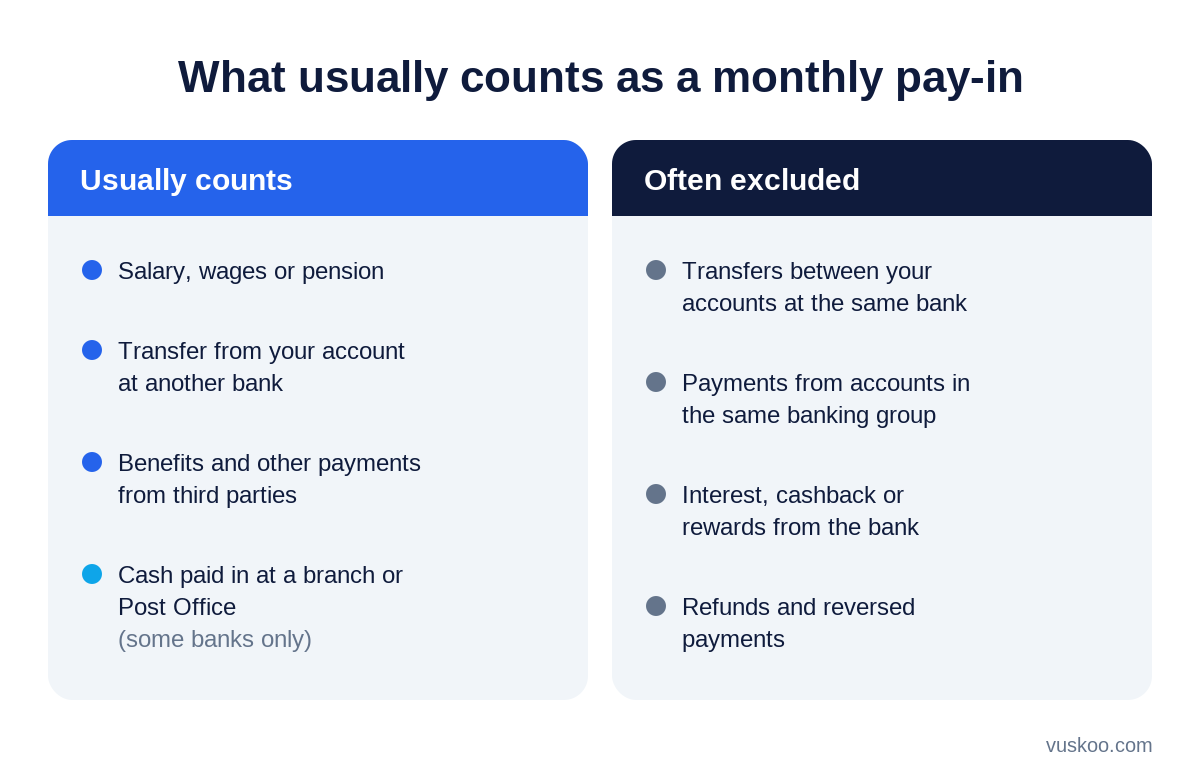
This is where people most often lose a bonus. Terms usually talk about "eligible credits" or "payments in" and then list exclusions. Wording differs from bank to bank, but the general picture is below.
Does moving money between your own accounts count?
It depends where it comes from. A transfer from an account in your name at another bank is often accepted, because to the receiving bank it looks like any other payment coming in. Transfers between accounts at the same bank, such as from your savings to your current account with the same provider, are often excluded. Some banks also exclude payments from accounts within the same banking group. If you plan to meet the rule by moving money you already have, check this before you rely on it.
Do cash deposits count?
Some banks count cash paid in at a branch or Post Office, others don't. Interest, cashback or refunds from the bank itself almost never count.
How Direct Debit rules fit in
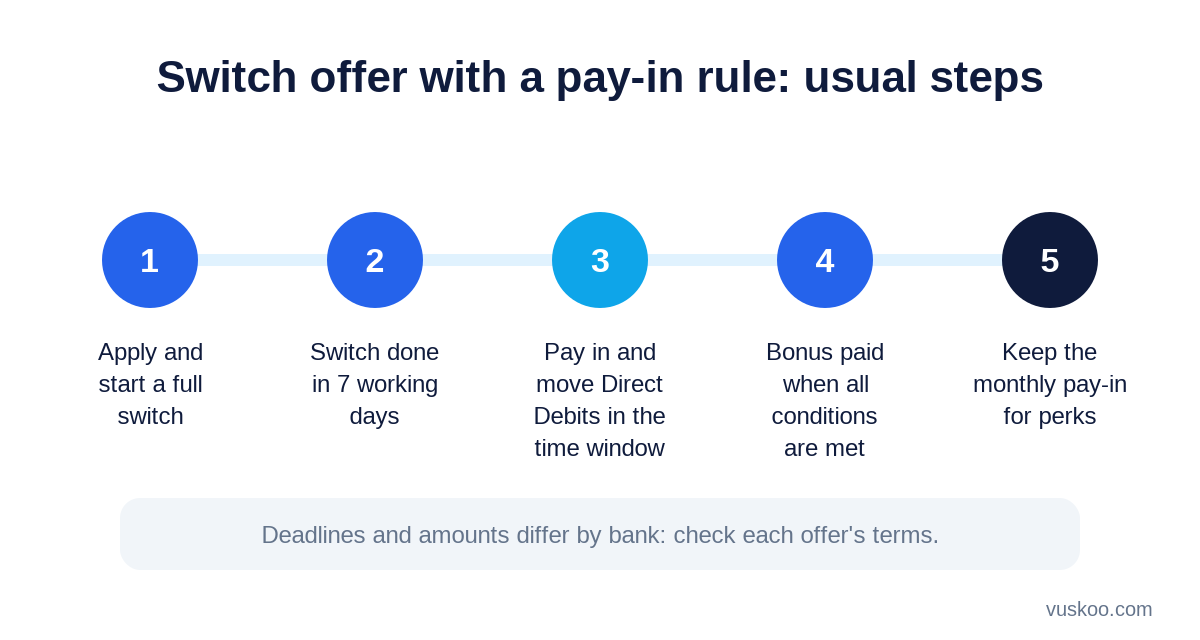
Switch offers in particular often come with Direct Debit conditions on top of the pay-in amount. Typical versions are:
- Having a minimum number of active Direct Debits on the account by a certain date.
- Switching from an old account that has a minimum number of Direct Debits.
- Using the full Current Account Switch Service rather than a partial switch, so the old account is closed.
A full switch through the Current Account Switch Service takes seven working days. Your Direct Debits, standing orders and incoming payments move to the new account, and payments sent to the old account are redirected. Pay.UK, which runs the service, says redirection lasts at least three years. This matters because your salary moves over without you having to tell your employer, which helps you meet the pay-in rule in the first month.
Keep in mind that standing orders are not the same as Direct Debits, and many offers only count Direct Debits.
What happens if you miss a month?
What you lose depends on what the pay-in rule is attached to:
- Switch bonus: if you miss the deadline within the qualifying window, you usually lose the bonus completely. Banks rarely make exceptions, even if you're only slightly short or a few days late.
- Monthly perks or interest: often you miss out for that month only, and the perk comes back once you meet the rule again. Some accounts take the perk away until you reapply.
- Fee waivers: you may be charged the monthly fee for any month you fall short.
- Linked savings: a savings account that's only open to current account customers who meet the pay-in rule may move to a lower rate.
Missing a pay-in doesn't normally affect your credit file, because it isn't a missed repayment. The account itself usually stays open.
How to avoid missing the requirement
- Read the definition of "month". Calendar month and statement period can be a few days apart. A salary paid on the last working day might fall into the next period.
- Check bank holidays. If payday moves earlier or later, it can push a payment into another month.
- Set up a standing order from another bank as a backup if your income varies, after checking that external transfers count.
- Keep evidence. Screenshots of the offer terms on the day you applied can help if there's a dispute.
- Track the bonus deadline. Put the end of the qualifying window in your calendar.
Is your money protected?
Money in UK bank and building society accounts is protected by the Financial Services Compensation Scheme. The limit rose to £120,000 per person, per authorised firm on 1 December 2025. Brands that share a banking licence count as one firm. This is worth checking if a pay-in rule makes you hold more with one bank than you normally would.
What to compare before choosing
- The pay-in amount and whether your regular income covers it naturally.
- Which payments count, especially transfers from your own accounts.
- Direct Debit and full-switch conditions, and their deadlines.
- Whether perks are lost for one month or permanently if you miss.
- Any monthly fee and when it applies.
- Whether you've already had a switch bonus from that bank, since many offers exclude previous recipients.
FAQ
Do I have to keep the deposit in the account?
Usually not. Most pay-in rules are about money coming in, not a minimum balance. Check the terms, as a few accounts set a balance condition as well.
Can I pay in money and move it straight back out?
Some people do this to meet the rule, and many banks count each eligible payment in regardless of what happens next. Others exclude money that goes back to the same source, so read the exclusions first.
Does my partner's payment into a joint account count?
Often yes, if it comes from another bank, but some offers need the payment to come from a named account holder. Check the wording.
Can I get a switch bonus without a monthly deposit?
Most switch offers need at least one qualifying pay-in, though the conditions vary. Compare the live offers on this page to see current requirements.
What if my salary arrives late one month?
For ongoing perks you'll usually just miss that month's benefit. For a switch bonus, a late payment after the deadline usually means no bonus, so leave some margin before the window closes.
Photo: nosheep / Pixabay