
In this article
- How do broadband and mobile bundle discounts work?
- Is a bundle cheaper than broadband and SIM-only bought separately?
- Catch 1: mismatched contract end dates
- Catch 2: price rises written into the contract
- Catch 3: leaving one part of the bundle early
- What else should you check before combining?
- When does a broadband and mobile bundle make sense?
- Frequently asked questions
A broadband and mobile bundle is sometimes cheaper than buying broadband and a SIM-only plan separately, but not automatically. The saving usually comes from a discount or extra allowance applied when you hold both services with the same provider or group. Whether that beats two separate deals depends on the total you pay across the whole contract, not the headline monthly figure, and on how the two contracts are tied together if your plans change.
This guide explains how bundle discounts work, how to compare a bundle against buying each part on its own, and the catches worth checking before you sign.
How do broadband and mobile bundle discounts work?
Providers that sell both home broadband and mobile want you to keep both with them, because customers with two services tend to switch less. To encourage that, they offer one or more of the following:
- A monthly discount on the SIM, the broadband or both, applied while both services stay active on the same account.
- Extra mobile data or other perks, such as boosted allowances, rather than a lower price.
- Shared benefits across a household, where each additional SIM on the account earns a further saving.
In the offers shown on this page you will see examples of both approaches. EE lists a broadband plus unlimited-data SIM saving, while Virgin Media pairs its broadband with an O2 SIM under the Volt name, as Virgin Media and O2 are part of the same group. Sky and Virgin Media also sell broadband with TV, which is a different type of bundle with its own considerations.
The important detail is that the discount is usually conditional. It applies only while you keep both services, and the terms may allow it to be withdrawn if one of them ends.
Is a bundle cheaper than broadband and SIM-only bought separately?
The only reliable way to find out is to calculate the total cost of each option over the same period. A bundle can look cheaper because the discount is shown up front, while a separate SIM-only deal from a smaller network such as SMARTY, GiffGaff, iD Mobile, Voxi or Tesco Mobile may already cost less than the discounted bundle SIM before any saving is applied.
Equally, a separate broadband deal from a provider such as Plusnet or BT may undercut the broadband part of a bundle. Mixing and matching often works out well, but it is not guaranteed, so do the sums.
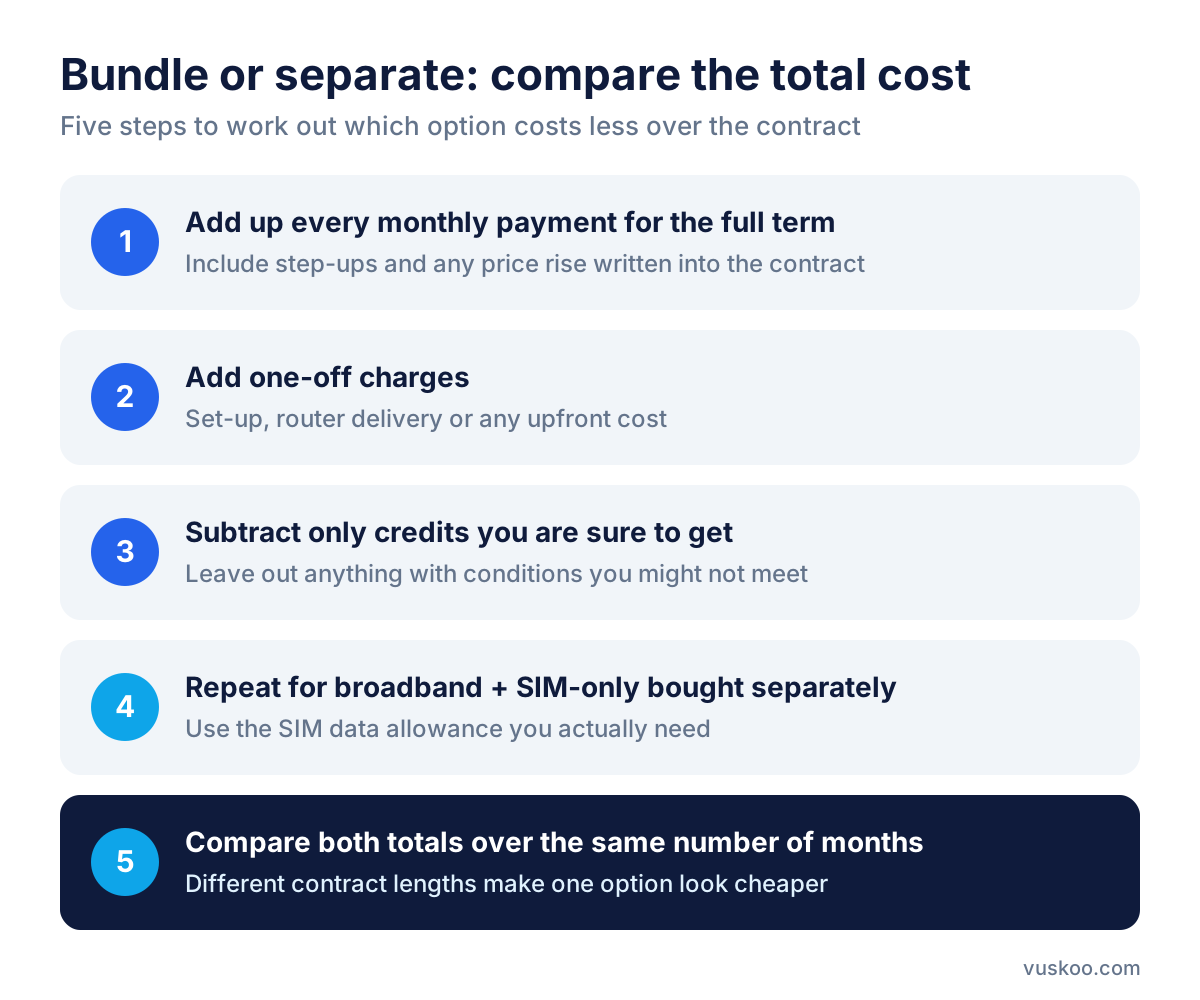
What should go into the total?
- Every monthly payment for the full minimum term, including any step-up after an introductory period.
- Any price rise already written into the contract. Under Ofcom rules, contracts taken out from January 2025 must state any built-in mid-contract rise in pounds and pence at the point of sale, so you can add it to your calculation.
- One-off charges such as set-up, router delivery or an upfront cost.
- Credits you are certain to receive, such as a bill credit. Leave out anything that depends on conditions you might not meet.
Then compare the bundle total with the combined total of the broadband deal and the SIM-only deal you would actually choose. If the two contracts have different lengths, compare over the same number of months, otherwise one option will look artificially cheap.
Do you need the same amount of data either way?
A bundle discount sometimes applies only to a larger or unlimited data plan. If you normally use a modest amount of data, a smaller standalone SIM may cost less even without the saving. Check your recent usage in your phone settings or your current network's app before deciding which plan to compare against.
Catch 1: mismatched contract end dates
Many people add a SIM to an existing broadband contract, or the other way round. That means the two minimum terms start at different times and end at different times. When the first one ends, you can be left with a choice between staying put on that service to protect the discount, or leaving and losing the saving on the service that is still in contract.
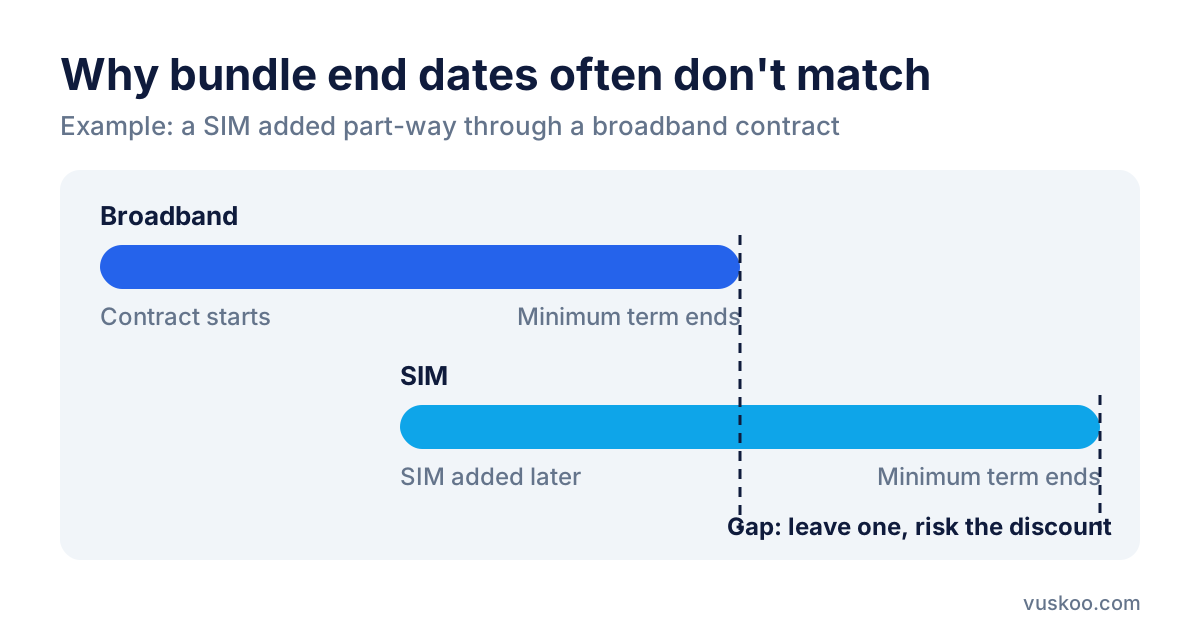
Before you sign, ask for the minimum term end date of each service and write both down. If the dates are far apart, factor that gap into your decision. Providers are required by Ofcom to send an end-of-contract notification shortly before each minimum term ends, setting out what you pay now, what you will pay afterwards and their best available deals, but with two services you may receive these at different times.
Catch 2: price rises written into the contract
Each service in a bundle can carry its own annual price rise. Since January 2025, Ofcom requires providers to show these rises in pounds and pence when you sign up, rather than linking them to inflation. That makes them easier to compare, but it does not remove them.
Look for:
- The amount of the rise for the broadband and for the SIM, listed separately.
- The month each rise takes effect, as they may not coincide.
- Whether the bundle discount is a fixed amount or a percentage, and whether it is affected by the rise.
If a provider raises prices in a way not set out in your contract, Ofcom's rules mean you should be given notice and the chance to leave without paying an exit fee.
Catch 3: leaving one part of the bundle early
Life changes. You might move to an address your broadband provider cannot serve, or find a mobile network with better coverage where you live. If you leave one part of a bundle during its minimum term, two things can happen:
- You may pay an early termination charge for the service you cancel.
- The discount on the service you keep may stop, so it costs more for the rest of its term.
Read the terms for both scenarios before signing. A bundle that saves a little each month can end up costing more than two separate deals if you have to break it.
What else should you check before combining?
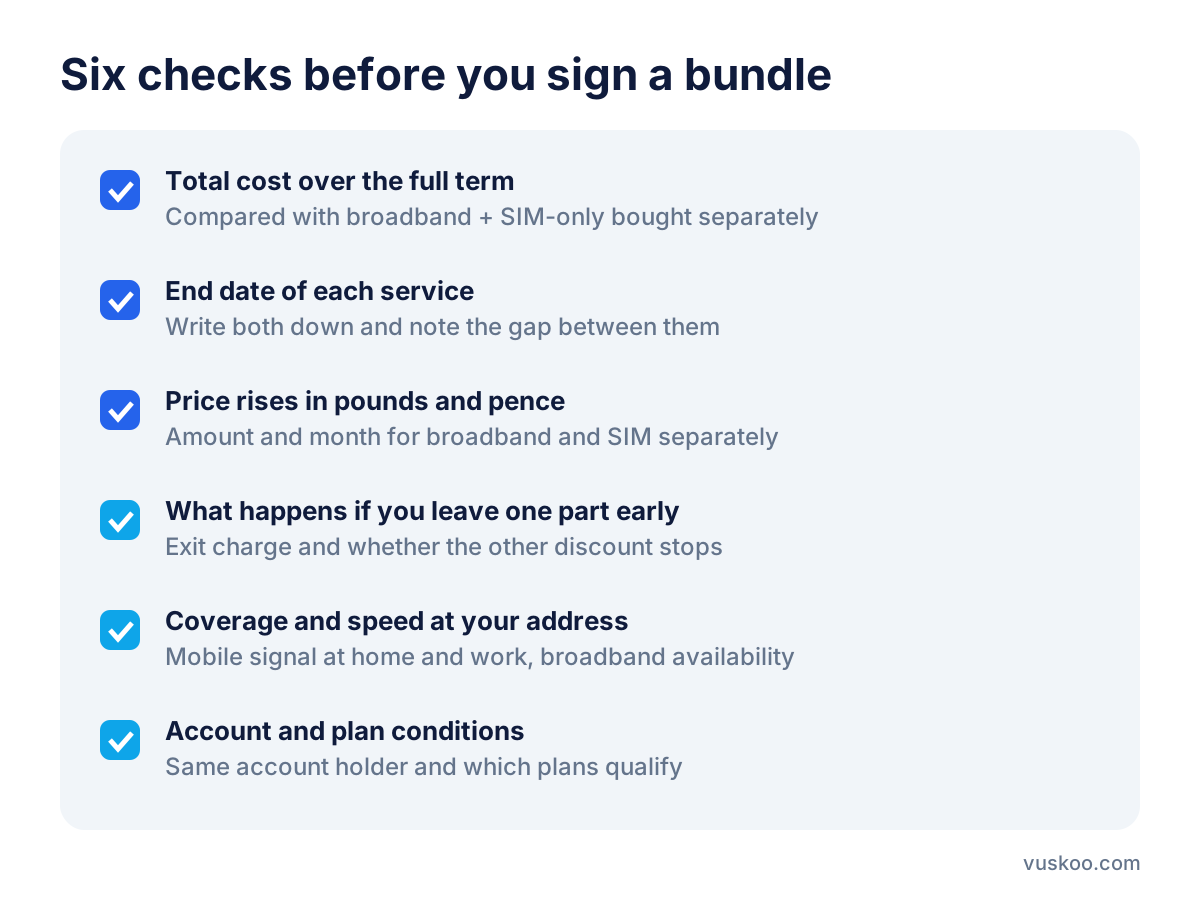
- Coverage and speeds. Check mobile signal at home and work, and confirm which broadband speeds are available at your address. A discount does not make up for a poor connection.
- Who the account holder is. Some savings require both services to be in the same name on the same account.
- Switching later. Broadband switching between providers on certain networks uses Ofcom's One Touch Switch process, introduced in September 2024, where your new provider arranges the move. Mobile is switched separately, so leaving a bundle means handling each service on its own.
When does a broadband and mobile bundle make sense?
A bundle tends to work well if you were going to choose that provider for both services anyway, your contracts can start together or close together, and you are fairly confident you will not need to leave either early. It is also worth considering for households with several SIMs, where per-line savings can add up.
Buying separately tends to suit you if you want flexibility, use little mobile data, or can find a SIM-only deal and a broadband deal that together cost less over the same period. Keeping them apart also means each contract can be switched on its own timetable.
Frequently asked questions
Do I have to get broadband and mobile from the same company to get a discount?
Usually yes, or from companies in the same group, such as Virgin Media broadband with an O2 SIM. Check the terms to see which plans qualify.
Can I add a bundle SIM to my existing broadband contract?
Often you can, but the SIM will usually start a new minimum term, so the two end dates will differ. Check whether that suits you before adding it.
What happens to the discount when my broadband contract ends?
That depends on the provider. Some keep the discount while both services remain active, even out of contract; others link it to the minimum term. Ask before signing and check your end-of-contract notification.
Are price rises the same for both parts of a bundle?
Not necessarily. Each service can have its own rise and its own date, which must be shown in pounds and pence for contracts taken out from January 2025.
Is it cheaper to buy SIM-only separately?
Sometimes. Compare the bundle's total cost over the full term with the combined total of a separate broadband deal and the SIM-only plan you would actually use.
Photo: ClickerHappy / Pixabay