In this article
If your broadband or mobile contract started on or after 17 January 2025, your broadband price rise in April 2027 should already be written into your contract as a fixed amount in pounds and pence. That is Ofcom's rule. It means you can check the exact increase now, but it also means you usually cannot leave penalty-free just because the rise happens, since you agreed to it when you signed. If you are out of contract, you are free to switch or negotiate before the new price applies.
This guide explains how the rule works, where to find your own figure, when an increase does give you the right to exit without fees, and what to compare if you decide to move.
What Ofcom's pounds-and-pence rule means for April 2027
Before 2025, many providers linked their yearly rises to inflation, often the Consumer Price Index plus a fixed percentage. Customers could not know the size of the increase when they signed up. Ofcom banned these inflation-linked and percentage-based price rise terms in new phone, broadband and pay TV contracts from 17 January 2025.
Under the rule, providers must state, at the point of sale, how much any mid-contract price rise will be in pounds and pence and when it will take effect. Several providers, including BT, EE and Plusnet, moved to this approach for their customers, and O2 also switched to pounds-and-pence rises.
There are two important limits to keep in mind:
- The rule does not cap the size of rises. A fixed amount can end up higher than an inflation-linked rise would have been, especially on cheaper packages.
- It was not applied retrospectively. Contracts signed before 17 January 2025 can still contain older inflation-linked terms. Most 18- and 24-month broadband deals from that period will have ended by April 2027, but some longer mobile handset contracts may still run on the old terms.
How to find the price rise written into your own contract
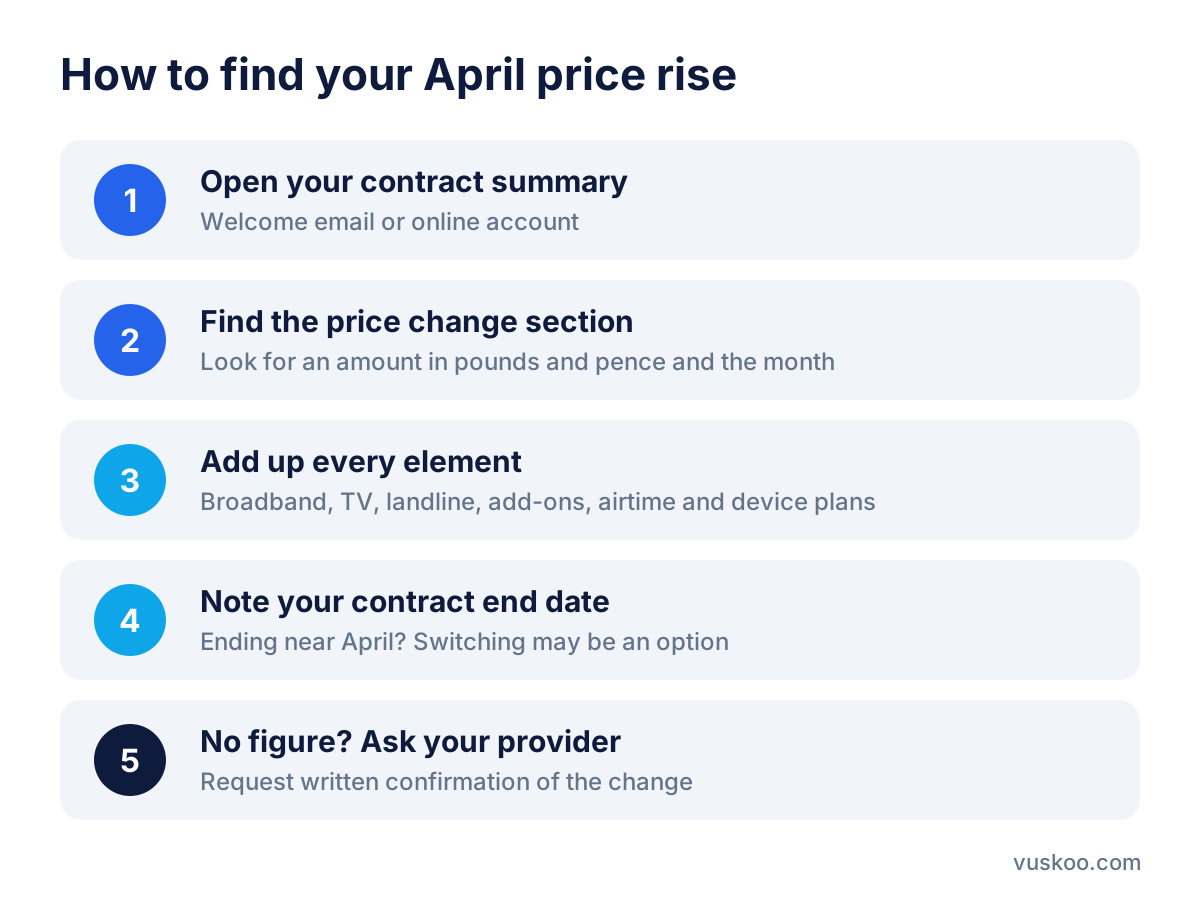
Your increase should be easy to locate if you know where to look. Work through these steps:
- Find your contract summary. Providers must give you a short contract summary before you sign. It is usually in your welcome email or in your online account. This is the quickest place to see the rise.
- Look for the price change section. Search the document for terms such as "annual price change", "price rise" or "April". You should see a figure in pounds and pence and the month it applies.
- Check whether the rise applies to every element. Some providers set separate amounts for broadband, TV, landline and add-ons, or for airtime and device plans on mobile. Add them together to get your total.
- Note your contract end date. If your minimum term ends before or soon after April, you may be able to switch rather than pay the higher price for long.
- Log in to your account or app. Many providers show the upcoming price and your end date on the account dashboard.
If you cannot find a pounds-and-pence figure and your contract started after 17 January 2025, contact your provider and ask them to confirm in writing what the April 2027 change is and where it is set out.
When can you leave without paying exit fees?
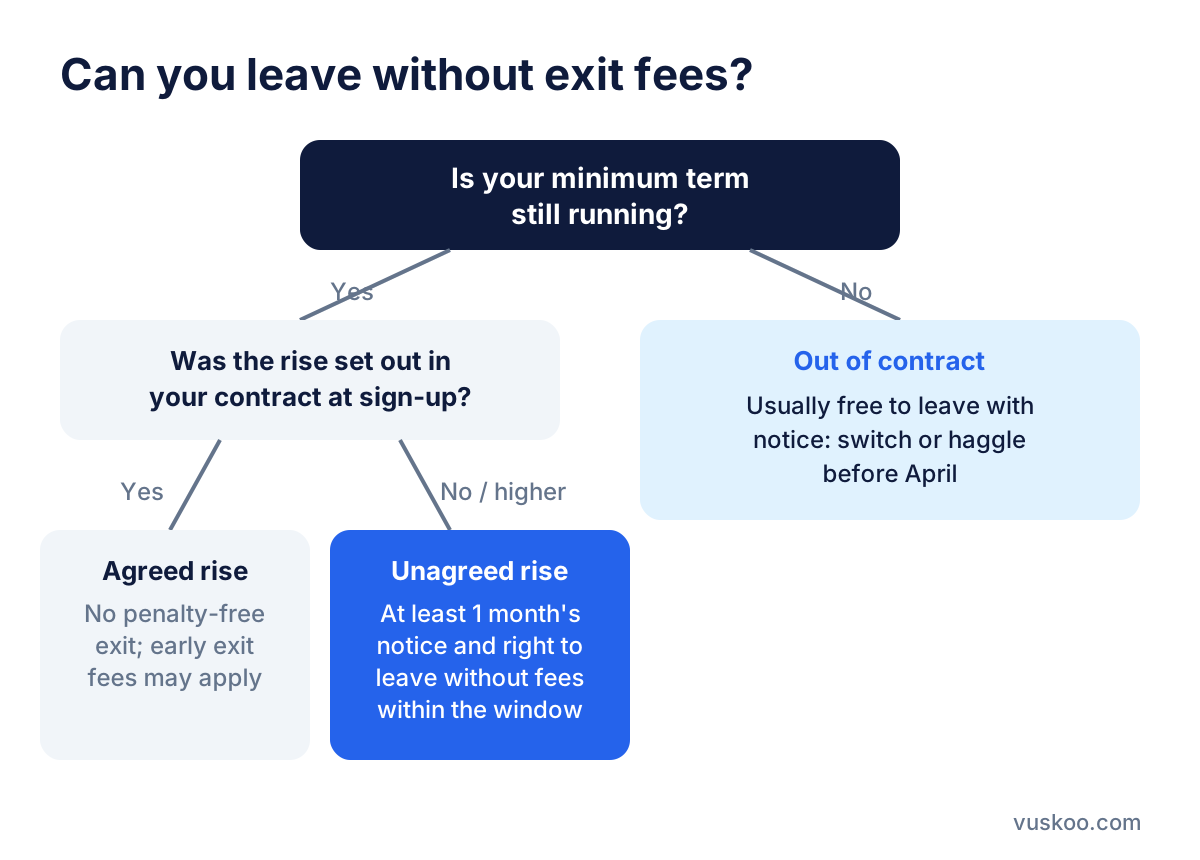
Ofcom's General Conditions require providers to give at least one month's notice of any contract change likely to leave you materially worse off, and to let you leave without penalty. Ofcom treats an increase in your monthly subscription charge as a change of this kind. However, the right does not apply when the rise was clearly set out, with its amount and timing, when you signed up.
In practice, that gives three common situations:
- The April rise matches what your contract says. You agreed to it, so there is no penalty-free exit. You can still leave if you pay any early termination charges.
- The rise is higher than your contract states, or was never mentioned. This is a change you did not agree to. You should receive at least one month's notice and be allowed to leave without exit fees. Act within the window given in the notice, as providers' terms often set a time limit, commonly 30 days.
- You are on an older inflation-linked contract. If the rise follows the formula in your terms, it counts as agreed. Check the formula and the inflation figure the provider is using.
The penalty-free exit also does not apply to changes that are only to your benefit, such as a speed upgrade at no extra cost. If you believe your provider is applying a rise that is not in your contract and is refusing to let you leave, complain to the provider first. If that does not resolve it, you can take the complaint to the alternative dispute resolution scheme your provider belongs to, which will be named in your provider's complaints code.
Out of contract? Switch or haggle before April
If your minimum term has ended, you are usually on a rolling monthly arrangement and can leave with around a month's notice. Out-of-contract customers are often on higher prices than new customers, and an April rise can widen that gap.
Your provider must send you an end-of-contract notification before your minimum term ends, showing your end date, what you will pay if you do nothing, and their best available deals. If you stay out of contract, they must send you best tariff information at least once a year. Use these notices as your starting point.
How to haggle with your current provider
- Compare equivalent packages first so you know what speed, data and extras are available elsewhere.
- Contact your provider's retention or loyalty team and say you are considering leaving.
- Ask for the new price in pounds and pence, the length of the new contract and the amount of any rise built into it.
- Get the offer confirmed in writing before you agree.
How to switch
For most home broadband switches, you only need to contact your new provider, which arranges the move and the end of your old service. For mobile, you can text "PAC" to 65075 to get a code that keeps your number, or "STAC" to 75075 if you do not need to keep it. The provider must tell you about any outstanding charges when you request the code.
What to compare when choosing a new deal
A headline monthly price does not tell you what you will pay over the full contract. When you compare providers such as BT, EE, Plusnet, Sky or Virgin Media for broadband, or SIM-only deals from O2, Three, Voxi, giffgaff, SMARTY, iD Mobile or Tesco Mobile, look at:
- The rise written into the contract. Check the pounds-and-pence amount and when it applies, so you can work out the cost in each year.
- Contract length. A longer term may include more rises. Some SIM-only plans are monthly rolling, which gives flexibility.
- Price after any introductory period. Some deals change price partway through the term, separately from the annual rise.
- Upfront and set-up costs. Router delivery, installation or activation fees add to the total.
- Bundle savings. Combining broadband with a SIM or TV can reduce costs, but each part may have its own rise.
- Speed and data you actually need. Paying for a higher tier you do not use makes every future rise more expensive.
The offer boxes on this page show current prices, so you can compare these points against live deals.
Frequently asked questions
Will every broadband provider raise prices in April 2027?
Not necessarily. Many providers set their annual change for April, but the timing and amount depend on your contract. Check your contract summary for your own figure and date.
Can my provider increase prices by more than my contract says?
They can propose a change, but it must come with at least one month's notice and, because a higher monthly charge leaves you worse off, you should be allowed to leave without exit fees.
Does the pounds-and-pence rule apply to contracts signed before 2025?
No. It covers contracts agreed from 17 January 2025. Older contracts may still use inflation-linked rises, although some providers moved existing customers to fixed amounts.
Does the rule apply to SIM-only deals?
Yes. It applies to mobile contracts, including SIM-only, as well as broadband and pay TV.
When should I start looking for a new deal?
If you are out of contract, before April, so you can avoid paying the higher price. If you are in contract, check your end date and compare deals in the weeks before it ends.
Photo: MAKY_OREL / Pixabay