In this article
Buildings and contents insurance are two separate types of home cover. Buildings insurance pays to repair or rebuild the structure of your home: the walls, roof, floors and permanent fixtures such as a fitted kitchen or bathroom suite. Contents insurance covers the things you would take with you if you moved, such as furniture, clothes, electronics and jewellery. Homeowners usually need both. Renters normally only need contents cover, because the landlord or freeholder insures the building. You can buy them together in one combined policy or separately from different insurers.
This guide explains who is responsible for which cover, how combined and separate policies compare, and the details worth checking before you buy, from accidental damage to excesses and the winter claims that often lead to disputes.
What does buildings insurance cover?
Buildings insurance protects the physical structure of the property against events such as fire, flood, storm, subsidence, theft damage and escape of water. As a rule, it includes:
- The main structure: walls, roof, foundations, floors and ceilings
- Permanent fixtures and fittings: fitted kitchens, bathroom suites, built-in wardrobes, fitted flooring in some policies
- Pipes, cables, drains and underground services you are responsible for
- Often, garages, sheds, fences, gates and driveways, although limits on outbuildings vary
Many policies also pay for alternative accommodation if your home becomes uninhabitable while repairs are carried out. Check whether there is a cap on this.
Rebuild cost is not the same as market value
The amount you insure the building for (the sum insured) should reflect what it would cost to rebuild the property from scratch, including demolition, site clearance and professional fees. This is often quite different from what the house would sell for. The Association of British Insurers (ABI) and the Building Cost Information Service (BCIS) offer a free calculator to estimate rebuild cost for standard homes, though it is not suitable for older, listed, unusual or very large properties, where a professional survey is a better guide.
If the sum insured is lower than the real rebuild cost, you are underinsured, and the insurer may pay only a proportion of a claim. Building costs change over time, so it is worth reviewing the figure at every renewal. Some policies avoid this issue by offering unlimited buildings cover or a high fixed limit.
What does contents insurance cover?
Contents insurance covers your personal possessions inside the home against risks such as theft, fire, flood and water damage. A simple test: if you turned the house upside down, anything that would fall out is contents.
Points to look at closely:
- Single-item limit: most policies cap what they pay for any one item unless you list it separately. Engagement rings, watches, artwork and expensive bikes often exceed this.
- Valuables limit: there may also be an overall cap on jewellery and valuables combined.
- New for old: check whether items are replaced at today's price or whether the insurer deducts an amount for wear and tear.
- Personal possessions cover: an optional add-on that protects items you take out of the home, such as phones, laptops or a bike.
- Contents in outbuildings and gardens: sheds and garages often have lower limits, and items left in the open may be excluded.
Who needs buildings and contents insurance?
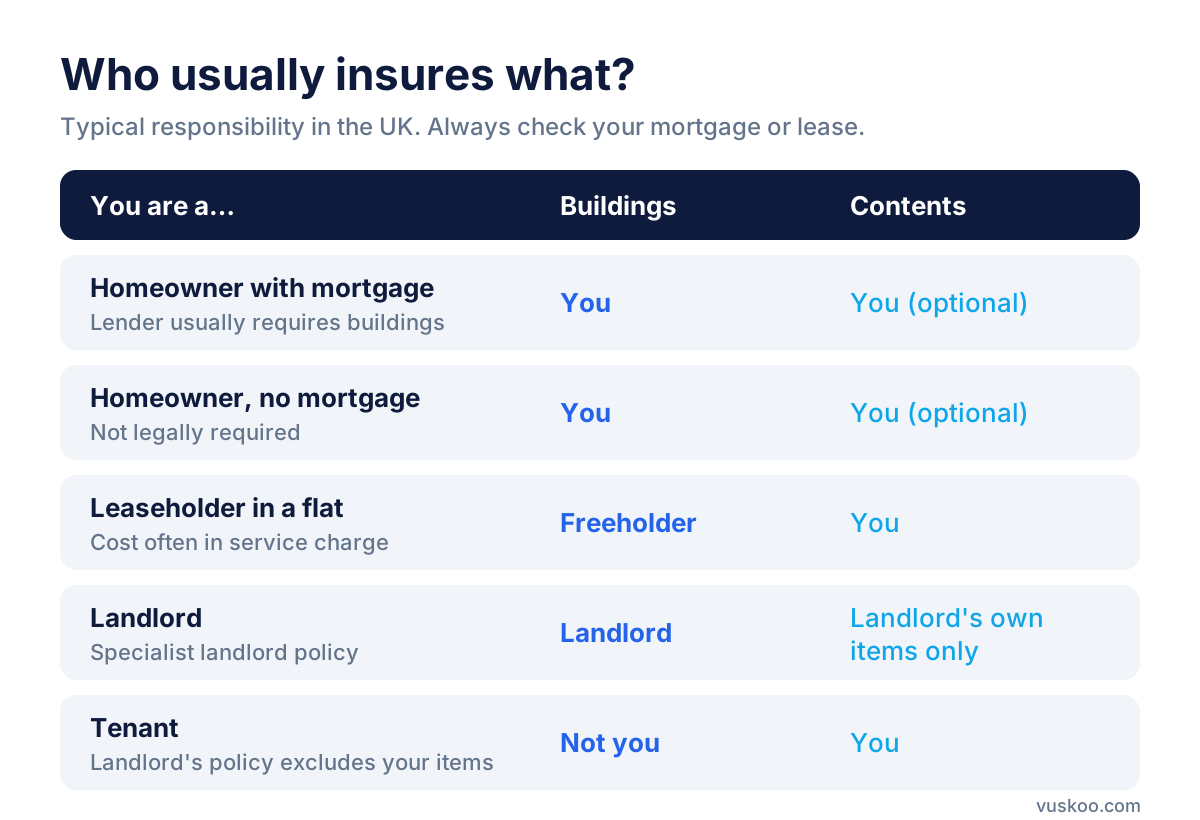
Home insurance is not a legal requirement in the UK, but in practice responsibility falls as follows.
- Homeowners with a mortgage: lenders almost always require buildings insurance to be in place from exchange of contracts or completion. Contents cover is optional but sensible.
- Homeowners without a mortgage: nobody requires cover, but you would carry the full cost of rebuilding after a fire or major flood.
- Leaseholders in flats: the freeholder or management company usually insures the building and recovers the cost through the service charge. Check your lease. You arrange your own contents cover.
- Landlords: landlords normally arrange buildings cover. Standard home insurance is usually not designed for let properties, so a specialist landlord policy is generally needed. Landlord contents cover applies only to items the landlord supplies, such as furniture or white goods in a furnished let.
- Tenants: the building is not your responsibility, and the landlord's policy does not cover your belongings. Contents insurance for renters fills that gap, and some policies include cover for accidental damage to the landlord's fixtures.
Combined or separate policies?
A combined buildings and contents policy puts everything under one insurer, one renewal date and, often, one claims process. That matters when a single event damages both, such as a burst pipe that ruins a ceiling and the sofa beneath it. With two insurers, you may find yourself managing two claims, two excesses and two loss adjusters.
Separate policies can make sense if one insurer offers better terms on buildings and another on contents, or if your situation requires only one type of cover. Insurers such as Aviva and More Than sell home insurance as buildings only, contents only or combined. Compare quotes for each option, and use the live offers on this page as a starting point.
Accidental damage: standard or add-on?
Standard policies cover named events such as fire or theft. They usually do not cover accidental damage, such as dropping a television, spilling paint on a carpet or putting a foot through a ceiling while in the loft. Accidental damage cover is commonly an optional extra, sometimes available separately for buildings and for contents. Some higher-tier policies include it as standard. If you have young children, pets or expensive flooring, it is worth checking what the policy says.
How excesses work
The excess is the part of each claim you pay yourself. There are usually two parts:
- Compulsory excess: set by the insurer.
- Voluntary excess: an extra amount you choose to lower the premium.
Many insurers apply a higher, separate excess for escape of water and subsidence claims. On a combined policy, check whether one excess applies per incident or one for buildings and another for contents. A low premium paired with a high escape of water excess may cost more when you actually claim.
Winter claims that catch people out
Burst and frozen pipes
Most home insurance policies cover damage from a sudden escape of water, including pipes that freeze and burst. Buildings cover pays for structural damage such as ceilings, floors and plaster, while contents cover pays for damaged belongings. Common reasons claims are reduced or refused include:
- Unoccupied homes: many policies restrict cover, especially for escape of water and frost damage, if the property is left empty for longer than a set period, often 30 or 60 consecutive days. Read the conditions before a long winter trip, and expect to need the heating left on or the water drained down.
- Gradual leaks and wear and tear: slow leaks, corroded pipes and worn seals are usually excluded. Only the sudden damage is covered.
- Trace and access: finding the source of a hidden leak can mean lifting floors. Check whether the policy covers this and up to what limit.
The ABI advises lagging loft pipes and water tanks, fixing dripping taps and knowing where your stopcock is. If a pipe does burst, turn the water off at the main stopcock straight away and contact your insurer as soon as you can.
Storm damage
Storm claims are often disputed. Insurers usually need evidence that storm conditions actually happened, and many policies define a storm by wind strength or heavy rainfall. Even then, a claim may be refused if the insurer concludes the damage was caused by an existing problem, such as loose roof tiles, worn flashing or rotten fence posts, rather than by the storm itself. Keeping the roof, gutters and fences maintained, and keeping dated photos of their condition, makes claims easier to support. Fences and gates are also excluded from storm cover on some policies.
What to check before you buy
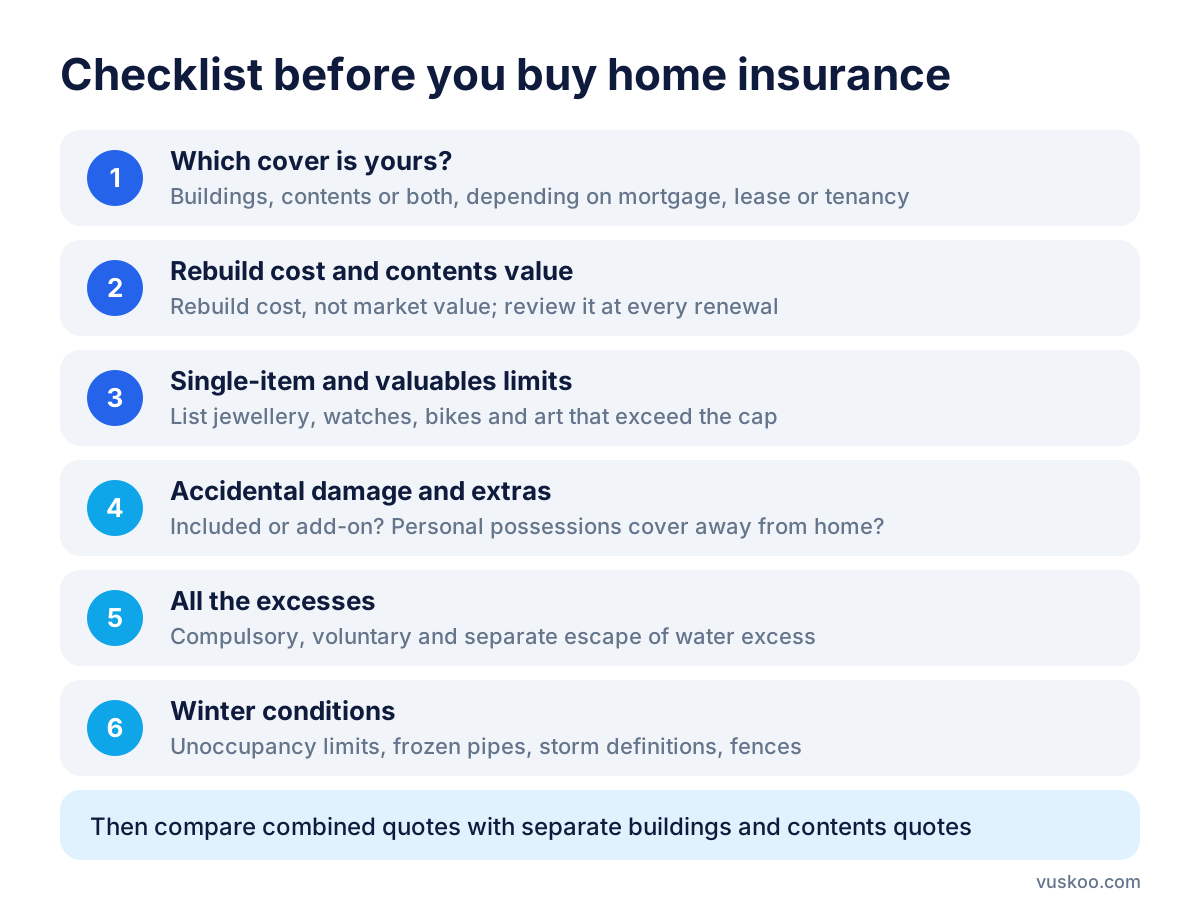
- Confirm which cover you are responsible for: buildings, contents or both.
- Set an accurate rebuild cost and a realistic total contents value.
- Look at the single-item and valuables limits, and list high-value items.
- Decide whether you want accidental damage and personal possessions cover.
- Compare the compulsory, voluntary and escape of water excesses.
- Read the conditions for unoccupied homes and storm damage.
- Check what happens at renewal: an introductory discount often ends after the first year, so compare the renewal quote against the market.
Frequently asked questions
Is buildings and contents insurance compulsory?
No, it is not a legal requirement. However, mortgage lenders almost always make buildings insurance a condition of the loan.
Do tenants need buildings insurance?
No. The building is the landlord's or freeholder's responsibility. Tenants normally only need contents insurance for their own belongings.
Is a combined policy always cheaper?
Not always. Combined policies are often competitively priced and simpler to claim on, but comparing combined quotes with separate buildings and contents quotes is the only way to know for your property.
Are carpets buildings or contents?
It depends on the insurer. Some treat fitted carpets as contents and fitted hard flooring as buildings. Check the policy definitions, especially if you are a tenant or leaseholder.
Will my insurance cover a burst pipe while I am away?
Usually, provided the home has not been empty for longer than the period set in the policy and you have met any conditions, such as keeping the heating on. Check the unoccupancy clause before you travel.
Photo: JamesDeMers / Pixabay