In this article
A car finance calculator works out your monthly payment from four inputs: how much you borrow (the car price minus your deposit), the APR, the term in months and, on PCP, the balloon payment due at the end. To give you a rough idea, borrowing £20,000 on hire purchase at an example APR of 9.9% costs about £502 a month over 48 months, and you pay around £4,108 in interest. The worked examples below show how changing each input changes the result, so you can check a dealer's quote against your own figures.
All figures here are our own calculations at three example APRs (6.9%, 9.9% and 12.9%). They are not offers from any lender. They assume fixed monthly payments and no fees, so a real quote will come out slightly different. Current deals for each car are shown live next to this article.
How does a car finance calculator work out the monthly payment?
On hire purchase (HP), the amount you borrow is split into equal monthly payments that cover both interest and capital. Once you make the last payment, the loan is cleared and the car is yours. The calculation uses the monthly equivalent of the APR, so a small change in the rate or the term moves the payment more than you might expect.
A handy rule of thumb: the payment rises in direct proportion to the amount you borrow. At 9.9% APR over 48 months, every £1,000 borrowed adds about £25.11 a month. Once you know the figure per £1,000 for a given APR and term, you can scale it up to any loan amount.
Monthly payments on £10,000 to £40,000 by APR
The table below shows HP monthly payments and total interest over 48 months for four loan amounts at each of the three example APRs.
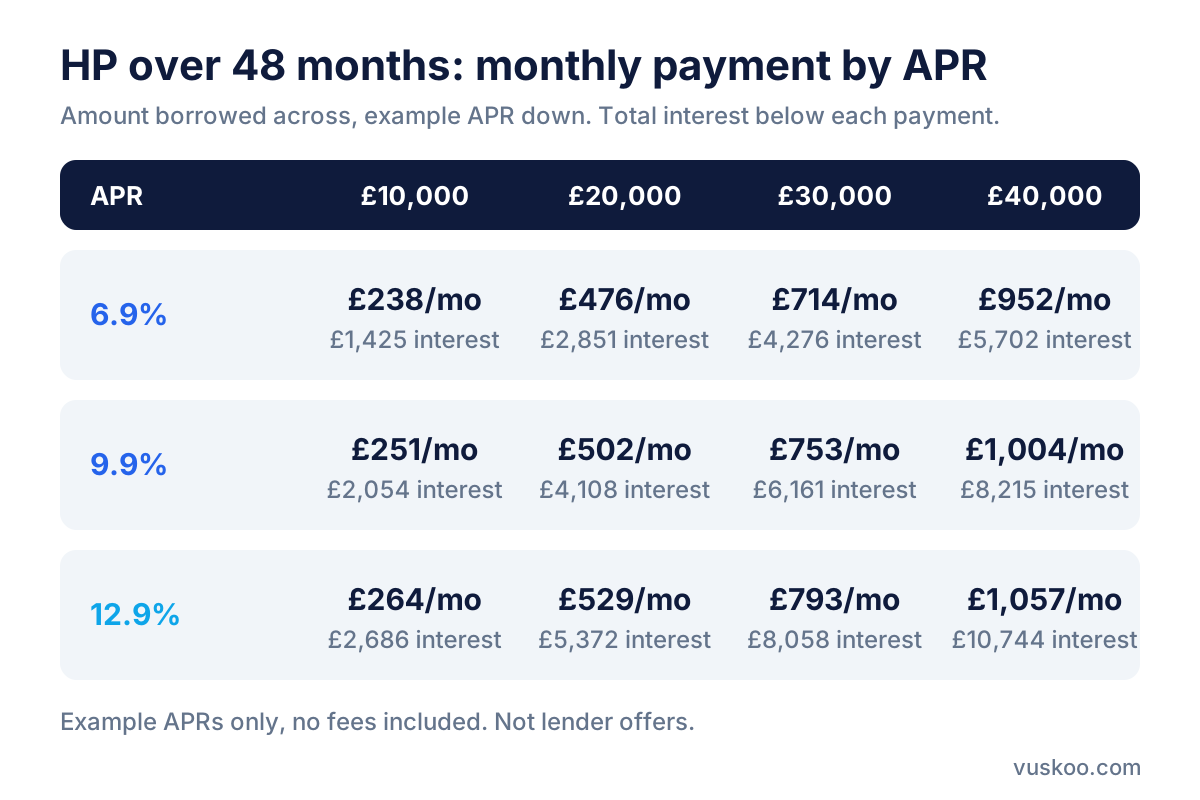
Two things stand out. First, the gap between 6.9% and 12.9% APR on a £30,000 loan works out at about £79 a month, which adds up to roughly £3,782 over the four years. Second, the total interest grows faster than the monthly payment does, so it is worth comparing quotes on the total amount payable, not only the monthly figure.
How does the term change the cost?
Spreading the loan over more months lowers the payment but increases the interest, because you owe money for longer. Here is £20,000 borrowed on HP at each example APR:
- 6.9% APR: about £615 a month over 36 months (£2,130 interest), £476 over 48 months (£2,851 interest), £393 over 60 months (£3,587 interest).
- 9.9% APR: about £640 a month over 36 months (£3,056 interest), £502 over 48 months (£4,108 interest), £420 over 60 months (£5,189 interest).
- 12.9% APR: about £666 a month over 36 months (£3,981 interest), £529 over 48 months (£5,372 interest), £447 over 60 months (£6,812 interest).
Going from 36 to 60 months at 9.9% cuts the payment by about £221 a month but adds around £2,133 in interest. A longer term also means you are more likely to owe more than the car is worth in the early years, which matters if you want to change car or settle early.
How much difference does a deposit make?
A deposit reduces the amount you borrow, so it lowers both the payment and the interest. Take a £25,000 car financed on HP at 9.9% APR over 48 months:
- No deposit (borrow £25,000): about £628 a month, £5,134 interest.
- £2,500 deposit (borrow £22,500): about £565 a month, £4,621 interest.
- £5,000 deposit (borrow £20,000): about £502 a month, £4,108 interest.
- £7,500 deposit (borrow £17,500): about £439 a month, £3,594 interest.
In this example, each extra £2,500 of deposit takes about £63 off the monthly payment and saves around £513 in interest. Some manufacturers offer a deposit contribution on certain models. If they do, check whether it comes with a higher APR, because that can cancel out the benefit.
HP or PCP: how does a balloon payment change the numbers?
With personal contract purchase (PCP), part of the loan is held back as a final balloon payment, often called the guaranteed minimum future value (GMFV). It is the lender's estimate of what the car will be worth at the end of the agreement. Because you only pay off the difference during the term, the monthly payments are lower. You still pay interest on the full amount borrowed, though, including the part deferred to the balloon.
At the end of a PCP you usually have three choices: pay the balloon and keep the car, hand the car back with nothing more to pay (as long as you have kept within the mileage limit and the car is in fair condition), or use any equity as a deposit on another car.
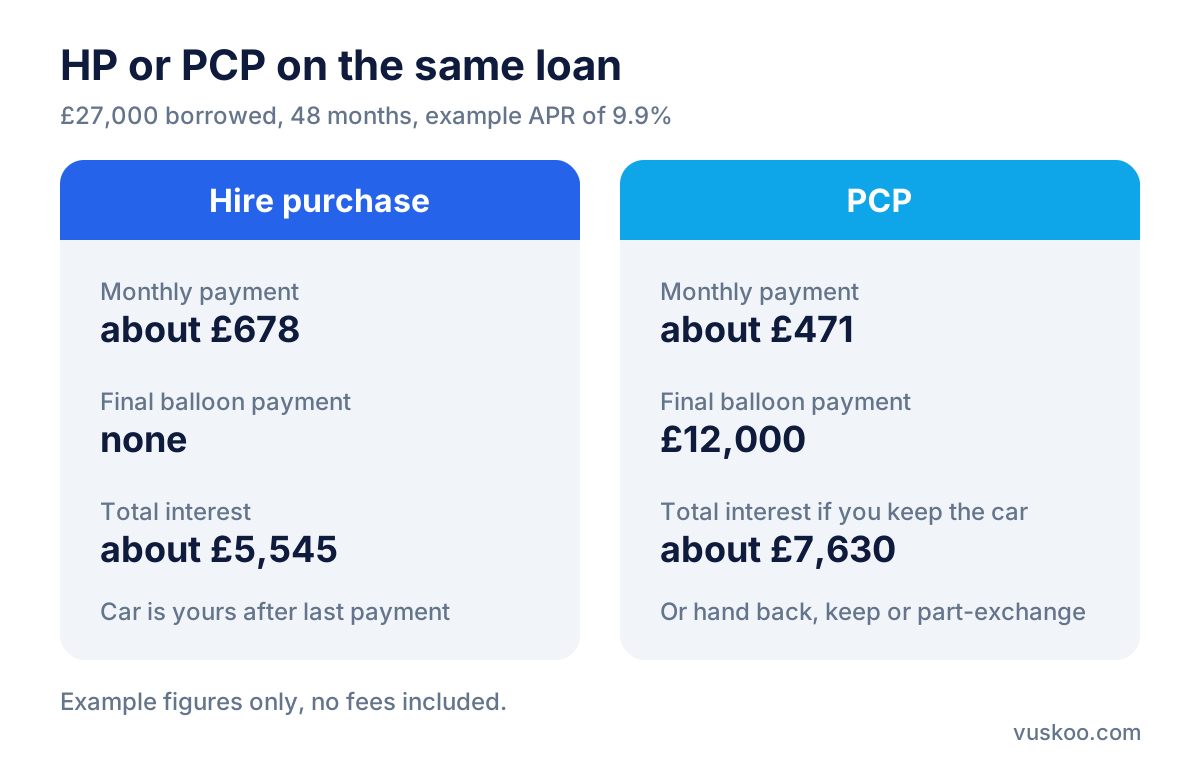
In our example of £27,000 borrowed over 48 months at 9.9% APR with a £12,000 balloon, PCP comes to about £471 a month, compared with about £678 on HP. If you then pay the balloon to keep the car, the total interest is about £7,630, against about £5,545 on HP. PCP keeps the monthly cost down, but it costs more overall if you plan to keep the car.
What affects the balloon payment?
- Annual mileage: a higher mileage allowance lowers the expected value of the car, so the balloon is smaller and the monthly payments are higher.
- Term: a longer agreement usually means a lower balloon.
- The car itself: models expected to hold their value well, whether a small petrol hatchback like the Volkswagen Polo, a hybrid such as the Toyota Yaris or Corolla, or an electric car such as the Kia EV6, Tesla Model 3 or Polestar 2, will have different balloon figures because lenders forecast their resale values differently.
- Excess mileage and damage charges: these apply if you hand the car back, so set a realistic mileage from the start.
What to check in a car finance quote
Dealers often lead with the monthly payment. To compare quotes properly, ask for the full breakdown in writing and check these points.
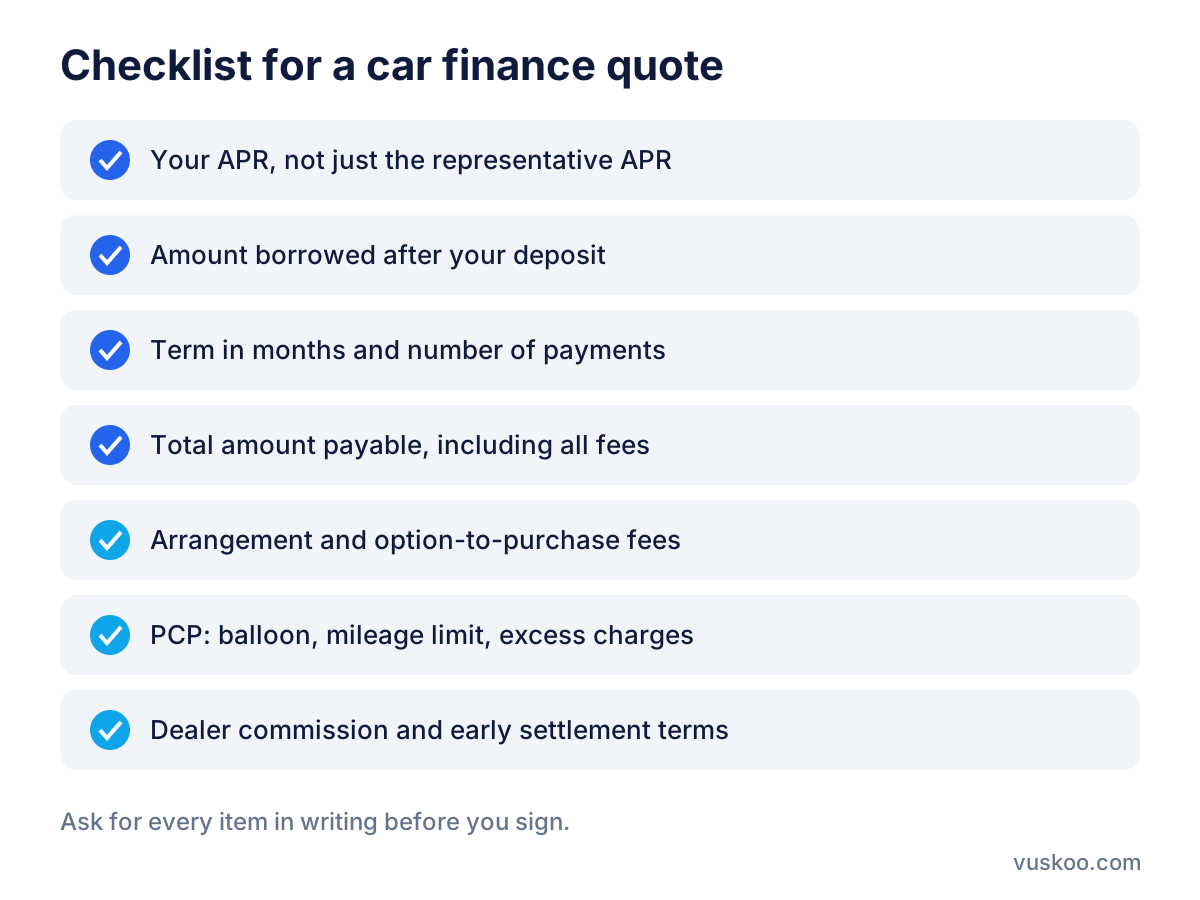
- Representative APR versus your APR: an advertised representative APR only has to be one that the lender reasonably expects at least 51% of customers to get. Your own rate depends on your credit check.
- Total amount payable: this is the clearest single figure for comparing quotes on the same car.
- Fees: look for an arrangement or documentation fee and an option-to-purchase fee, which is often added to the final payment.
- Balloon, mileage and excess charges on PCP.
- Commission: the dealer may be paid by the lender for arranging the finance. You are entitled to ask how much, and how the arrangement works.
- Early settlement: ask for the settlement figure rules and whether paying off early reduces the interest.
Your rights once you have signed
Regulated car finance agreements come with a 14-day period during which you can withdraw from the credit agreement, although you would need to repay what you have borrowed. You can also end an HP or PCP agreement early under voluntary termination once you have paid half the total amount payable, as long as you have taken reasonable care of the car. On PCP the balloon counts towards that total, so the halfway point comes later than on HP.
If you took out car finance between 2007 and November 2024, the FCA has set up a redress scheme for some agreements where commission was not properly disclosed. At the time of writing, parts of the scheme are on hold while legal challenges are heard, so check the FCA's latest update before you act.
FAQ
How do I calculate a car finance payment myself?
Take the amount you are borrowing, the APR and the number of months, and use the per-£1,000 figure for that APR and term. For example, at 9.9% over 48 months it is about £25.11 per £1,000, so £18,000 borrowed comes to roughly £452 a month. For PCP, you also need the balloon amount.
Is a lower monthly payment always cheaper?
No. A longer term or a large balloon lowers the payment but usually increases the total interest. Compare the total amount payable instead.
Does a bigger deposit lower the APR?
Not necessarily. It lowers the amount you borrow and therefore the interest, but the APR depends on the lender and your credit profile. Some offers do set different rates depending on the deposit, so ask.
Why does my quote differ from a calculator?
Calculators usually leave out fees, use a sample APR and assume equal payments. Your actual APR, any fees added to the first or final payment, and the exact balloon figure all change the result.
Photo: Shutterbug26 / Pixabay