Car leasing vs PCP: the short answer
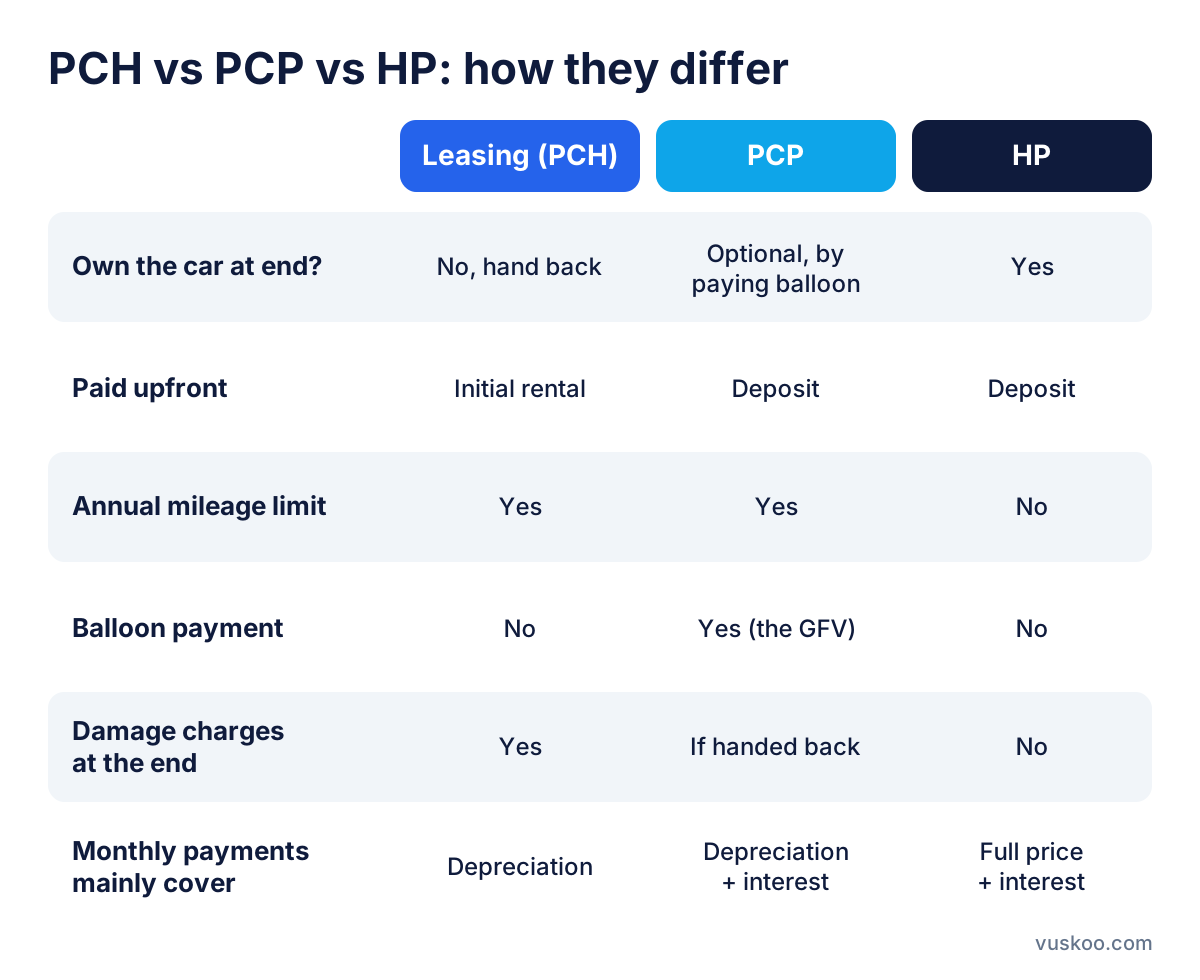
When you compare car leasing vs PCP, leasing (personal contract hire, or PCH) usually has the lower monthly payment, because you only pay for the car's loss in value while you have it and you never own it. PCP (personal contract purchase) also bases its monthly payments on that loss in value, but you pay interest on the whole amount borrowed and you can buy the car at the end with a final "balloon" payment. Hire purchase (HP) has the highest monthly cost because you pay off the full price, but the car is yours once the last payment is made. Which one costs you less overall comes down to whether you want to own the car and how long you plan to keep it.
How each option works
Personal contract hire (leasing)
You rent a new car for a fixed term, often two to four years. You pay an initial rental upfront, usually set as a multiple of the monthly payment, and then fixed monthly rentals. You agree an annual mileage at the start. At the end you hand the car back, and you are charged for extra miles and for any damage beyond fair wear and tear. Many leasing firms judge the car's condition against the BVRLA fair wear and tear standard, an industry guide to what counts as acceptable condition. There is no option to buy the car.
Personal contract purchase (PCP)
You pay a deposit, then monthly payments over the term. The lender sets a guaranteed future value (GFV) at the start, which is its estimate of what the car will be worth at the end. Your monthly payments cover the gap between the price (less your deposit) and the GFV, plus interest. At the end you choose one of three things:
- pay the balloon payment (the GFV) and keep the car
- hand it back and walk away, subject to mileage and condition checks
- part-exchange it, putting any equity (value above the GFV) towards your next car
Hire purchase (HP)
You pay a deposit, then spread the rest of the price plus interest over the term. There is no balloon payment, no mileage limit and no condition check at the end, because the car becomes yours after the last payment (sometimes there is a small "option to purchase" fee). Until then the lender owns the car, so you can't sell it without settling the finance first.
Monthly costs compared: a worked example
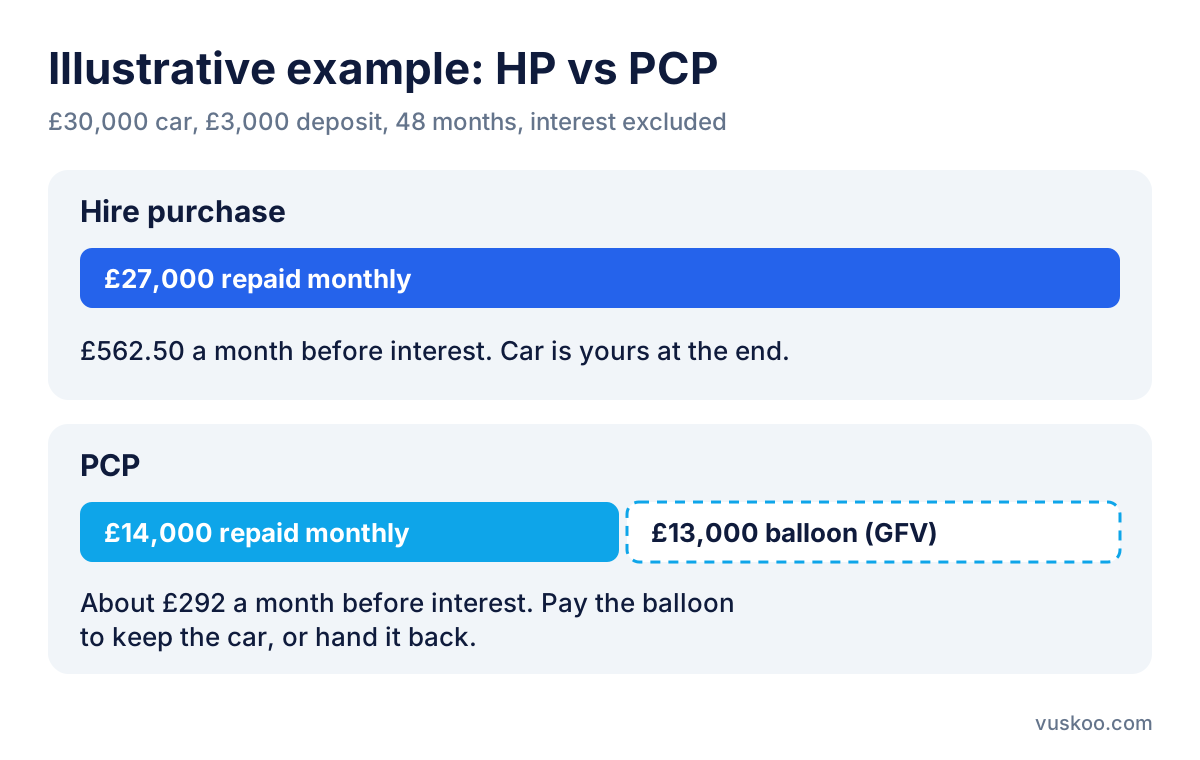
Numbers make the difference clearer. The example below uses a made-up car and leaves interest out on purpose, so you can see how the structure of each deal changes the monthly figure. It is not a quote.
- Car price: £30,000
- Deposit: £3,000
- Term: 48 months
- Guaranteed future value (PCP only): £13,000
HP: you finance £27,000 and pay it all off over 48 months, which is £562.50 a month before interest. At the end you own the car.
PCP: you also borrow £27,000, but your monthly payments only cover £14,000 of it (£27,000 minus the £13,000 GFV). That is about £292 a month before interest. To keep the car you then pay £13,000. Interest is charged on the full £27,000 for the whole term, because the balloon stays outstanding until the end.
PCH: the leasing company works out the rental from its own estimate of depreciation, its funding costs and any manufacturer support, and VAT is included in personal lease prices. You pay nothing at the end apart from any excess mileage or damage charges, and you have no car to show for it.
So in this example PCP roughly halves the monthly payment compared with HP. But if you pay the balloon, you end up paying the full price plus more interest than HP, because more of the debt was outstanding for longer.
Which works out cheaper overall?
To compare fairly, look at the total amount payable on each quote, not just the monthly figure. Then ask what you will have at the end.
- If you change cars every few years: leasing and PCP-with-handback are both effectively paying for depreciation. Compare the total cost of the lease (initial rental plus all monthly rentals plus any admin fee) with PCP's deposit plus monthly payments. Manufacturer deposit contributions on PCP and discounts on lease rates can push either one ahead.
- If you want to keep the car for many years: HP usually costs less in total than PCP plus the balloon, because you pay interest on a balance that falls each month. Once it's paid off, you have years of driving with no finance payments.
- If you aren't sure: PCP keeps both options open, but that flexibility comes at the cost of extra interest if you do decide to buy.
Deposits, mileage limits and end-of-contract charges
Deposits and initial rentals
A bigger deposit lowers PCP and HP monthly payments and the interest you pay. On a lease, a bigger initial rental lowers the monthly rentals, but it is not a deposit: you don't get it back and it doesn't reduce interest in the same way. Compare total cost, not just the upfront sum.
Mileage limits
Leasing and PCP both set an annual mileage. Going over it means a pence-per-mile charge at the end, set out in your agreement. Underestimating to get a lower monthly payment often backfires. HP has no mileage cap, which suits high-mileage drivers.
Condition and damage
When you hand a car back on a lease or PCP, you can be charged for damage beyond fair wear and tear, such as kerbed alloys, deep scratches or missing service history. Taking photos when you collect and return the car helps if there's a disagreement.
Ending early
With PCP and HP, the Consumer Credit Act gives you a right to voluntary termination: you can hand the car back once you have paid half the total amount payable, or pay up to that point. Excess mileage limits don't apply on HP when you terminate this way, but damage charges can. On PCP the balloon makes up a large part of the total, so you usually reach that point late in the contract. Leases don't come with this right, and ending one early often means paying a large share of the remaining rentals.
Electric cars and hybrids: what changes
Leasing is common for EVs because it moves the risk of the car losing value onto the leasing company, which matters when battery technology and used EV prices change quickly. A few points to check:
- Vehicle tax: since 1 April 2025, electric cars pay vehicle excise duty. Under GOV.UK guidance, the expensive car supplement applies to zero-emission cars registered from that date with a list price above £50,000. On a lease, ask whether road tax is included in the rental for the whole term.
- Electric Car Grant: the government grant on eligible new EVs is applied by the dealer at the point of sale and can apply to leased and financed cars as well as cash purchases. Check whether the exact version you want is on the GOV.UK eligible list and whether the discount is reflected in the quote.
- GFVs on PCP: lenders set future values differently for EVs and hybrids, which can make the monthly gap between models such as the Nissan Leaf, Kia EV6 or Tesla Model 3 bigger or smaller than the price difference suggests.
- Hybrids: a self-charging hybrid like the Toyota Yaris Hybrid is taxed and financed much like a petrol car such as the Volkswagen Polo, so compare them on total cost and expected mileage.
Which suits which driver?
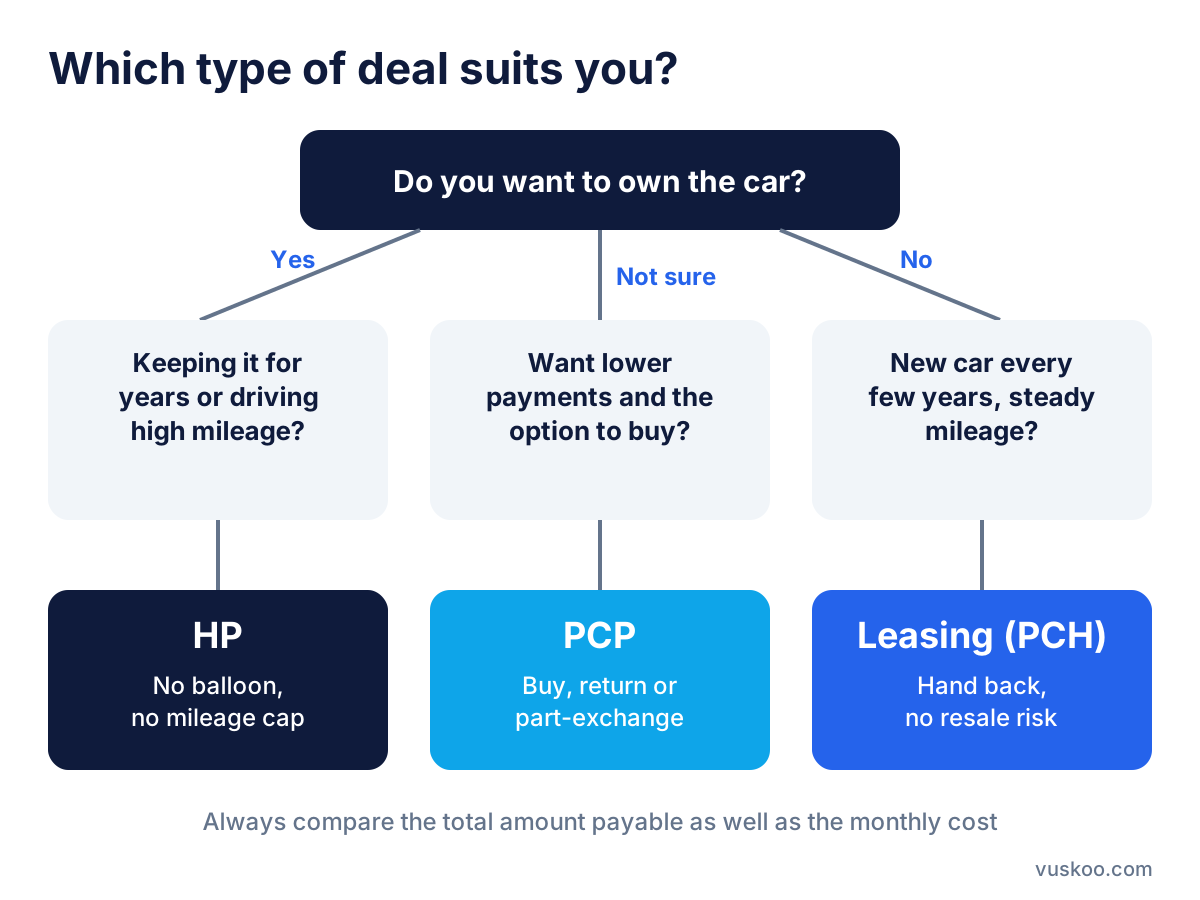
PCH suits drivers who want a new car every few years, a predictable monthly cost and no worries about resale value, and who can estimate their mileage accurately. PCP suits drivers who want lower monthly payments but want the option to buy, or to use any equity towards the next car. HP suits drivers who want to own the car, drive high mileage, or plan to keep it well beyond the finance term.
How to compare quotes
- Check that every quote covers the same car, term and annual mileage.
- Note the deposit or initial rental and any admin or documentation fees.
- Compare the APR and total amount payable for PCP and HP.
- For PCP, note the GFV and the excess mileage charge.
- For leasing, check what is included: road tax, breakdown cover, maintenance.
- Read the end-of-contract terms on damage and early termination.
Car finance is regulated by the Financial Conduct Authority. Following concerns about commission paid to dealers, the FCA has also set up a redress scheme for some older motor finance agreements. On any new deal, you can ask the dealer or broker how they are paid.
Frequently asked questions
Is leasing cheaper than PCP?
Monthly payments on a lease are often lower than PCP for the same car, but not always, as PCP deposit contributions can close the gap. Compare the total cost over the term, assuming you hand the car back in both cases.
Is PCP or HP cheaper if I want to keep the car?
HP usually costs less in total, because interest is charged on a balance that falls each month. On PCP, the balloon is outstanding for the whole term and builds up interest.
Do I own the car on a lease?
No. On personal contract hire you hand the car back at the end and can't buy it under the agreement.
What happens if I go over my mileage?
On a lease or a PCP you return, you pay the excess mileage charge in your agreement for every mile over the limit. If you keep a PCP car by paying the balloon, the mileage limit no longer matters.
Does car finance affect my credit score?
PCP and HP are credit agreements and leases also involve a credit check, so all three show on your credit file. Paying on time helps your record. Missed payments harm it.
Photo: jlamping / Pixabay