In this article
- What size of system does a small business need?
- What does commercial solar cost?
- How does daytime use shorten the payback period?
- What tax relief is available on solar panels for business?
- How do export payments work for businesses?
- Roof, lease and grid checks before you get quotes
- How to compare installers
- Frequently asked questions
Commercial solar panels for business tend to pay back fastest where the premises uses most of its electricity in daylight hours, on weekdays, all year round. Shops, offices, workshops, cold stores and small factories usually fit that pattern. Most of the power is used on site, so each unit generated replaces a unit you would otherwise buy from the grid at your business tariff. On top of that, companies and sole traders can usually claim capital allowances on the installation. Any surplus can be sold through a Smart Export Guarantee (SEG) tariff. Before you ask for quotes, check that the roof, the lease and the grid connection can take a system.
What size of system does a small business need?
Commercial systems are measured in kilowatt-peak (kWp), which is the output of the panels under standard test conditions. Homes typically have about 3 to 6 kWp. Small commercial roofs often take somewhere between 10 and 50 kWp, and larger warehouses or factories can go well beyond that. The commercial packages listed on this page, from installers such as Spectrum Energy Systems and Spirit Energy, are sized in that small-to-mid commercial range.
The right size depends on three things:
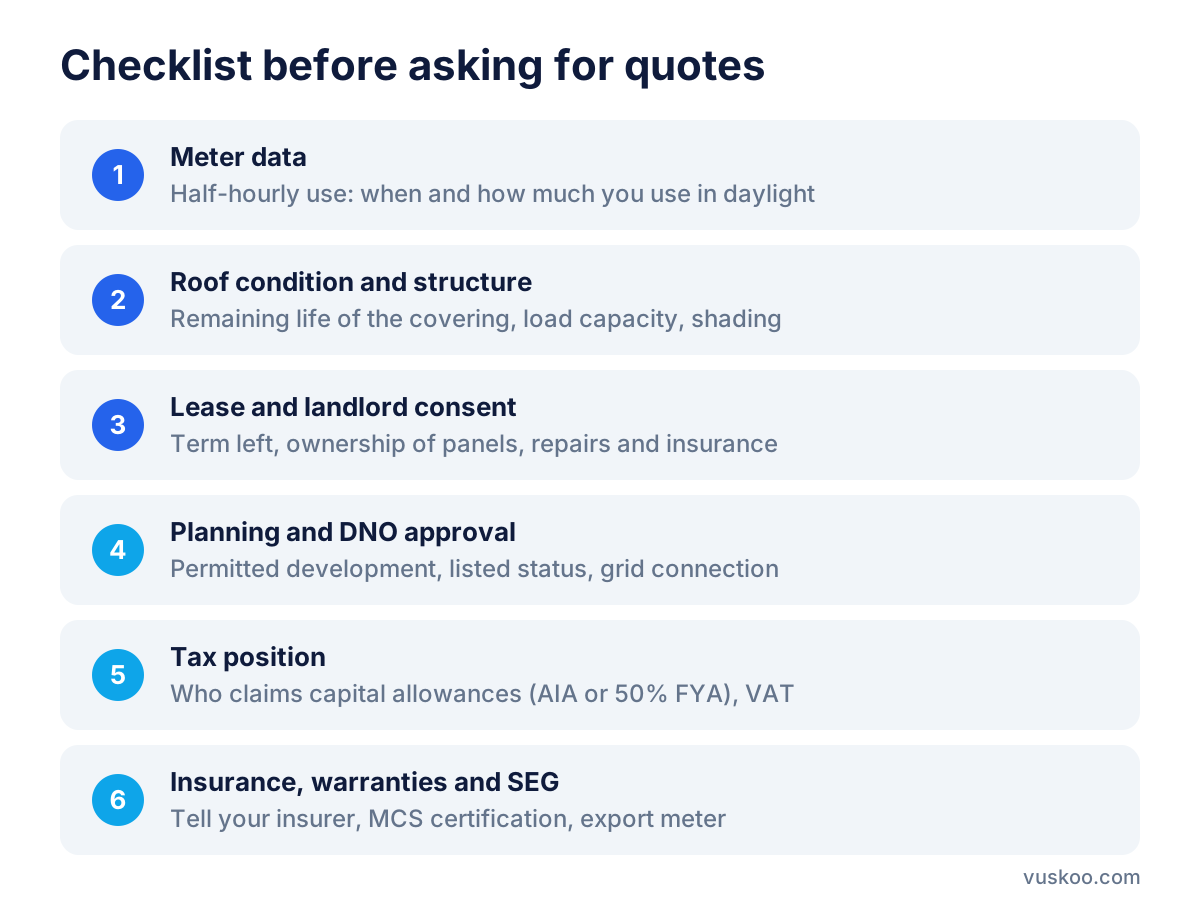
- Your daytime demand. Look at half-hourly data from your smart or half-hourly meter. It shows how much you use between roughly 8am and 6pm, and on which days.
- Usable roof area. Orientation, shading from nearby buildings, roof lights and access walkways all reduce the space available.
- Grid capacity. Your local distribution network operator (DNO) may limit how much you can export, or ask for upgrades before it allows a larger system to connect.
A common approach is to size the system so that most of its output is used on site, not exported. Exported electricity usually earns much less per unit than it costs you to import.
What does commercial solar cost?
Prices change often, so check the live offer boxes beside this article for current figures. When you compare quotes, these are the items that move the total:
- Panels and inverters. Panel efficiency, the inverter type (string inverter or optimisers) and the warranty length on each.
- Mounting. Flat roofs need ballasted or tilted frames. Profiled metal roofs need clamps. Older roofs may need repairs first.
- Access and scaffolding. Height, edge protection and working hours for an occupied building.
- Electrical works. Cable runs, distribution board upgrades and three-phase connection work.
- Grid application. Anything above a small single-phase system normally needs prior DNO approval, and the DNO may charge for any network reinforcement.
- Battery storage. This is optional. It is worth considering if you have evening or weekend loads, but it adds cost and lengthens the simple payback.
- Monitoring and maintenance. Remote monitoring, cleaning, and inspection visits.
VAT on commercial installations is charged at the standard rate. VAT-registered businesses can normally reclaim it in the usual way. Ask your accountant how this applies to you.
How does daytime use shorten the payback period?
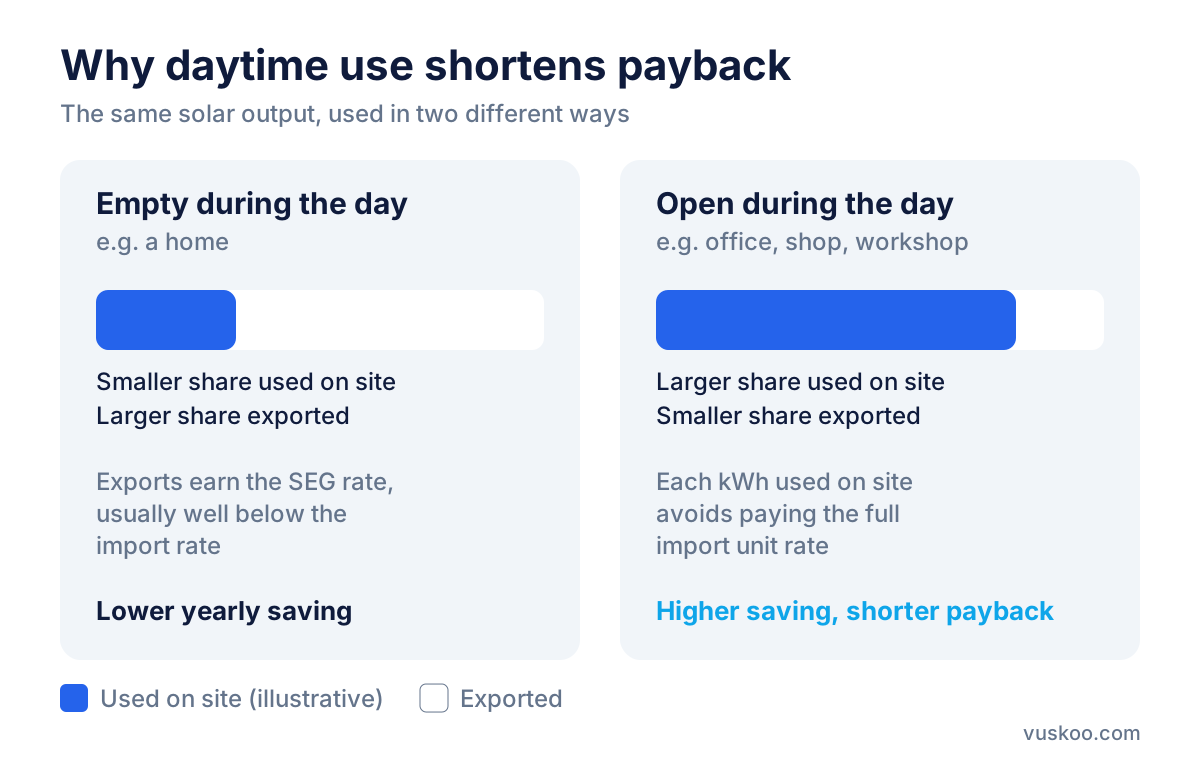
The payback period is the installed cost divided by the yearly saving. The yearly saving comes from two parts:
- Self-consumed electricity. Each kWh you use on site saves you your full import unit rate, and that rate is often higher for businesses than for homes once standing charges and levies are included.
- Exported electricity. Each kWh you send to the grid earns your SEG export rate, which is usually far lower.
Solar output peaks around midday, from spring to early autumn. A home is often empty at that time, so a large share of what it generates is exported. A business open in the daytime can use most of its generation as it is produced. The same system then saves noticeably more each year, so the payback is shorter. Weekend-only premises, or sites that mostly run in the evening, get less from solar on its own, and may need a battery or a smaller system.
When an installer gives you a payback estimate, ask what self-consumption percentage it assumes. Ask which import tariff and which export rate they used, and whether panel degradation and inverter replacement are included. Run the figures again using your own meter data and your current contract rates.
What tax relief is available on solar panels for business?
HMRC classes solar panels as special rate plant and machinery for capital allowances. In practice this means:
- Annual Investment Allowance (AIA). This gives 100% relief in the year of purchase, up to the annual AIA limit (currently £1 million). It is available to companies, sole traders and partnerships, and is the usual route for small businesses.
- 50% first-year allowance. Companies can claim this on special rate assets above the AIA. Full expensing does not apply to solar panels, because they are special rate assets.
- Special rate pool. Any spending you do not claim another way goes into the special rate pool and is written down at 6% a year.
The relief reduces taxable profits, so how much it is worth depends on your tax rate and your profits. If you own the building but rent it out, who can claim the allowances depends on who pays for the system and how the lease is set up. Get advice from an accountant before you commit.
In England, eligible plant and machinery for onsite renewable generation and storage, including rooftop solar, is exempt from business rates until 31 March 2035. This means installing panels should not raise your rateable value for that period. Scotland has its own exemption. Wales sets its own rules, so check with your local authority there.
How do export payments work for businesses?
The Smart Export Guarantee applies across Great Britain to systems up to 5 MW, which covers almost all small commercial installations. To qualify you generally need:
- an installation and installer certified under MCS or an equivalent scheme
- a meter that records exports half-hourly, normally a smart meter
- a SEG tariff with a licensed supplier. Larger suppliers must offer one, and your export supplier does not have to be the one that supplies your import.
SEG rates and terms vary between suppliers and can change. Compare whether a rate is fixed or variable, the contract length, and whether it is tied to your import contract.
Roof, lease and grid checks before you get quotes
Roof condition and structure
Panels typically stay on a roof for 25 years or more. If the roof covering will need replacing in that time, do the work first, because removing and refitting panels is expensive. Ask for a structural check that the roof can carry the extra load, particularly on older steel-frame or asbestos-cement roofs.
Lease terms
Tenants usually need the landlord's written consent to alter the roof. Check the lease length against the payback period, who owns the panels at the end of the lease, and who is responsible for repairs and insurance. Landlords installing panels for tenants can sell the electricity under a separate power purchase agreement. This needs careful drafting.
Planning and grid connection
Many rooftop systems on commercial buildings fall under permitted development. Listed buildings, conservation areas and some ground-mounted arrays may need planning permission, so confirm this with your local planning authority. For anything beyond a small system, your installer should apply to the DNO and get approval before installation.
Insurance and warranties
Tell your buildings insurer before work starts. Compare product, performance and workmanship warranties, and check whether an insurance-backed guarantee covers the workmanship if the installer stops trading.
How to compare installers
Get at least three quotes based on the same meter data. As well as specialist commercial installers, some energy suppliers that mainly sell home systems, such as E.ON Next, EDF, British Gas and Octopus Energy, may also handle smaller business premises. Check that each quote states the system size in kWp, the expected yearly generation, the assumed self-consumption, the equipment brands, the full scope of works, the warranties and who handles the DNO application.
Frequently asked questions
Can a business with a leased unit install solar panels?
Yes, if the landlord gives consent and the remaining lease term is long enough for the system to pay back. Agree in writing who owns, maintains and insures the panels, and what happens to them when the lease ends.
Do solar panels increase business rates?
In England, eligible onsite solar and battery storage is exempt from business rates until 31 March 2035. Scotland and Wales have their own arrangements.
Is a battery worth adding to a commercial system?
It depends on your load profile. If most of your electricity is used during daylight, a battery adds less value. If you have significant evening, early-morning or weekend use, it can raise self-consumption, though it lengthens the simple payback period.
Can sole traders claim capital allowances on solar panels?
Yes. The Annual Investment Allowance is available to unincorporated businesses as well as companies. The 50% first-year allowance is for companies only.
Photo: michaelyeoman / Pixabay