In this article
- What is the difference between dual fuel and separate suppliers?
- Dual fuel vs separate gas and electricity suppliers: which is cheaper?
- Two standing charges: what you actually pay
- How to compare the total annual cost properly
- Two bills and two switches: the practical side
- What to check before the January 2027 price cap
- Frequently asked questions
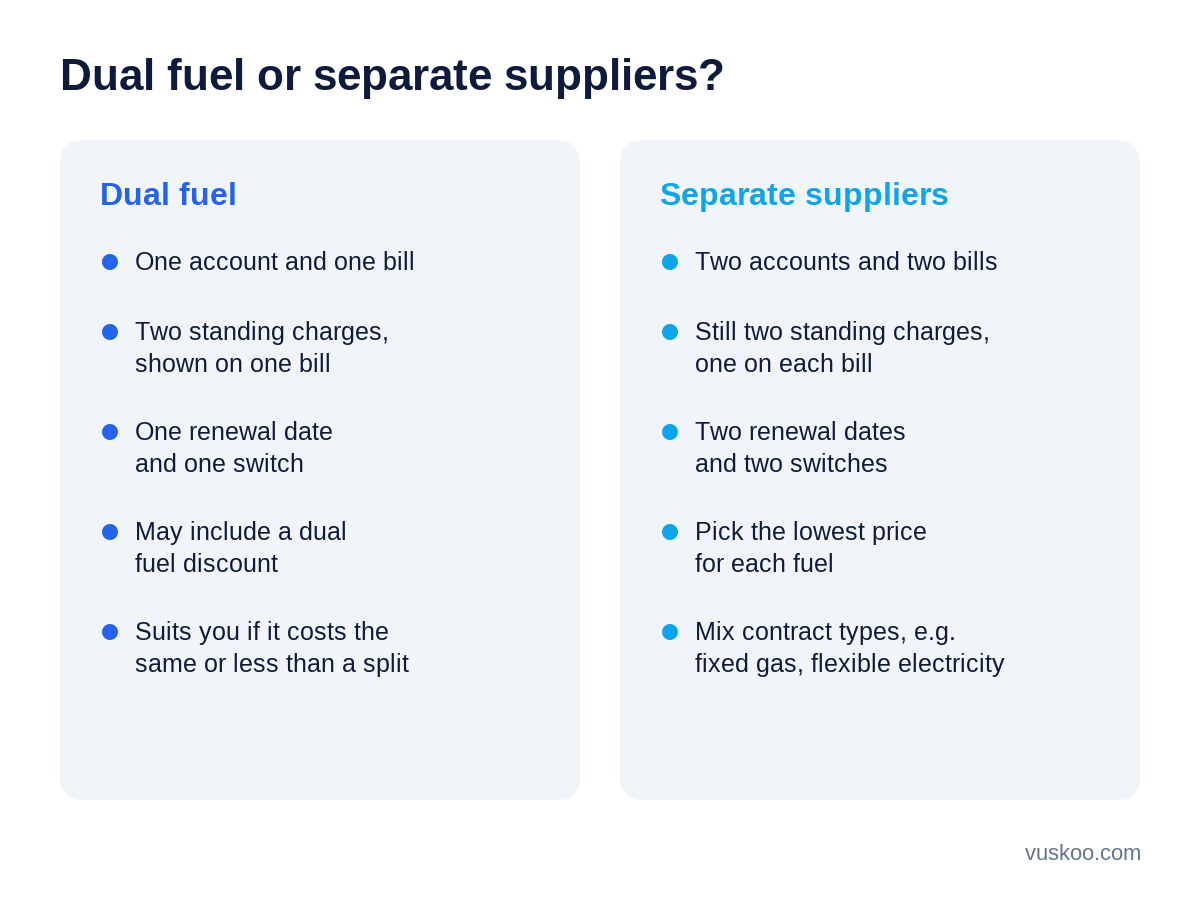
Choosing between dual fuel and separate gas and electricity suppliers comes down to one number: the total you will pay for both fuels over a year. A dual fuel deal puts gas and electricity with one supplier, which is simpler and sometimes comes with a small discount. Separate suppliers can work out cheaper when one company has a good electricity tariff and another has a good gas tariff, and the gap between them is bigger than any dual fuel discount. Either way, you pay two standing charges, one for each fuel, so splitting does not add an extra daily charge.
This guide explains how dual fuel discounts work, when splitting makes sense, what changes in practice when you have two suppliers, and how to compare deals properly ahead of the price cap period that starts on 1 January 2027.
What is the difference between dual fuel and separate suppliers?
With a dual fuel tariff, one supplier provides both your gas and your electricity. You have one account, usually one Direct Debit and one customer service team. The tariff still has separate prices for each fuel: a unit rate and a standing charge for electricity, and a unit rate and a standing charge for gas.
With separate suppliers, you take an electricity-only tariff from one company and a gas-only tariff from another. Some suppliers publish single-fuel versions of their tariffs, for example Octopus Energy lists electricity and gas versions of its flexible and fixed tariffs separately, which makes it easier to compare each fuel on its own.
Dual fuel vs separate gas and electricity suppliers: which is cheaper?
There is no fixed answer. It depends on the prices available in your region on the day you compare, your payment method and how much of each fuel you use.
How dual fuel discounts work
Some suppliers reward customers who take both fuels. The discount may be shown as a reduction on the annual bill, or it may simply be built into lower unit rates or standing charges on the dual fuel version of a tariff. Other suppliers charge the same whether you take one fuel or both. Always check whether the discount is guaranteed for the whole contract or only for a limited period.
When splitting can save money
- One supplier is strong on electricity, another on gas. If the cheapest electricity tariff and the cheapest gas tariff come from different companies, combining them can beat any single dual fuel deal.
- Your usage is unbalanced. A home with high gas use for heating but modest electricity use (or the reverse, such as a household charging an electric car) benefits most from a low price on the fuel it uses most.
- You want different contract types. You might prefer to fix one fuel for 12 or 18 months and keep the other on a flexible or tracker tariff.
- You need a specialist tariff for one fuel. Electric vehicle or time-of-use tariffs are usually about electricity. If one is only offered on certain terms, splitting can keep your gas choice open.
When dual fuel tends to make more sense
- The dual fuel deal is cheaper or within a few pounds of the best split combination, and you value having one account.
- The supplier offers a dual fuel discount or exclusive dual fuel tariff that disappears if you take only one fuel.
- You prefer to manage one renewal date and one switch rather than two.
Two standing charges: what you actually pay
The standing charge is a fixed daily amount you pay to be connected, whether or not you use any energy. Electricity and gas each have their own. A dual fuel customer pays two standing charges on one bill. A customer with separate suppliers pays the same two standing charges, just on two bills.
What does change is the level of each standing charge. Suppliers set their own standing charges (Ofgem does not set them, although the price cap limits them on default tariffs), so one company's electricity standing charge may be lower while another's gas standing charge is lower. This is why you need to compare standing charges and unit rates together. A tariff with a low unit rate but a high standing charge can cost more for a low-usage home, and the opposite can be true for a high-usage home.
How to compare the total annual cost properly
Headline monthly payments can mislead, because they are estimates and may be set to build up credit. Work from the tariff details instead.
- Find your annual usage in kWh for electricity and for gas. It is on your annual statement or in your supplier's app. Use actual readings rather than estimates where you can.
- Note each fuel's unit rate and standing charge for every tariff you are considering. Make sure they are for your region, your meter type and your payment method.
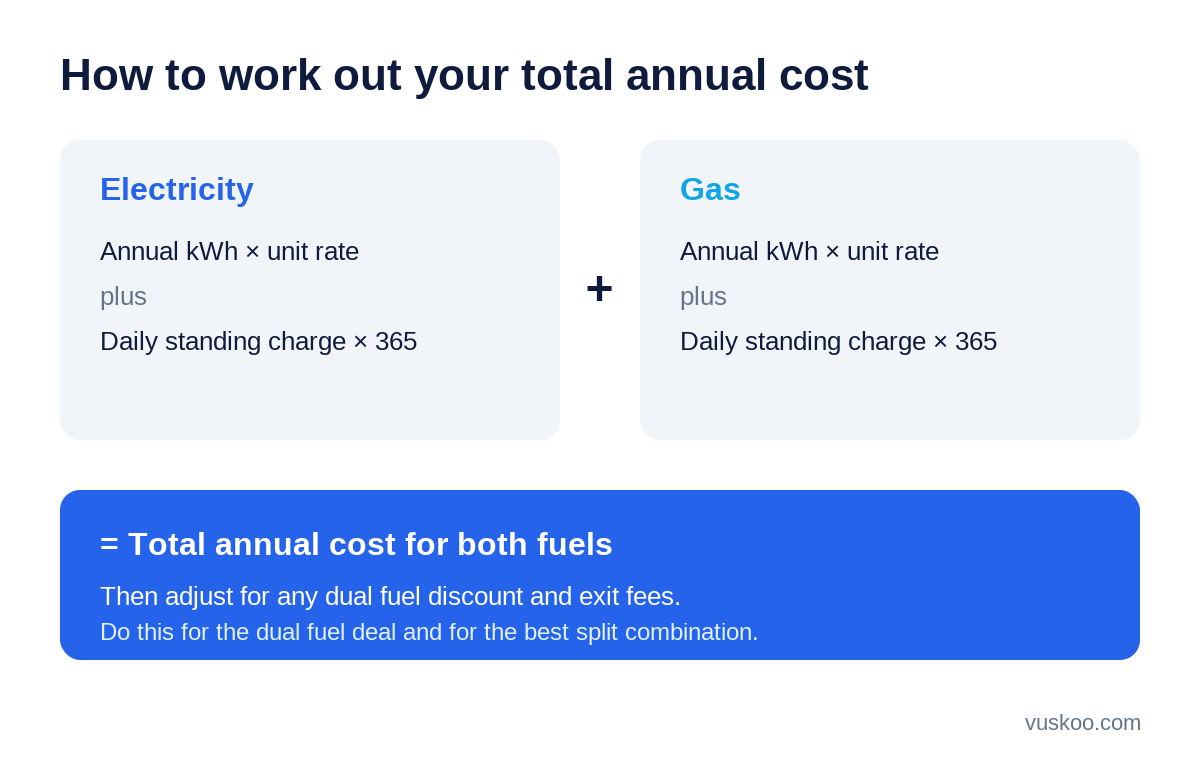
- Calculate each fuel separately: annual kWh multiplied by the unit rate, plus the daily standing charge multiplied by 365.
- Add the two fuels together for the dual fuel option, and add the best electricity-only and best gas-only figures for the split option.
- Adjust for discounts and fees: any dual fuel discount, exit fees on your current fixed deal, and whether rates on a variable or tracker tariff can change during the year.
Compare like with like. A fixed price for 12 months is not directly comparable with a variable tariff whose rates can move every quarter, so weigh price certainty as well as the calculated total.
Two bills and two switches: the practical side
- Two accounts. You will have two logins, two payment arrangements and two sets of meter readings to submit, unless smart meters send readings automatically.
- Two renewal dates. Fixed deals started at different times end at different times. Note both end dates so neither rolls onto a more expensive default tariff without you noticing.
- Two switches. Each fuel switches independently. If one switch is delayed, the other is not affected.
- Exit fees. If you leave a fixed deal early, check the exit fee for each fuel. Under Ofgem's rules, suppliers cannot charge an exit fee if your switch completes within the 49 days before your fixed deal ends.
- Prepayment. If you use a pay as you go arrangement, such as Utilita Pay As You Go, check how top-ups work for each fuel and whether the tariff is available for gas, electricity or both.
What to check before the January 2027 price cap
Ofgem is due to announce the price cap for 1 January to 31 March 2027 on 25 November 2026. Industry forecasts published in November point to an increase on the October to December 2026 level, but the official figures are what count, so check Ofgem's announcement before deciding.
Keep in mind how the cap works:
- It limits the unit rates and standing charges on default tariffs, such as British Gas Standard Variable or other suppliers' standard variable and flexible tariffs. It does not cap your total bill, which still depends on how much you use.
- Cap levels vary by region, payment method and meter type, so your own rates may differ from the national averages reported in the news.
- If you are on a fixed tariff, such as E.ON Next Fixed 12-Month, EDF Simply Fixed or OVO Energy 1-Year Fix, your rates do not change when the cap changes, until your fixed term ends.
- Tracker tariffs, such as EDF Simply Tracker, follow their own pricing formula and can move independently of the cap.
Before the new cap applies, compare the rates of fixed deals for each fuel against the expected default rates. If you are considering a split, this is also a good moment to check whether a fixed deal on one fuel and a flexible tariff on the other suits your situation.
Frequently asked questions
Do I pay two standing charges if I use separate suppliers?
You pay one standing charge per fuel, so two in total, which is the same number as with a dual fuel tariff. The amounts may differ between suppliers.
Is dual fuel always cheaper?
No. A dual fuel discount can be smaller than the saving from choosing the lowest-priced electricity and gas tariffs from different suppliers. Compare the total annual cost of both options.
Can I switch only my electricity or only my gas?
Yes. Each fuel can be switched on its own. If you are on a dual fuel deal, check whether moving one fuel affects the price or any discount on the other.
Does the price cap apply to fixed deals?
No. The cap applies to default tariffs. Fixed tariffs keep their agreed rates for the contract term.
My home has no gas. Does this apply to me?
Only partly. With electricity only, you pay a single standing charge and compare electricity-only tariffs on unit rate, standing charge and contract type.
Photo: Life-Of-Pix / Pixabay