In this article
- Energy standing charges explained in brief
- What does a standing charge pay for?
- How much are standing charges under the price cap?
- Why do standing charges vary by region?
- Does the way you pay change the standing charge?
- Who pays most relative to their usage?
- What is a low or zero standing charge tariff?
- When does a low standing charge tariff work out cheaper?
- How to compare tariffs before the January 2027 cap
- Frequently asked questions
Energy standing charges explained in brief
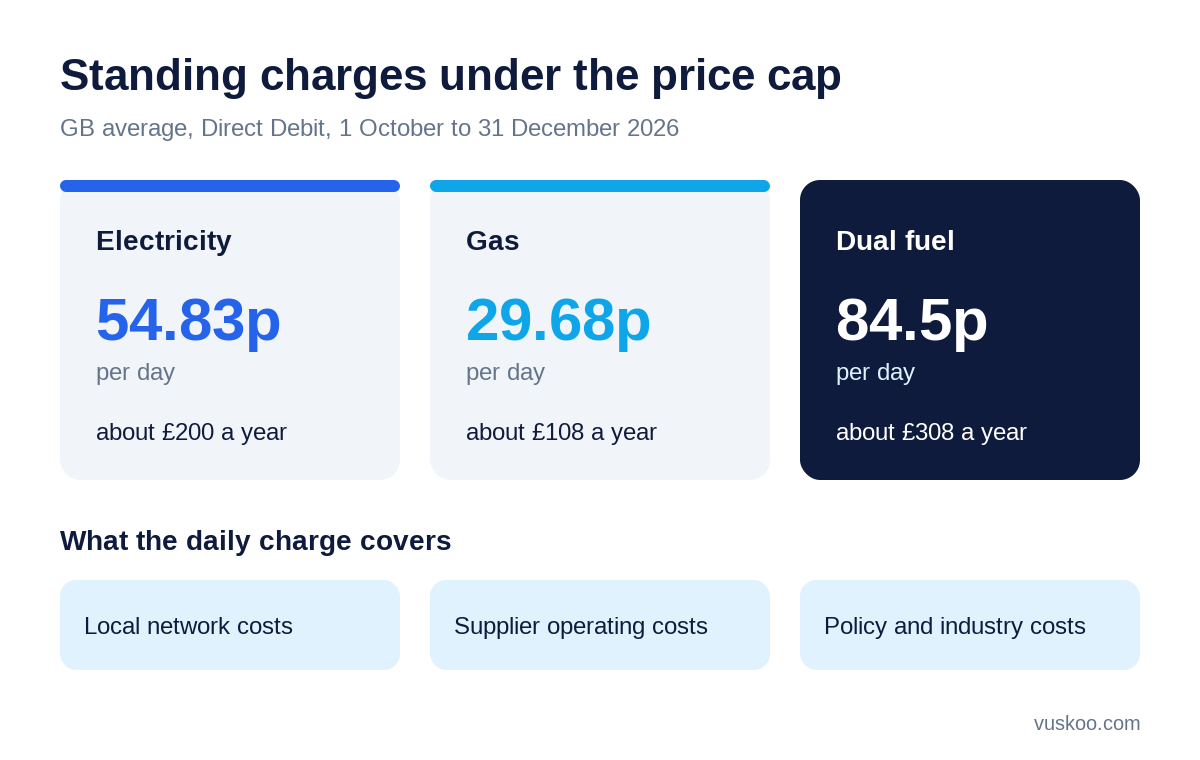
A standing charge is a fixed amount you pay for every day you are connected to the gas or electricity network, however much energy you use, even none at all. Under Ofgem's price cap for 1 October to 31 December 2026, the Great Britain average for Direct Debit customers is 54.83p a day for electricity and 29.68p a day for gas. That adds up to about 84.5p a day for a dual fuel home, or roughly £308 a year before you use a single unit. Your own rate depends on where you live, how you pay and which tariff you are on.
This guide covers what the charge pays for, why it differs between regions and payment methods, and how to tell whether a tariff with a low or zero standing charge would cost you less. That last question matters most for households that use little energy.
What does a standing charge pay for?
Your bill has two parts: a unit rate for each kilowatt hour (kWh) you use, and the standing charge. The standing charge covers costs that do not change with how much energy you use. Ofgem groups these roughly as follows:
- Network costs: building, maintaining and running the local wires and pipes that bring energy to your home.
- Operating costs: running your account, billing, customer service and meter-related costs.
- Policy and industry costs: shared costs that are put on every bill, including the cost of customers moved to a new supplier when their old one went bust.
Because these costs are spread across every connected household, the standing charge makes up a much bigger share of the bill for people who use little energy than for heavy users.
How much are standing charges under the price cap?
The price cap limits the standing charge and unit rate that suppliers can charge on standard variable (default) tariffs. It does not cap your total bill. For October to December 2026, the GB averages for Direct Debit are:
- Electricity: 54.83p a day, down from 57.19p in July to September 2026.
- Gas: 29.68p a day, up from 29.04p in July to September 2026.
Ofgem reviews the cap every three months. The level for 1 January to 31 March 2027 is due to be announced on 25 November 2026, so the daily rates above may change from New Year's Day. Fixed tariffs are not covered by the cap, and suppliers can set standing charges above or below cap levels on them.
Why do standing charges vary by region?
Ofgem sets a separate cap for each of the 14 electricity regions in England, Scotland and Wales, so the national figure is only an average. The differences mostly come from network costs. Each regional network operator shares out its costs among the homes in its area, and those costs depend on things like:
- how many people live in the region and how spread out they are
- how much energy the region uses on average
- the cost of building, repairing and upgrading the local network
Rural areas, or areas with hard ground and long cable runs, can cost more to serve per home than dense cities. Electricity standing charges vary by region far more than gas ones. Ofgem publishes the cap levels for each region, and your bill or online account should show your current daily rate.
Does the way you pay change the standing charge?
Yes, to a degree. The three main payment methods are treated differently:
- Direct Debit: the benchmark that most headline figures use.
- Prepayment: since April 2024, prepayment standing charges under the cap have been brought into line with Direct Debit. Prepayment tariffs such as Utilita Pay As You Go come under their own cap level, so compare unit rates as well as the daily charge.
- Standard credit (paying by cash or cheque when the bill arrives): usually costs more, because suppliers can pass on the extra cost of collecting late or irregular payments.
Who pays most relative to their usage?
Low users pay most in proportion to what they use. A small flat, a second home, a property left empty for months or a home with good insulation might use very little gas or electricity, but the standing charge stays the same. In some homes with low use, the standing charges can make up a large part of the bill. High users spread the same fixed cost over many more units, so for them the unit rate matters more.
What is a low or zero standing charge tariff?
These tariffs cut the daily charge or remove it, and make up the difference with a higher unit rate. The supplier still has to cover its fixed costs, so on average you pay the same overall. What changes is who pays more.
In 2025, Ofgem consulted first on a zero standing charge version of the price cap and then on requiring suppliers to offer lower standing charge tariffs. It then chose a pilot. From June 2026, four suppliers (EDF, E.ON, Octopus Energy and British Gas) have been offering lower standing charge tariffs to eligible customers. Ofgem's aim is for a dual fuel household on one of these tariffs to pay about £150 a year less in standing charges than under the cap, with higher unit rates to balance it out. The number of places is limited: some suppliers can limit the tariffs to existing customers, and at least one allocation has already filled. Other suppliers can offer similar tariffs if they choose to. Ofgem will use what it learns from the pilot to decide whether to go further.
When does a low standing charge tariff work out cheaper?
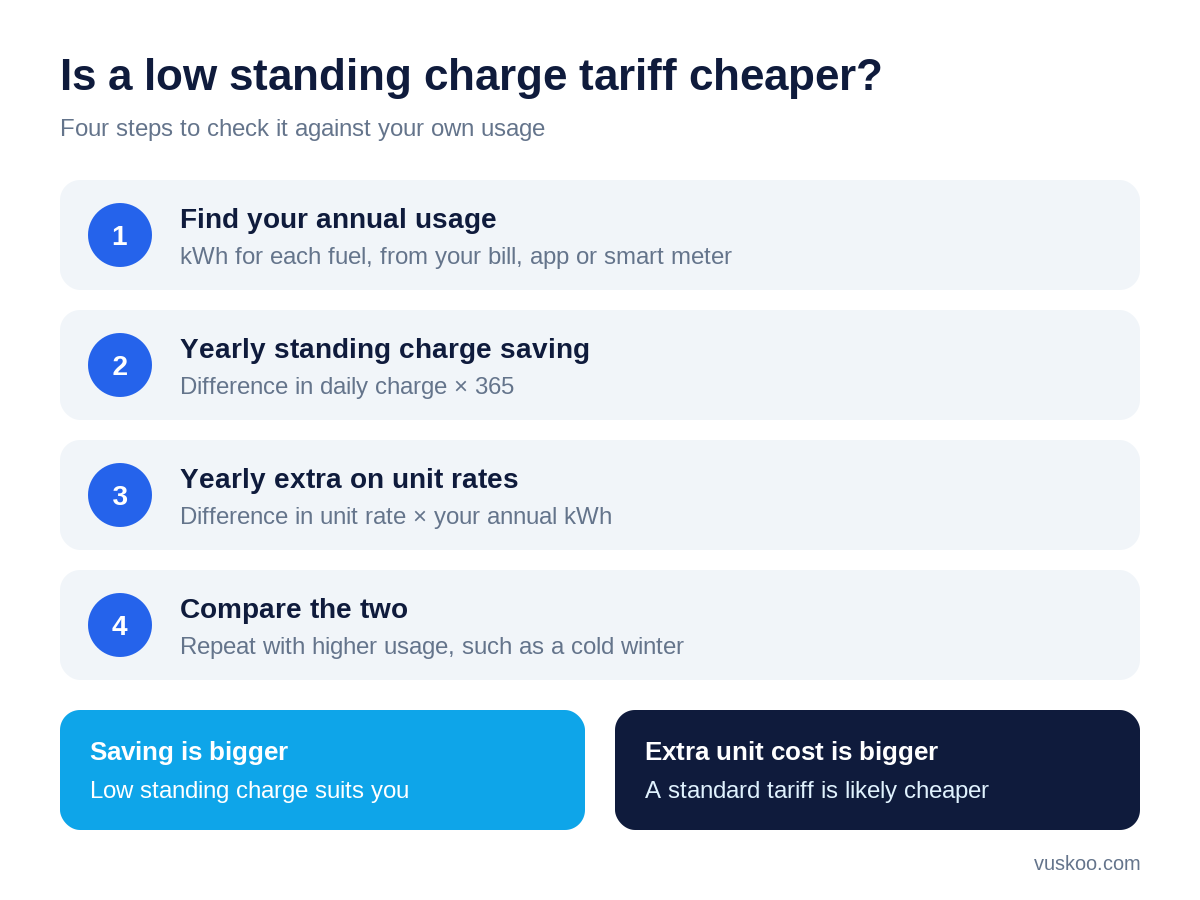
It comes down to one calculation: does the amount you save on standing charges over a year beat the extra you pay on unit rates? To check:
- Find your annual usage in kWh for each fuel on your bill or in your app. A smart meter gives the most accurate figures.
- Work out the yearly saving on standing charges: the difference in the daily charge multiplied by 365.
- Work out the yearly extra on unit rates: the difference in the unit rate multiplied by your annual kWh.
- If the first number is larger, the low standing charge tariff is cheaper for you at your current usage.
- Do the sum again with a higher usage figure, such as a cold winter or someone working from home, to see how much room you have.
The break-even usage is the standing charge saving divided by the extra cost per kWh. If your usage is well below that point, you gain. If it is close to it or above, a standard tariff with a normal standing charge is likely to cost less.
How to compare tariffs before the January 2027 cap
With a new cap level due from 1 January 2027, it is a good time to check what you pay now. When you look at offers such as Flexible Octopus, So Energy Flex, British Gas Standard Variable, EDF Simply Fixed, E.ON Next Fixed 12-Month or OVO Energy 1-Year Fix, look at:
- Standing charge and unit rate together, for your own region, not the national average.
- Fixed or variable: a fixed tariff keeps both rates the same for the term, while a variable one moves with each cap review.
- Exit fees on fixed deals, in case prices fall and you want to switch.
- Time-of-use or tracker designs such as EDF Simply Tracker or E.ON Next Drive Smart, which suit some usage patterns and not others.
- Payment method: check the rates shown match how you plan to pay.
- Total estimated annual cost worked out from your real kWh, which is the fairest single figure to compare.
The live offer boxes on this page show current prices, so you can put these checks into practice.
Frequently asked questions
Do I pay a standing charge if I use no energy?
Yes. On most tariffs the standing charge applies every day you are connected, whether or not you use any energy, including when a property is empty.
Can I refuse to pay the standing charge?
No, not on a tariff that includes one. The only way to lower it is to move to a tariff with a smaller or zero standing charge, where one is available to you.
Is the standing charge the same for gas and electricity?
No. They are set separately, and under the current cap the electricity standing charge is higher than the gas one. If you only have electricity, you pay just the electricity standing charge.
Will standing charges change in January 2027?
They may. Ofgem is due to announce the cap for 1 January to 31 March 2027 on 25 November 2026, and both unit rates and standing charges can move.
Does a smart meter lower my standing charge?
Not directly. It does give you accurate usage data, which you need to work out whether a low standing charge or time-of-use tariff would save you money.
Photo: geralt / Pixabay