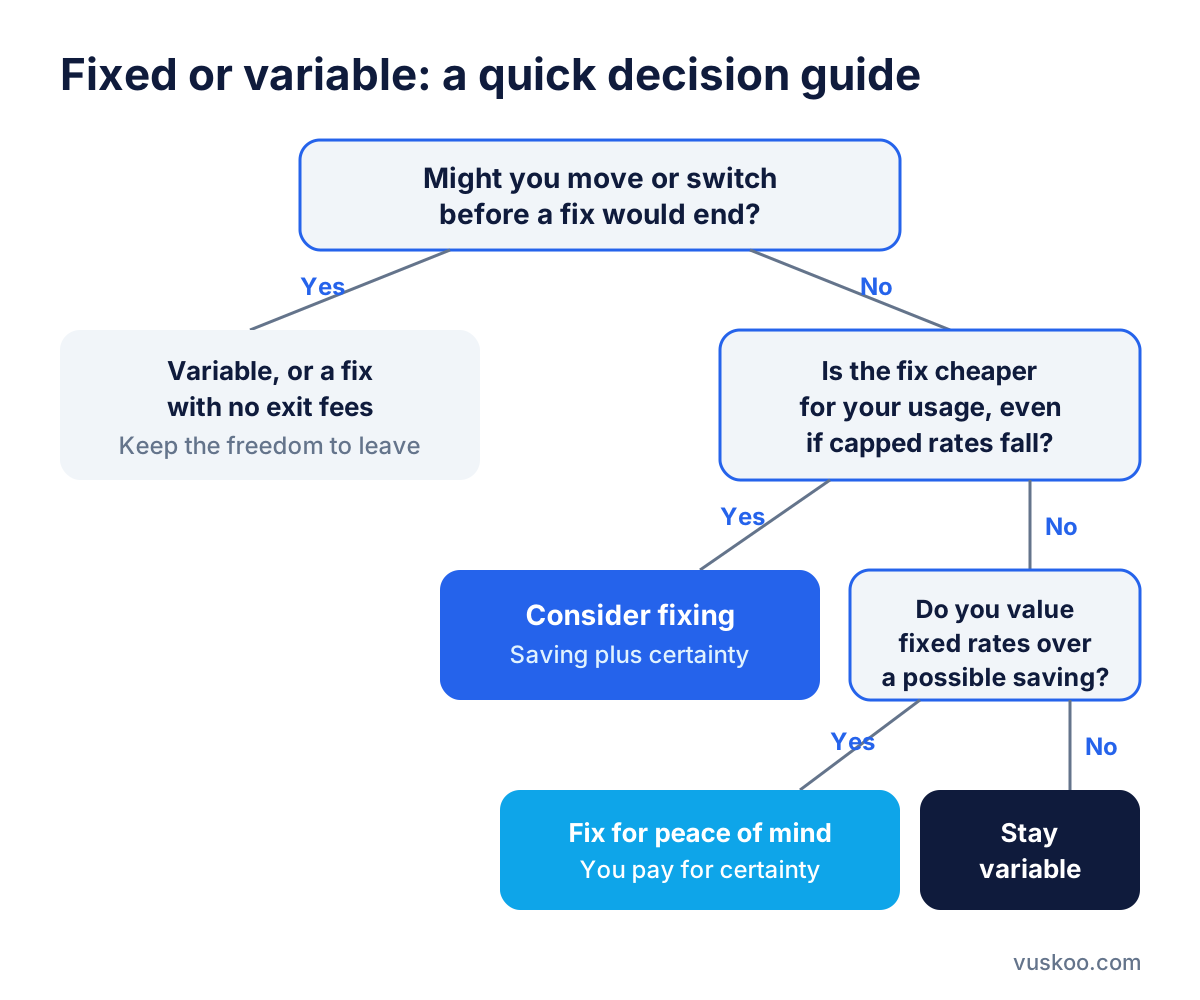
Whether a fixed or variable energy tariff suits you depends on four things: how much gas and electricity you use, the unit rates and standing charges of the fix compared with the capped variable rates, any exit fees, and how much you value knowing your rates in advance. A fix is worth it when its rates, applied to your own annual usage, come out below what you expect to pay on the price cap over the same period, or when the certainty matters more to you than a possible saving. Staying variable makes sense when the fixes available cost more than the cap, or when you want the freedom to switch at any time without penalty.
With Ofgem due to set the cap for January to March 2027 in late November 2026, many households coming off a fix, or sitting on a standard variable tariff, are weighing this up now. This guide explains how the cap works, what a fixed deal actually locks in, and how to run the numbers for your home.
How does the Ofgem price cap work?
The energy price cap is set by Ofgem, the energy regulator for Great Britain. It limits the maximum unit rate (the price per kWh) and the daily standing charge that suppliers can charge on default tariffs, such as a standard variable tariff or a default prepayment tariff. Northern Ireland has a separate market and is not covered by it.
Two points are often misunderstood:
- It is not a cap on your total bill. The more energy you use, the more you pay. The headline annual figure Ofgem publishes is based on typical household consumption, so your own bill can be higher or lower.
- It is a ceiling, not a set price. Suppliers can charge less than the cap on their variable tariffs, though most default tariffs sit at or close to it.
When does the price cap change?
The cap is reviewed every three months, for the periods January to March, April to June, July to September and October to December. Ofgem announces each new level ahead of the start of the quarter. According to Ofgem's published schedule, the cap for 1 January to 31 March 2027 is due to be announced on 25 November 2026. Until then, any figures you see for January are forecasts, not confirmed rates.
If you are on a variable tariff, your rates will move automatically with each cap change. Your supplier must tell you before rates change, but you do not need to do anything.
What does a fixed tariff lock in?
A fixed tariff, such as E.ON Next Fixed 12-Month or OVO Energy 1-Year Fix, holds your rates for an agreed term, commonly 12 or 24 months. Before signing, check exactly what is fixed:
- Unit rates. The price per kWh for electricity and gas stays the same for the term, regardless of cap movements.
- Standing charges. These are usually fixed too, but confirm this in the tariff information label. A fix with a low unit rate and a high standing charge can work out more expensive for low-use homes.
- Exit fees. Many fixes charge a fee per fuel if you leave early. Some have none. Suppliers cannot charge exit fees if you switch in the final 49 days of your contract.
- Payment method. Rates can differ depending on whether you pay by monthly direct debit, on receipt of bill or on prepayment.
What a fix does not lock in is your bill. If you use more energy in a cold winter, you still pay more; you just pay the same rate for each unit.
Fixed or variable energy tariff: how to work out which is cheaper for you
Comparing a fix against the headline cap figure can mislead you, because that figure assumes typical usage. Use your own numbers instead.
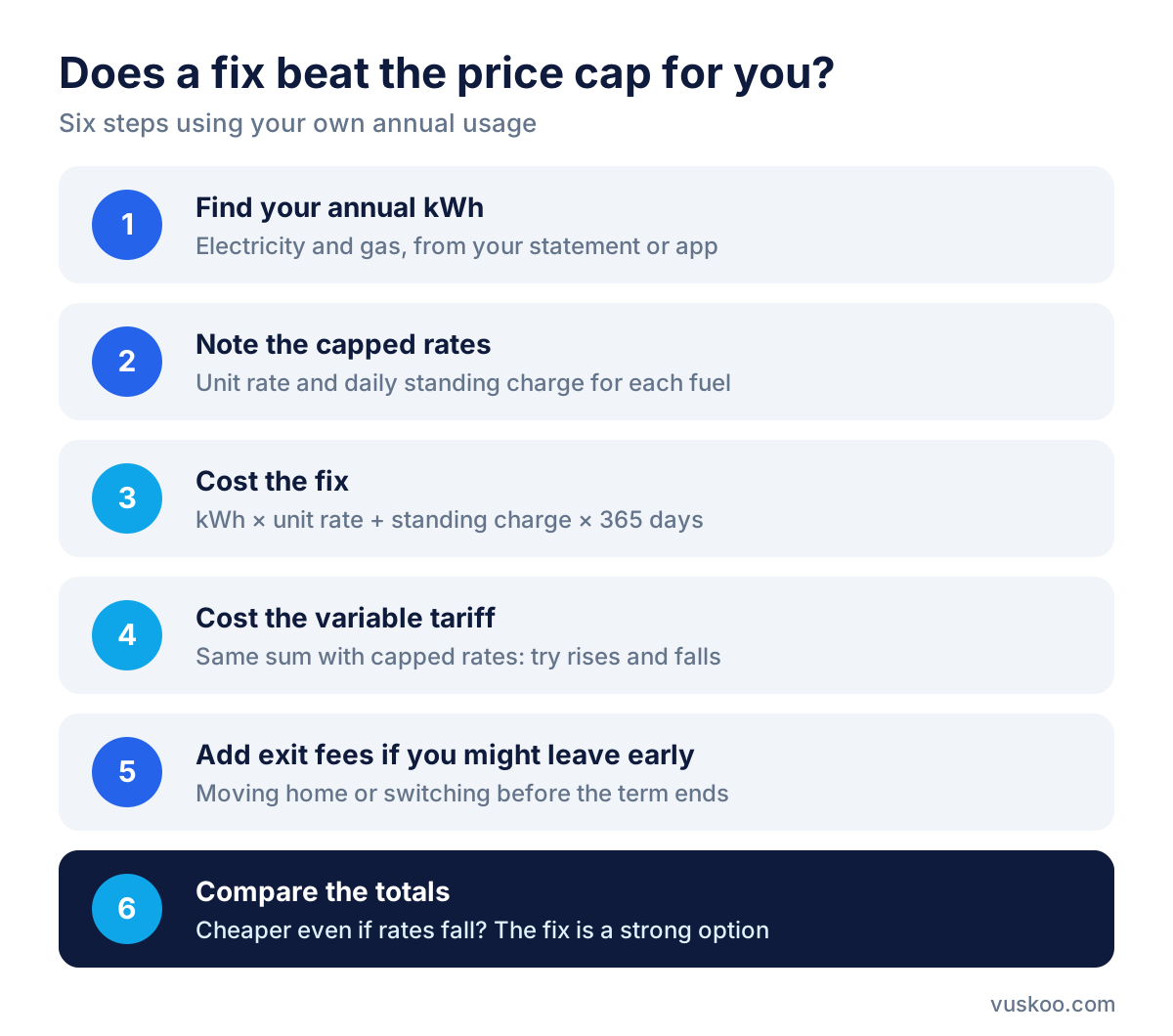
- Find your annual usage in kWh. It appears on your annual statement or in your supplier's app. Look for separate figures for electricity and gas.
- Note the capped rates. Write down the current unit rate and daily standing charge for each fuel on your variable tariff. Once Ofgem confirms the January 2027 cap, use those rates for the months it covers.
- Cost the fix. For each fuel, multiply your annual kWh by the fixed unit rate, then add the daily standing charge multiplied by 365.
- Cost the variable tariff. Do the same sum with the capped rates. Because the cap changes quarterly, you are making an assumption about future quarters, so try a version where rates rise and one where they fall.
- Add exit fees if relevant. If there is a realistic chance you will move home or want to switch before the term ends, include the exit fee in the cost of the fix.
- Compare the totals. If the fix is cheaper even in your "rates fall" scenario, it is a strong option. If it only wins when you assume rises, you are paying for certainty, which may still be worth it to you.
Why your usage profile matters
The balance between unit rates and standing charges affects households differently. A high-use home, for example one with electric heating or an electric car, gains most from a lower unit rate. A low-use flat may find the standing charge makes up a large share of the bill, so a deal with a lower standing charge can matter more than a small difference in unit rate. EV drivers may also want to look at tariffs built around off-peak charging, such as E.ON Next Drive — Fixed, and compare them on the same basis.
When does staying on a variable tariff make sense?
A variable tariff, such as British Gas Standard Variable or Octopus Energy Flexible Tariff, can be the better choice in several situations:
- The fixes on offer cost more than the cap. If every fix you find works out above your capped costs, there is no saving to lock in.
- You may move soon. Variable tariffs generally have no exit fees, so you can leave without penalty.
- You expect prices to fall. Nobody can predict the market reliably, but if forecasts point down, staying variable lets you benefit automatically.
- You want flexibility to switch. On a variable tariff you can move to a fix later, once new deals appear or after the next cap announcement.
Some suppliers also offer variable tariffs priced below the cap, or smart and time-of-use tariffs such as EDF Smart Tariff, where the rate depends on when you use energy. These are worth comparing if you can shift usage to cheaper times.
What to do if your fix is ending
Your supplier should contact you before your fixed term ends with details of what happens next. If you do nothing, you will usually move onto their default variable tariff, which is covered by the price cap. That is not a penalty, but it may not be the lowest option available to you.
Use the final 49 days to compare. You can switch during this window without paying an exit fee, and switching supplier does not usually interrupt your supply. Have your annual kWh, your meter type and your preferred payment method ready, as these affect which tariffs you can get.
Prepayment customers can compare too. Pay-as-you-go tariffs such as Utilita Pay As You Go have their own rates, and default prepayment tariffs are also covered by the cap.
Frequently asked questions
Is a fixed energy tariff always cheaper than the price cap?
No. Some fixes are priced below the capped rates and some above. The only way to know is to cost the fix with your own usage and compare it with the capped rates for the same period.
Will my fixed rates change when the price cap changes in January 2027?
No. Fixed unit rates and, where fixed, standing charges stay the same for the length of the contract. Only variable tariffs follow the cap.
Can I leave a fixed tariff early?
Yes, but you may pay an exit fee per fuel, depending on the tariff. You cannot be charged an exit fee if you switch in the last 49 days of the contract.
Does the price cap limit how much I pay in total?
No. It limits the unit rate and standing charge on default tariffs. Your total bill still depends on how much energy you use.
Should I wait for the January 2027 cap announcement before fixing?
Waiting gives you confirmed figures for January to March to compare against, which makes the sums more reliable. The risk is that fixed deal prices can move in the meantime, so compare what is available both before and after the announcement.
Photo: rgaudet17 / Pixabay