When people weigh up a fixed vs variable energy tariff, the choice is really between certainty and flexibility. A variable (standard) tariff follows the Ofgem price cap, so your unit rate and standing charge can rise or fall when the cap is reviewed each quarter. A fixed tariff locks your rates for a set term, usually a year or more, whatever happens to the cap. That certainty often comes with an exit fee if you leave early. To pick between them, compare what each would cost you for a year at your own usage, then think about how much price risk your household can take.
How the Ofgem price cap sets variable tariffs
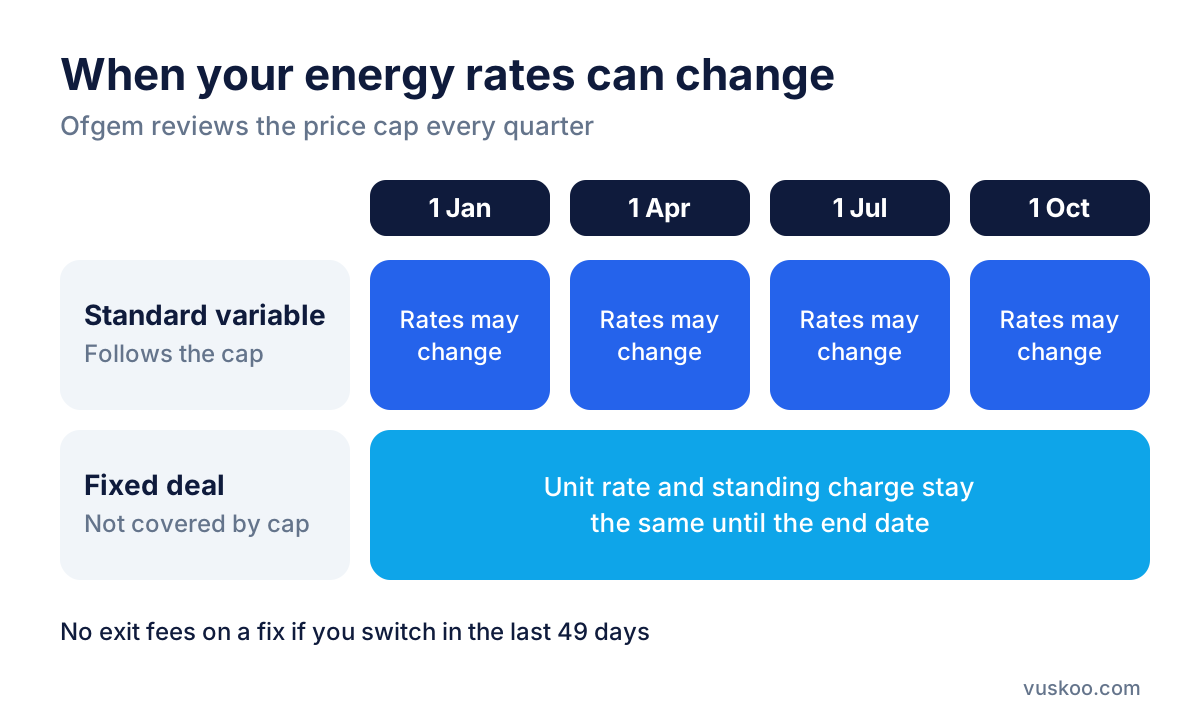
The energy price cap applies to standard variable and default tariffs for households in England, Scotland and Wales. Ofgem reviews it every quarter, with new levels starting on 1 January, 1 April, 1 July and 1 October. The new level is announced a few weeks before it takes effect, so variable customers get some notice before their rates change.
A few things about the cap are easy to get wrong:
- It caps rates, not bills. The cap sets a maximum unit rate (pence per kWh) and a maximum daily standing charge. Your bill still depends on how much energy you use.
- The headline figure is only an example. The annual amount you see in the news is for a typical household. If you use more, you pay more, even under the cap.
- Rates vary. The maximum rates are different depending on your region, how you pay (Direct Debit, prepayment or on receipt of a bill) and your meter type, such as single-rate or Economy 7.
- Suppliers can charge less. The cap is a ceiling, so a variable tariff can be priced below it.
British Gas Standard Variable and Octopus Energy Flexible Tariff are examples of variable tariffs. Their rates move when the cap changes, although a supplier can set rates below the cap.
Why the price cap doesn't apply to fixed deals
A fixed tariff is a contract with its own rates, agreed for a set term. Ofgem's cap does not apply to it, so a quarterly change to the cap has no effect on your fixed unit rate or standing charge while the contract lasts. That works both ways. If the cap rises, your fixed rates stay where they are. If the cap falls, you stay on your agreed rates and won't see the cut unless you switch.
When a fix ends and you haven't chosen a new deal, most suppliers move you onto their standard variable or default tariff. From then on your prices follow the cap again.
How to compare a fix against the price cap
Don't compare a fixed deal with the headline cap figure. Compare it with your own usage, using the rates you would actually pay in your region with your payment method.
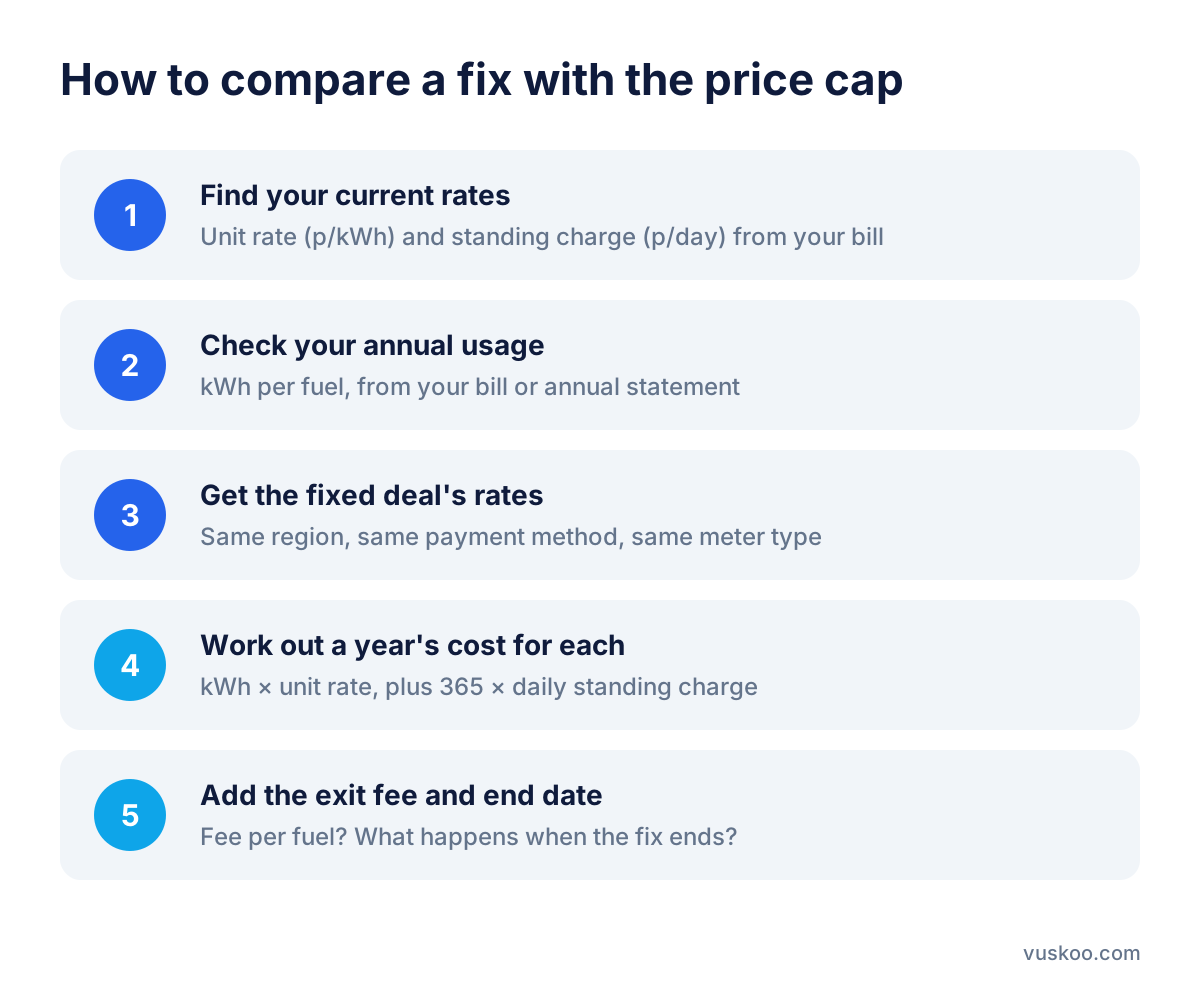
- Find your current rates. Your bill or online account shows your unit rate (p/kWh) and standing charge (p/day) for each fuel.
- Check your annual usage. Use the kWh figure from your annual statement or the estimate on your bill. If you have recently moved home or changed how you heat it, adjust the figure.
- Get the fixed deal's rates. Make sure they are quoted for the same region, payment method and meter type as your current tariff.
- Work out a year's cost for each. For each fuel, multiply your annual kWh by the unit rate, then add 365 times the daily standing charge.
- Factor in the exit fee and the end date. Check whether there is a fee per fuel for leaving early and when the fix finishes.
Keep in mind that the variable figure is only a snapshot. It shows what you would pay if the current cap stayed the same all year. In practice the cap may change up to four times while a 12-month fix runs, so look at the next announced level if there is one.
Unit rate or standing charge: which matters more?
It depends on how much energy you use. In a low-usage home, such as a small flat, the standing charge makes up a bigger part of the bill, so a fix with a slightly higher unit rate but a lower standing charge can work out cheaper. In a high-usage home, for example one with gas central heating, an electric vehicle or a heat pump, the unit rate counts for more. Doing the yearly sum for both tariffs takes care of this, which is why it is more reliable than comparing single rates.
What to check about exit fees
Many fixed deals, such as E.ON Next Fixed 12-Month or OVO Energy 1-Year Fix, may charge an exit fee if you leave before the end date. Before you sign, check:
- whether the fee applies per fuel, so dual fuel could mean two fees
- whether the fee changes as the contract goes on
- the 49-day switching window. Suppliers cannot charge exit fees if you switch in the 49 days before a fixed deal ends. They must also contact you 42 to 49 days before the end date.
Standard variable tariffs do not normally have exit fees, so you can leave whenever you like.
When fixing makes sense
- You value a predictable budget. Monthly costs only change with your usage, not with cap reviews.
- The fix compares well with the cap at your usage. If the yearly cost comes out level with or below the variable figure, you get certainty at little or no extra cost.
- You expect to stay put for the whole term. If you are unlikely to move house or switch early, the exit fee matters less.
- The next cap announcement points upwards. If Ofgem has already announced a higher level, fixing beforehand can lock in rates below it. Check this against the actual numbers, not the headlines.
When staying variable makes sense
- The available fixes cost more than the cap at your usage. Fixes sometimes include a premium for certainty. If the gap is large, prices would have to rise a lot for the fix to pay off.
- You want the option to leave. No exit fees means you can move to a better deal as soon as one appears.
- You may move house soon. A variable tariff avoids the risk of a fee if your plans change.
- You want to benefit if the cap falls. On a variable tariff, a lower cap feeds into your rates at the next review.
Some tariffs are neither a standard fix nor a cap-tracking variable deal. These include smart, time-of-use and EV tariffs such as EDF Smart Tariff or E.ON Next Drive — Fixed, and prepayment options such as Utilita Pay As You Go. Read their terms carefully, as rates can differ by time of day or payment method. The same yearly-cost comparison still applies.
What to do when the price cap changes
Each time Ofgem announces a new cap level, it is worth taking a few minutes to check your position:
- On a variable tariff, look at the new rates for your region and run the comparison against the fixes available.
- On a fixed tariff, note your end date. If it falls within the next couple of months, start comparing so you can switch inside the 49-day window rather than being moved onto a default tariff.
- Read your meter, or make sure your smart meter is sending readings, around the date of the change so that old and new rates are billed correctly.
FAQ
Is a fixed or variable energy tariff cheaper?
Neither is always cheaper. A fix is cheaper over its term if the variable rates under the cap end up higher than your fixed rates on average, and the reverse is also true. Nobody knows in advance how the cap will move, so compare the yearly cost at your usage and decide how much certainty is worth to you.
Does the price cap protect me on a fixed tariff?
No. The cap applies only to standard variable and default tariffs. Your fixed rates are set by your contract, and they don't change when the cap does.
What happens when my fixed deal ends?
If you don't choose a new tariff, you will usually be moved onto your supplier's standard variable or default tariff, which follows the price cap. You can switch without an exit fee during the 49 days before the fix ends.
Can I switch from a variable tariff at any time?
Standard variable tariffs do not normally have exit fees, so you can switch whenever you find a deal that suits you. Check your supplier's terms to be sure.
Photo: jillrose999 / Pixabay