
In this article
- How much life insurance do I need? The basic formula
- Step 1: Your mortgage and other debts
- Step 2: The income your family would lose
- Step 3: Childcare, education and other future costs
- Step 4: Funeral costs
- Step 5: Subtract savings and existing cover
- Level term, decreasing term or joint: which fits?
- What to check before you buy
- Frequently asked questions
The amount of life insurance you need is roughly what your household would have to pay off or replace if you died, minus the money that would already be there. In practice that means adding up your outstanding mortgage and debts, the income your family would lose for as long as they rely on it, extra childcare costs and funeral costs. You then take away your savings, any existing life cover and any death-in-service benefit from your employer. What's left is a sensible starting figure for your quotes.
This guide walks through that calculation one step at a time. It then explains when level term, decreasing term or a joint policy tends to fit, and what to check before you buy.
How much life insurance do I need? The basic formula
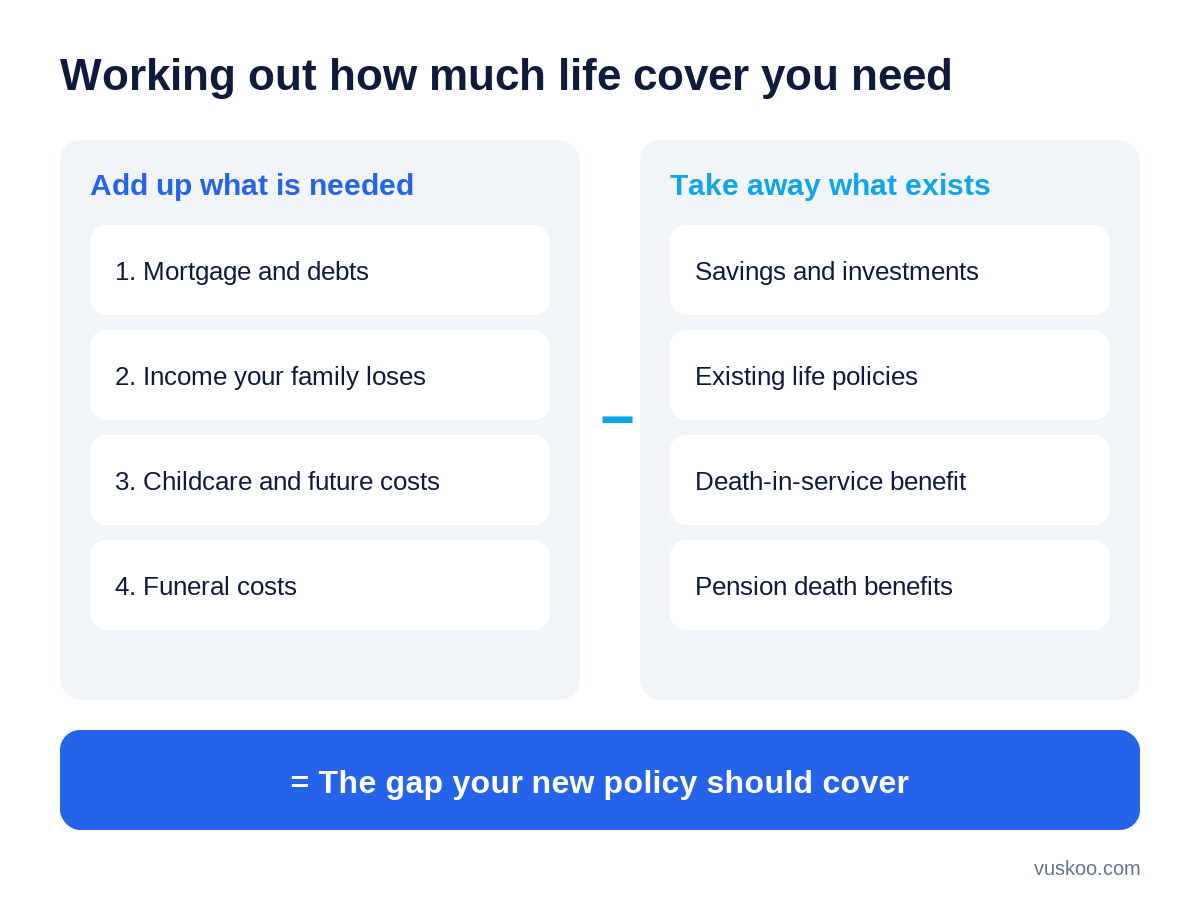
Rules of thumb such as "ten times your salary" are easy to remember, but they ignore your mortgage, how old your children are and the savings you already have. A needs-based calculation takes a little longer but gives a more accurate figure:
- What your family would need: mortgage and debts, plus replacement income, plus childcare and other costs, plus funeral costs.
- Minus what they would already have: savings and investments, existing life policies and death-in-service benefit.
- Equals: the gap a new policy should cover.
Step 1: Your mortgage and other debts
For most homeowners the mortgage is the largest single figure. Check your latest mortgage statement for the outstanding balance and the remaining term, not the amount you originally borrowed. Then add any other debts that would need clearing or would be hard for your partner to keep paying:
- personal loans and car finance
- credit card balances
- any loans secured against your home
Some debts, such as certain student loans, are written off on death, so you don't usually need to include them. Check the terms of each agreement if you're unsure.
Step 2: The income your family would lose
This is where income multiples come in, but it helps to be specific. Ask yourself how much of your take-home pay your household relies on each year, and for how many years. For parents, a common approach is to cover the years until your youngest child finishes education or becomes financially independent.
A simple way to estimate it:
- Work out the annual shortfall your partner or dependants would face without your income, after their own earnings.
- Multiply it by the number of years they would need support.
- Bear in mind that rising prices will reduce the value of a fixed sum over a long period.
As an illustration only: if your household would be short of £20,000 a year for 15 years, the income part of your cover would be around £300,000. Your own figures will differ, so use your real budget.
What about stay-at-home parents?
A parent who doesn't earn a salary still provides childcare, school runs and running the household. If they died, the surviving parent might have to pay for nursery, after-school care or reduce their working hours. Cover for a non-earning partner is worth including in your calculation, even though there is no salary to multiply.
Step 3: Childcare, education and other future costs
On top of lost income, think about costs that would rise or appear if you weren't there:
- extra childcare so the surviving parent can keep working
- school or university costs you had planned to help with
- a buffer for emergencies, such as a boiler or car replacement
You don't need to cover every possible expense. The aim is to give your family time and breathing space rather than a perfect forecast.
Step 4: Funeral costs
Funeral costs are often overlooked. According to SunLife's Cost of Dying Report 2026, which looked at costs in 2025, the average traditional attended funeral cost £4,510, and costs in London were higher than the UK average. Adding a sum for the funeral and for winding up your affairs means your family doesn't have to find that money at a difficult time.
Step 5: Subtract savings and existing cover
Now take away what your family would already receive or could draw on:
- Savings and investments that your partner could access, such as cash ISAs or shares. Be cautious about counting money set aside for retirement.
- Existing life insurance, including any policy you took out with your mortgage.
- Death-in-service benefit. Many employers pay a lump sum, often set as a multiple of salary, if you die while employed. Check your staff handbook or pension scheme documents for the exact amount.
- Pension death benefits payable to your partner or children.
Treat death-in-service with care. It usually stops when you leave the job, so if you change employers, become self-employed or take a career break, that part of your protection goes. Many people treat it as a bonus rather than relying on it fully.
Level term, decreasing term or joint: which fits?
Once you know the amount, the next decision is the type of policy. Term life insurance pays out if you die within a set period, such as 25 years. The main choices are:
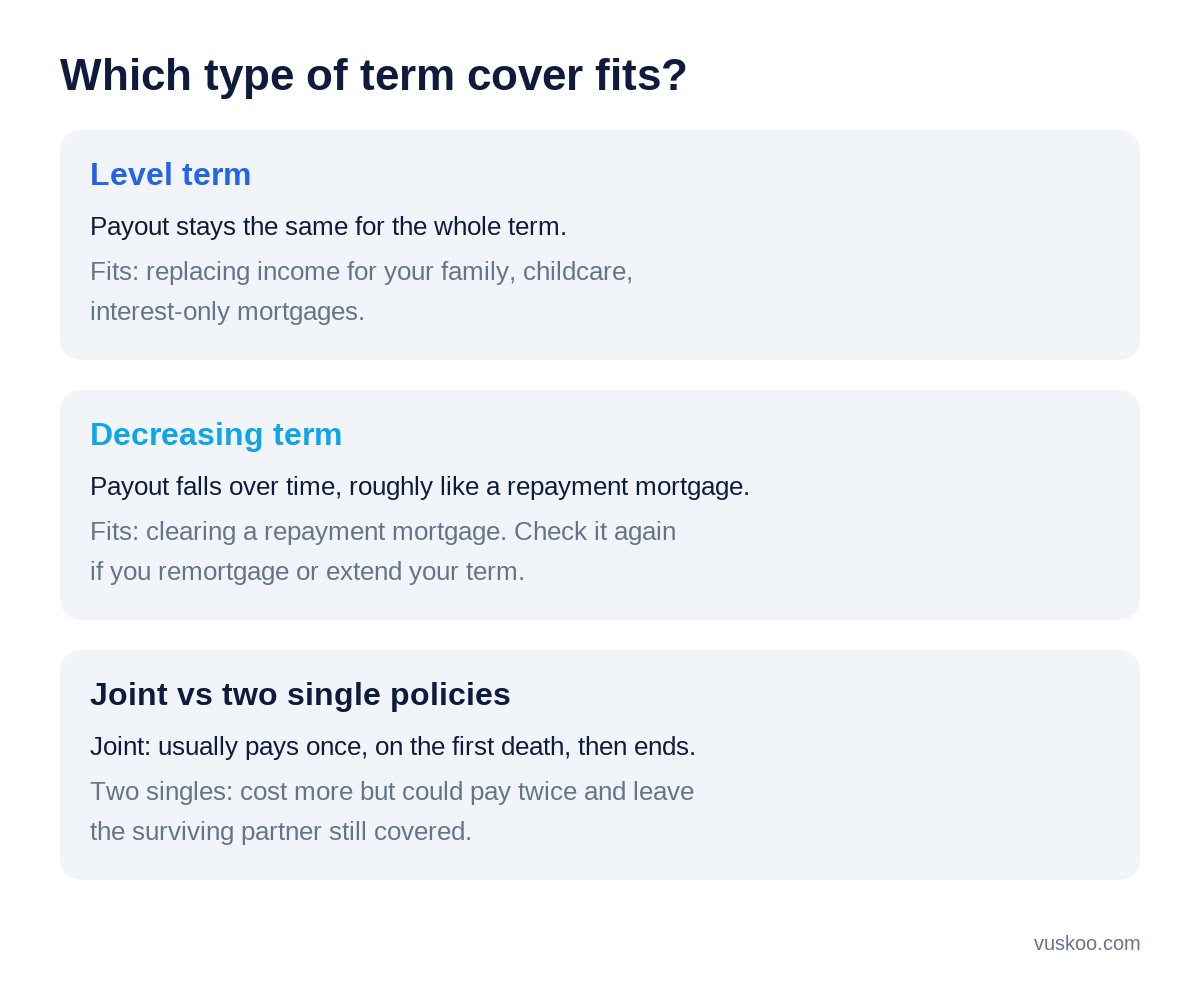
Level term
The payout stays the same throughout the policy. It suits family protection, where the aim is to replace income and cover living costs for a set number of years, and interest-only mortgages, where the balance doesn't fall. Some policies offer increasing cover linked to inflation, which helps keep the payout's real value over time but usually affects the premium.
Decreasing term
The payout falls over the term, roughly in line with a repayment mortgage. It is designed to clear the mortgage balance and is usually cheaper than level cover for the same starting amount. Make sure the rate of decrease assumed in the policy matches your mortgage, and check again if you remortgage, extend the term or borrow more.
Joint or two single policies
A joint policy covers two people and normally pays out once, on the first death, after which the cover ends. Two single policies cost more but could pay out twice and leave the surviving partner still insured. Single policies can also be easier to split if a relationship ends.
Many households combine policies: decreasing term to clear the mortgage, plus level term for income and childcare.
What to check before you buy
- The term: match it to your mortgage end date or the age your youngest child becomes independent.
- Whether the premium is guaranteed or can be reviewed during the policy.
- Disclosure: answer health, lifestyle and occupation questions fully. Incomplete answers can lead to a claim being reduced or refused.
- Writing the policy in trust: this can mean the payout goes directly to your beneficiaries without waiting for probate and may keep it out of your estate for inheritance tax. Trusts are hard to undo, so read the provider's guidance first.
- Optional extras such as critical illness cover or terminal illness benefit, and what they add to the cost.
- Like-for-like quotes: compare policies with the same cover amount, term and cover type. Providers such as Legal & General offer term life cover, and the offer boxes on this page show current quotes.
Frequently asked questions
Is ten times my salary enough life insurance?
It can be a rough guide, but it doesn't account for your mortgage balance, number of children, existing savings or death-in-service cover. Working through the steps above gives a figure based on your own circumstances.
Should my life cover match my mortgage?
At minimum, many homeowners want enough to clear the mortgage. If you have children or a partner who relies on your income, you will usually need more than the mortgage alone.
Can I rely on death-in-service from work?
It can reduce how much personal cover you need, but it is tied to your job and usually ends when you leave. Personal cover stays in place regardless of your employer.
How often should I review my cover?
Review it after major life events: buying a home, remortgaging, having a child, a pay rise or a change of job. Your needs change over time, and so might the right amount of cover.
Photo: jessebridgewater / Pixabay