In this article
How you cancel a broadband contract depends on two things: whether your minimum contract period has ended, and whether you're moving to another provider or giving up home broadband altogether. If you're switching, you usually only need to contact your new provider. Under One Touch Switch, the new provider arranges for your old service to end, and you shouldn't be charged for it after the switch date. If you're cancelling without switching, you contact your current provider and give notice. Either way, leaving before the minimum term ends can mean an early termination charge, unless you have a right to leave without one.
Step one: check whether you're still in contract
Before you do anything else, find your contract end date. You'll usually find it in your online account or app, on your bills or in your original order confirmation. Ofcom requires providers to send you an end-of-contract notification between 10 and 40 days before your minimum term ends. The notification tells you when the contract finishes and what the provider's best deals are for you.
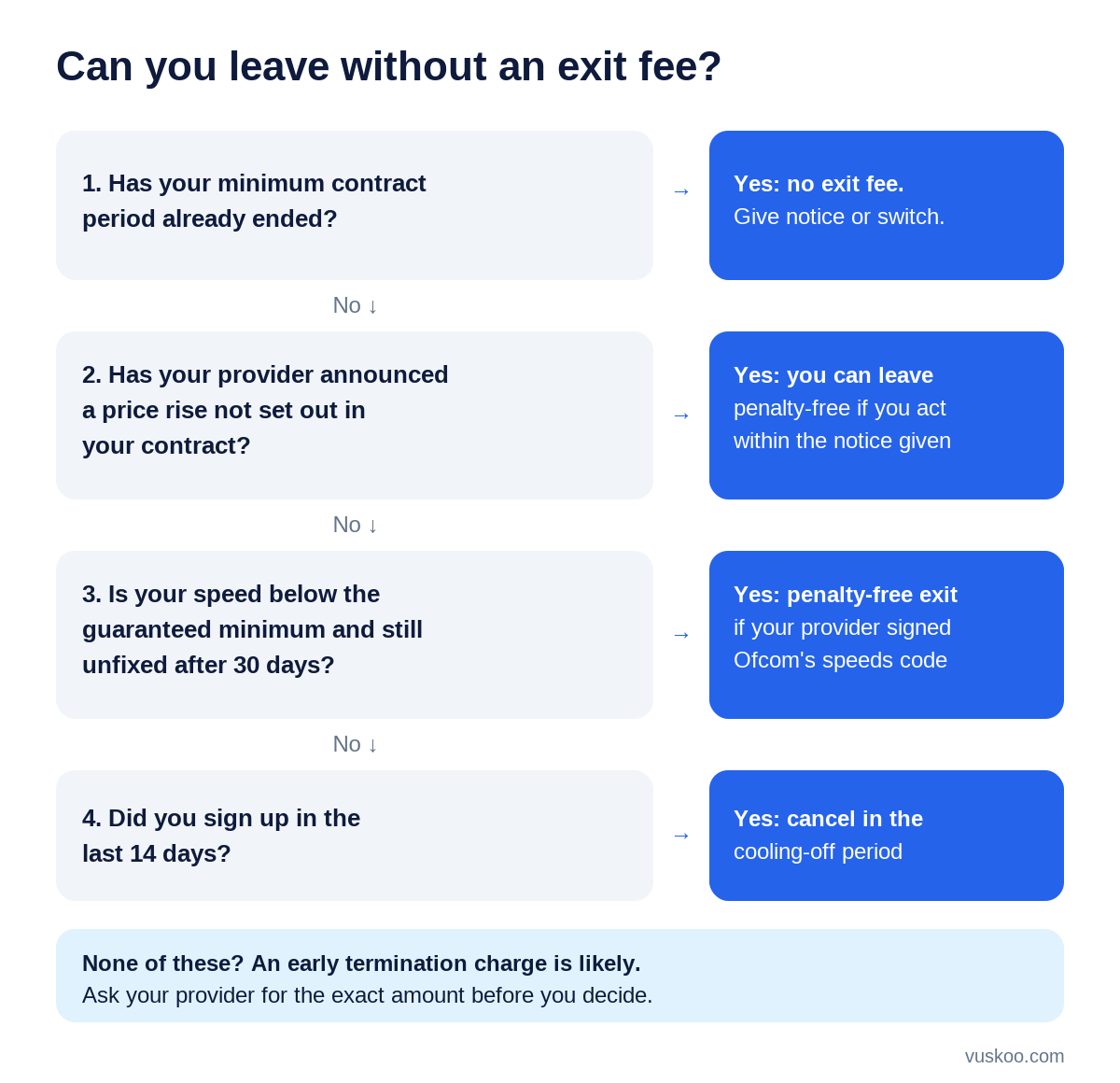
Once the minimum term has ended, you're out of contract. You can then leave without an early termination charge, but you still need to give notice or arrange a switch. Out-of-contract customers often pay more each month than they did during the minimum term, so it's worth knowing your date even if you don't plan to leave straight away.
How to cancel a broadband contract when you're switching provider
Most home broadband switches in the UK now go through One Touch Switch. It covers switches between broadband and landline services, regardless of which network the providers use, so moving between providers such as BT, EE, Plusnet, Sky and Virgin Media follows the same basic process.
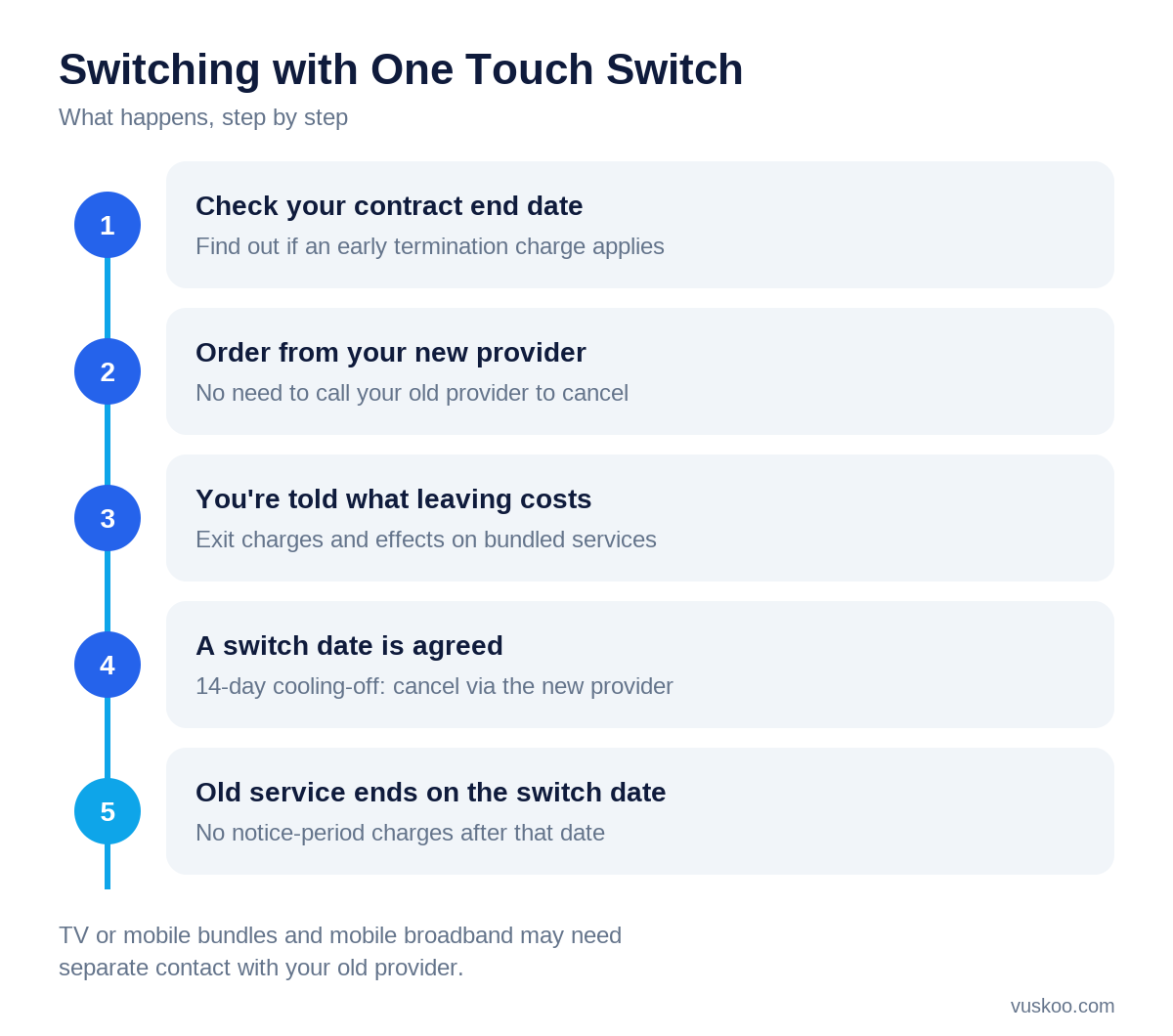
- Choose your new deal and order it from the new provider.
- The new provider contacts your current one. You don't need to call your old provider to cancel.
- You're told what leaving will cost. Before the switch goes ahead, you should be given information about any early termination charges and about how other services from your old provider could be affected.
- A switch date is agreed. Your old service ends on that date and the new one starts.
- You don't pay notice-period charges after the switch date. This is how One Touch Switch helps you avoid paying twice.
You have a 14-day cooling-off period on the new contract. If you change your mind, contact the new provider to cancel the switch.
When you may still need to contact your old provider
One Touch Switch doesn't handle everything automatically. You may need to deal with your old provider directly if:
- you have other services bundled with your broadband, such as a TV package or a mobile plan, that you also want to end or keep;
- you're moving to or from a mobile broadband service;
- you choose to arrange the switch yourself, for example so that the two services overlap for a while. In that case the One Touch Switch protections don't apply, and you may pay for both services during the notice period.
You should also check what happens to any email address provided by your old provider, and whether you need to return the router or TV box.
How to cancel if you're not switching
If you're giving up home broadband, moving abroad or moving in with someone who already has a connection, there's no new provider to arrange things for you. In that case:
- Contact your current provider by phone, live chat or through your account, and say you want to cancel.
- Ask for the date the service will end and confirmation of any final charges.
- Expect to pay for the notice period. Many providers ask for around 30 days' notice, but this varies, so check your terms.
- Return any equipment you're asked to send back, and keep proof of postage.
- Check your final bill and cancel the Direct Debit only after it has been settled.
How early termination charges work
If you leave during your minimum term without a right to exit, your provider can charge an early termination charge. These charges are usually based on the monthly payments left on your contract, sometimes with a reduction because the provider no longer has to supply the service. In general, the closer you are to the end date, the smaller the charge.
Before you commit to leaving, ask your provider for the exact amount. When you switch through One Touch Switch, your provider must tell you about any charges before the switch goes ahead. Things that affect the amount include:
- how many months are left on the contract;
- whether the monthly price includes a discount that ends partway through;
- whether you also have TV, phone or mobile services on the same contract;
- any equipment you're required to return, and what happens if you don't.
Compare the charge with what you would save on a new deal over the same period. Sometimes it makes more sense to wait a few weeks until the contract ends.
When you can leave without paying a fee
There are several situations where you can usually leave during your minimum term without an early termination charge.
Mid-contract price rises
Since January 2025, Ofcom has required providers to set out any price rise written into a new contract in pounds and pence at the point of sale. Price rises linked to inflation are banned in new contracts. If a rise is clearly set out in your contract, you generally can't use it as a reason to leave without a fee, because you agreed to it when you signed up.
It's different if your provider raises prices in a way that wasn't set out in your contract. In that case they must give you 30 days' notice and let you leave without a penalty. If you get one of these notices and want to leave, act within the time it gives you.
Speeds below the guaranteed minimum
Many providers have signed up to Ofcom's voluntary broadband speeds codes of practice. Under the codes, you should be given a personalised minimum guaranteed speed when you sign up. If your speed falls below that figure, report it. If the provider can't fix the problem within 30 days, you can leave without a penalty. Keep a record of speed tests run over a wired connection, and of every contact you have with the provider.
The 14-day cooling-off period
If you signed up recently, you can usually cancel within 14 days. You may still have to pay for any service you used during that time.
Moving home
There's no general legal right to cancel without a fee because you're moving house. Most providers will try to move your service to the new address. If they can't provide broadband there, their terms may let you leave without a charge, but policies vary, so check with your provider before you move. If they can provide the service and you would rather take a different deal, an early termination charge may apply.
A checklist to avoid paying twice
- Find your contract end date and the notice period in your terms.
- Ask for the exact early termination charge before you decide.
- Switch through your new provider so that One Touch Switch ends the old service on the switch date.
- Cancel bundled services (TV, mobile) separately if they aren't covered by the switch.
- Return equipment within the time given to avoid non-return charges.
- Check your final bill before you cancel the Direct Debit.
When you compare new deals, look at more than the opening monthly price: check the length of the minimum term, any price rises in pounds and pence written into the contract, the price after any introductory period and set-up costs. The offer boxes on this page show current prices.
FAQ
Do I need to call my old provider to cancel broadband when I switch?
Usually not. Under One Touch Switch, your new provider arranges for the old service to end. You may still need to contact your old provider about bundled services such as TV, or if you're switching to or from mobile broadband.
How much notice do I need to give to cancel broadband?
It depends on your provider's terms, and around 30 days is common. If you switch through One Touch Switch, you shouldn't be charged for notice beyond the switch date.
Can I cancel my broadband contract early without paying?
Yes, in some situations: within the 14-day cooling-off period, after a price rise that wasn't set out in your contract, or if your provider has signed the speeds code and can't fix speeds below your guaranteed minimum within 30 days.
What happens if I don't return my router?
Some providers charge if you don't return equipment they ask for back. Check the return instructions you're sent when you leave, and keep proof of postage.
Photo: Martinelle / Pixabay