
The best broadband price is the lowest total you'll pay over the time you plan to keep the deal, not the smallest monthly figure in an advert. To find it, multiply each monthly price by the number of months it applies, add any set-up or router fees, add the mid-contract price rises written into the contract, and then check what you'll pay once the minimum term is over. This guide explains how rolling monthly and 18–24 month contracts, short introductory offers and price locks each change that total, and includes a worked example.
What does "best broadband price" really mean?
A headline price only tells you what you pay in the first month. Over a 24-month contract, three things can change it:
- Introductory pricing: a lower rate for the first few months, followed by a higher one.
- Mid-contract rises: fixed increases, usually once a year, that are written into the contract.
- Upfront and one-off costs: set-up, activation or router delivery fees.
Two deals with the same headline price can end up hundreds of pounds apart, so always compare the total.
How do the headline prices compare over 24 months?
Here's a simple first step: multiply the advertised monthly price by 24. The chart below does this for broadband offers listed on Vuskoo. It doesn't include price rises, fees or intro discounts, and the contract length differs from offer to offer, so treat it as a starting point and check the terms of each deal.
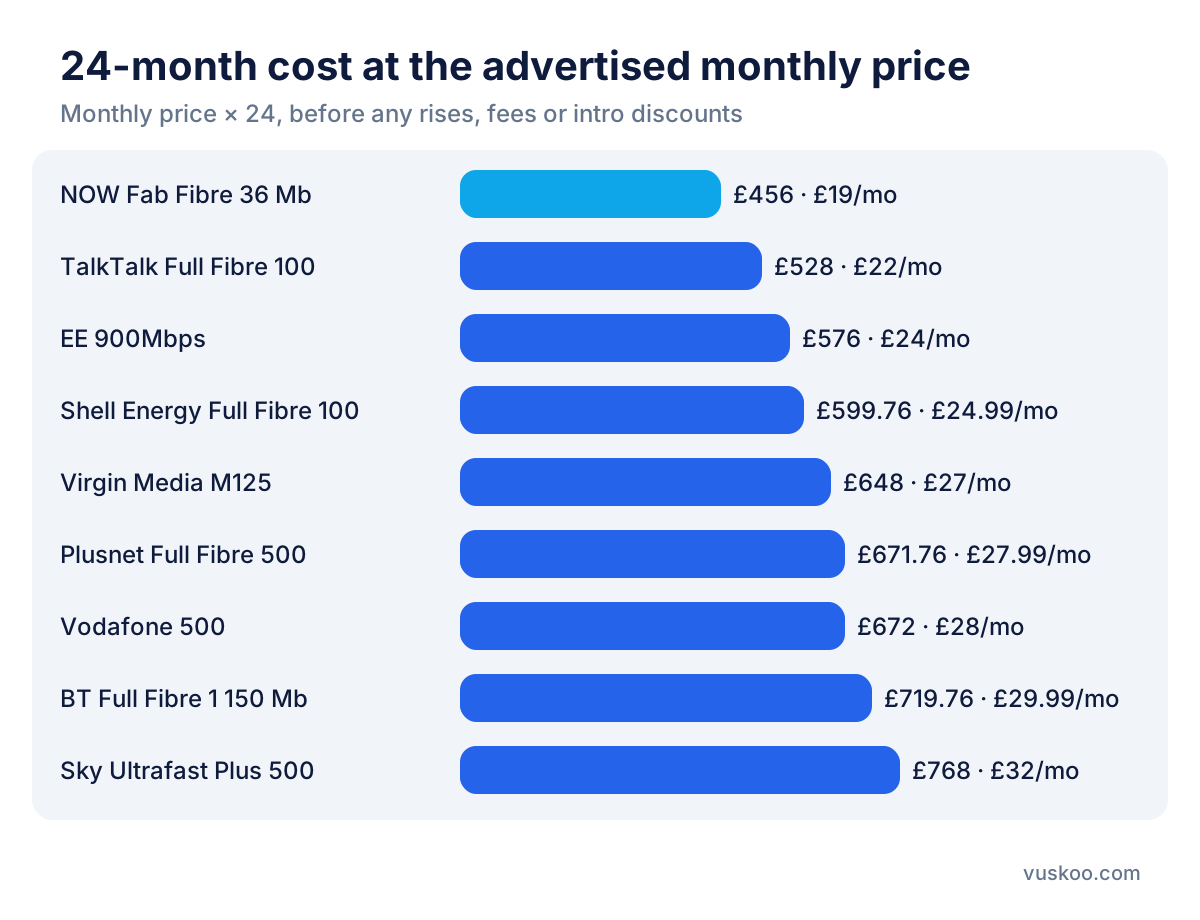
At these monthly prices, NOW Fab Fibre (36 Mb) at £19 a month comes to £456, while Sky Ultrafast Plus (500 Mb) at £32 a month comes to £768. Speeds differ a lot across this range, though. TalkTalk Full Fibre 100 (£22), EE 900Mbps (£24), Plusnet Full Fibre 500 (£27.99), Vodafone 500 (£28) and EE Full Fibre 900 (£39) all sit at different points on the price and speed scale. Settle on the speed you need first, then compare totals within that group.
Rolling monthly vs 18–24 month contracts
Rolling monthly
A rolling contract runs one month at a time, and you can usually leave with a month's notice. It suits renters, people who expect to move, and anyone who wants to try a provider before committing. The trade-off is that the monthly price, or any set-up fee, tends to be higher than on a fixed term with the same provider.
18 or 24-month contracts
A fixed term commits you to a minimum period. Leaving early usually means paying an early termination charge, often close to the monthly fees left on the contract. In return, providers tend to offer lower monthly prices, free set-up or intro discounts.
How to choose between them
- Decide how long you expect to stay at your address and with the provider.
- Work out the total for that period on both the rolling and the fixed option.
- If you might leave early, add the exit fee to the fixed-term total.
- Pick the lower figure, and treat flexibility as worth a little extra if your plans are uncertain.
How do short intro offers change the total?
Some deals charge a low rate for the first few months, often six, and then move to a higher standard rate for the rest of the minimum term. To compare fairly, use this formula:
Total = (intro price × intro months) + (standard price × remaining months) + any fees
Divide the total by the number of months in the contract and you get an average monthly cost. You can then compare that average directly with deals that have no intro offer. A low first six months can easily be outweighed by a higher price for the other 18.
Price locks vs pounds-and-pence rises
Since 17 January 2025, Ofcom has banned new phone, broadband and pay TV contracts from including mid-contract rises linked to inflation or set as a percentage. Providers can still raise prices during a contract, but they have to tell you up front, in pounds and pence, how much the price will go up and when. Contracts signed before that date may still contain the older inflation-linked terms.
That means a contract taken out now should tell you exactly how much it will rise and when, so you can include the rise in your total before you sign. Look for this in the contract summary.
A price lock is a provider's promise not to raise the price for a set period, such as the whole minimum term or a calendar year. Check exactly what's covered: the whole contract, one year, or only the broadband part of a bundle.
Worked example: a 24-month contract with April rises
Many contracts set their rise for April. Say you start a 24-month contract in November and the contract states a fixed increase each April. Your months fall like this:
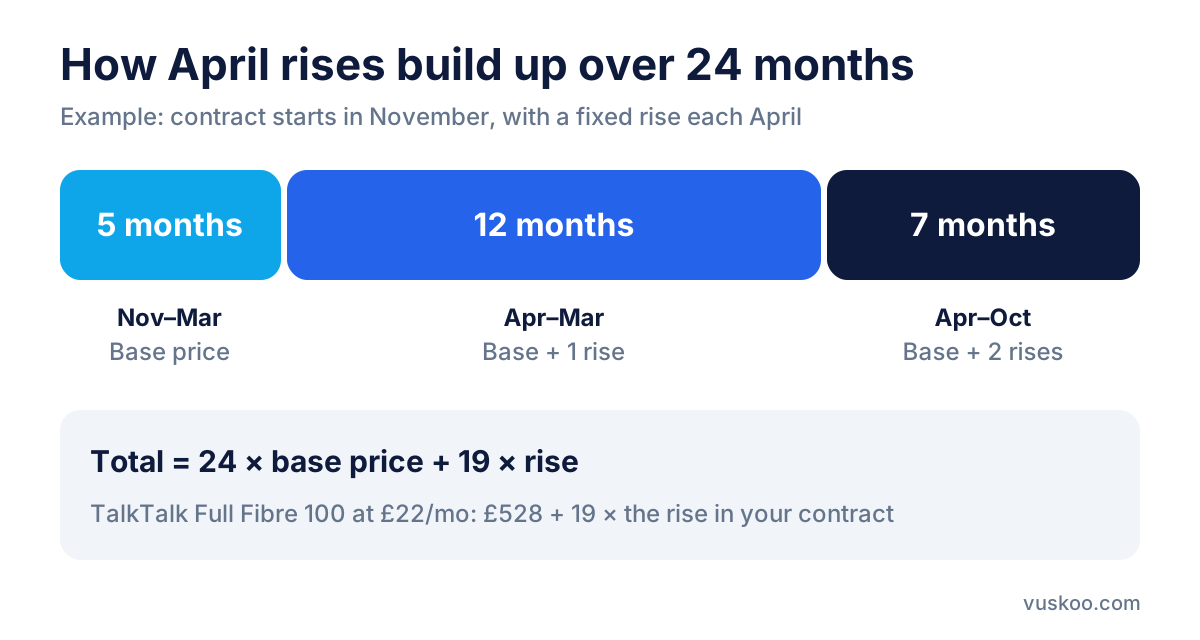
- Months 1–5 (November to March): the advertised price.
- Months 6–17 (April to the following March): the advertised price plus one rise.
- Months 18–24 (April to October): the advertised price plus two rises.
Over the contract, that works out at 24 × the advertised price + 19 × the rise. For TalkTalk Full Fibre 100 at £22 a month, the base comes to £528. Add 19 times whatever rise the contract sets out. Start in a different month and the number of months at each price changes, so redo the count for your own start date.
Applying the same method to a mobile-network broadband plan
Mobile networks are now selling home broadband too. giffgaff, which is best known for SIM-only plans (its 40 GB SIM-only plan is £10 a month on our list), launched full fibre broadband in September 2025. It sells rolling monthly plans and, since March 2026, a 24-month option. It has also said its rolling broadband plans won't see a price rise in 2026. To compare a plan like this:
- Total the rolling plan for the months you expect to stay, using its locked price for any period the lock covers.
- Total the 24-month plan using the formula for intro and standard prices, plus any rises set out in the contract.
- Remember that once a price lock ends, the provider can change the price on a rolling plan. Allow for that if you plan to stay longer.
- Compare both totals with fixed-term deals at a similar speed from other providers.
If you're also looking at your mobile, add the two bills together for the whole household. For example, a £10 giffgaff SIM plus NOW Fab Fibre at £19 comes to £29 a month, or £696 over 24 months before any rises.
What happens when the deal ends?
Under Ofcom rules, your provider must send an end-of-contract notice between 10 and 40 days before your minimum term ends. It must show your end date, the price you'll pay after that, and the provider's best available deals. Customers who stay out of contract must get best-tariff information at least once a year.
Out-of-contract prices are often higher than in-contract ones. Use the notice as a reminder to compare, ask your provider for a new deal, or switch.
Checklist before you sign
- Is the speed right for your household?
- How long is the minimum term, and what is the exit fee?
- Is there an intro price, and how many months does it last?
- How much is the mid-contract rise in pounds and pence, and when does it apply?
- Is there a price lock, and how long does it last?
- Are there set-up, activation or router fees?
- What is the total over the contract, and the average per month?
FAQ
Is a rolling monthly broadband deal more expensive?
Per month, often yes, because providers charge for the flexibility. Over a short stay it can still cost less in total than paying to leave a fixed contract early.
Can my broadband price go up during a contract?
Yes, if the contract allows it. For contracts signed from 17 January 2025, any rise must be set out in pounds and pence when you sign, not linked to inflation or set as a percentage.
How do I compare deals with different intro offers?
Work out the total over the full minimum term, including fees, then divide by the number of months. Compare the averages rather than the first-month prices.
Will my provider tell me when my contract ends?
Yes. Providers must send an end-of-contract notice 10 to 40 days before the end date, including the price you'll pay afterwards and their best available deals.
Photo: ClickerHappy / Pixabay