
In this article
If you want to reduce car insurance at renewal, start comparing quotes about three weeks before your policy ends instead of in the last few days. Then check that your details are still accurate and look at the few things that genuinely change the price: your voluntary excess, your estimated mileage, who is named on the policy, whether a telematics policy suits you, and whether you pay monthly or annually. The FCA's price-walking ban means your insurer can't charge you more for renewing than a new customer would pay. It doesn't mean your renewal quote is the lowest price you could find elsewhere.
Why your renewal price is worth questioning
Your renewal notice is a starting point, not the final word. Insurers reprice each policy every year, using claims costs, repair prices and their own view of your risk. Even if nothing about you or your car has changed, the quote can still go up or down. Other insurers price risk differently, so the same driver can get quite different quotes on the same day.
Your renewal notice should show the premium you paid last year next to the new quote, so the change is easy to see. Use that comparison as your prompt to shop around, even when the increase looks small.
When should you start getting quotes?
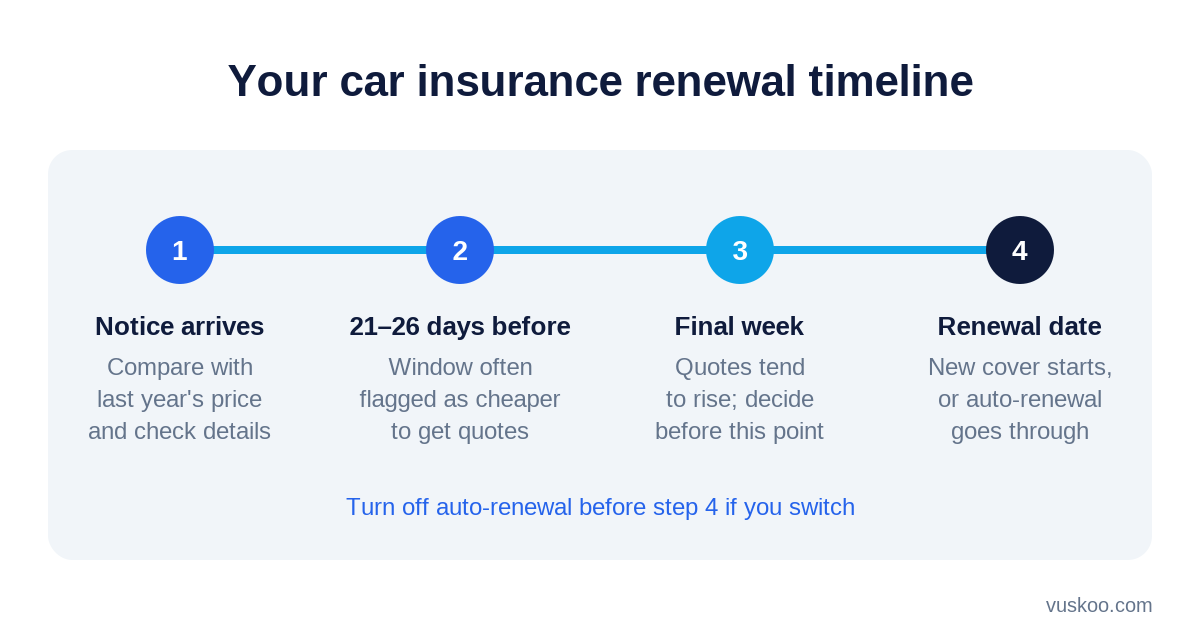
Timing matters more than many drivers expect. Analysis of large numbers of quotes by consumer finance sites has repeatedly found that prices tend to be lower roughly three to four weeks before the start date. The cheapest window often falls about 21 to 26 days ahead. In the final week before renewal, quotes tend to rise. Insurers' pricing can treat last-minute buyers as higher risk.
In practice, that means:
- Note your renewal date as soon as the letter arrives.
- Get comparison quotes around three weeks before that date.
- Buy the new policy so it starts the day the old one ends. You can usually buy in advance and choose a future start date.
- Avoid leaving it to the last few days, when quotes tend to be higher.
What the price-walking ban means for you
Since 1 January 2022, FCA rules for home and motor insurance have said that a firm must not offer a renewing customer a price higher than the "equivalent new business price". That is what the same firm would charge a new customer with the same risk, buying through the same channel. Before this, many insurers kept loyal customers on gradually rising prices while offering lower introductory deals to new customers. This practice became known as price walking.
There are three points to keep in mind:
- It compares you with the same insurer's new customers only. It doesn't stop another insurer quoting you less.
- It's tied to the sales channel. If you first bought directly, your renewal price is compared with that firm's direct price. A quote through a comparison site or broker may be priced differently.
- It doesn't freeze prices. If costs across the market go up, both new and renewing customers can pay more.
Because of this, comparing quotes is still the main way to check whether your renewal offer is competitive. Insurers such as Direct Line, Admiral, Churchill, LV=, Hastings Direct and, for drivers over 50, Saga can all give you a quote. Some insurers don't appear on every comparison site, so check how each one sells its policies.
Check before you auto-renew
Many policies are set to renew automatically, which is handy if you forget, but it can mean renewing without comparing. FCA rules require insurers to give you easy, accessible ways to turn off automatic renewal. They must also tell you that you have this right and what happens if you use it. Before your renewal date:
- Find out whether your policy will auto-renew and how the payment will be taken.
- Check that the details on the renewal notice are correct, including address, job title, car, modifications, parking, claims and convictions.
- Compare the renewal price with like-for-like quotes. Match the cover level, excess and extras such as breakdown cover, legal expenses or a courtesy car.
- If you're switching, turn off auto-renewal or tell your current insurer before the renewal date. Make sure the new policy starts the day the old one ends.
- Keep proof of your no-claims discount. Your new insurer may ask for it.
If you don't cancel in time and an unwanted renewal goes through, contact the insurer straight away. Ask what the policy terms say about cancellation and any fees.
Which changes really move the price?
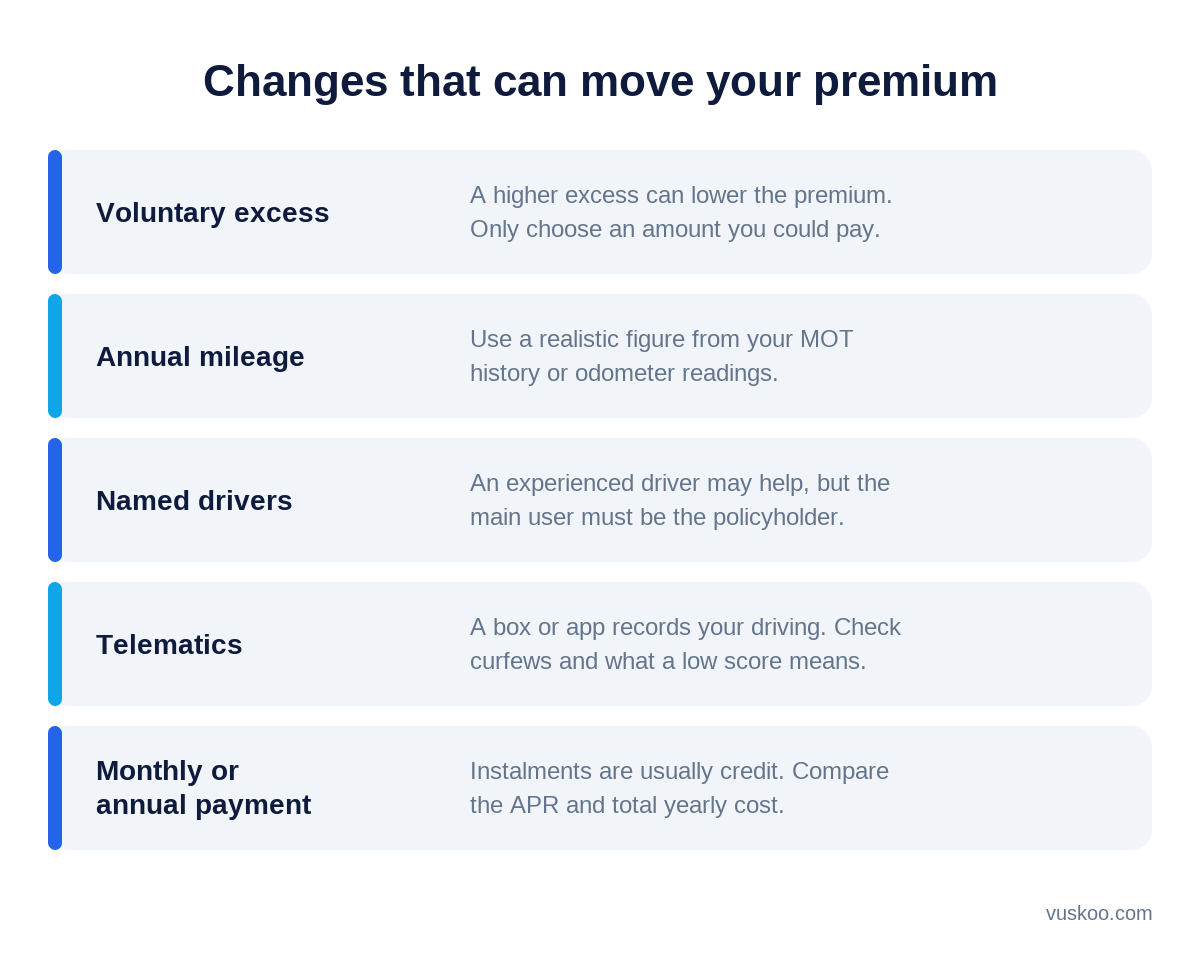
Many small tweaks make little difference. The ones below can have a bigger effect, but each one needs to be accurate and to suit how you actually use the car.
Voluntary excess
The excess is the amount you pay towards a claim. It's made up of a compulsory part set by the insurer and a voluntary part you choose. Raising the voluntary excess often lowers the premium, because you're taking on more of the cost of smaller claims. Only choose a total excess you could pay at short notice. Also check the excess for windscreen claims and for any young or inexperienced drivers named on the policy.
Annual mileage
Fewer miles usually means less risk. If you work from home more or have changed your commute, your mileage may have dropped. Work out a realistic figure from your MOT history or from odometer readings taken a year apart. Don't underestimate. Mileage that doesn't match your real use can cause problems if you make a claim.
Named drivers
Adding an experienced driver with a clean record as a named driver can sometimes lower the premium. Removing someone who no longer drives the car can also make a difference. The main driver must be the policyholder, though. Naming a more experienced person as the main driver when someone else uses the car most is called "fronting". It's a form of insurance fraud and can lead to claims being refused.
Telematics
A telematics policy uses a black box or a smartphone app to record how, when and how far you drive. It's often aimed at newer and younger drivers, and careful drivers may be able to keep their premium down. Before you choose one, check whether there are curfews or mileage limits, and how your driving data is used. Also find out what happens if your score is poor, as this can include extra charges or the policy being cancelled.
Paying monthly or annually
Paying in monthly instalments is usually a form of credit, so it often costs more over the year than paying the whole premium upfront. If you can afford to pay annually, compare the total yearly cost of both options. If you need to pay monthly, look at the APR and the total amount payable shown on the quote.
Other details worth reviewing
- Job title: describe your occupation accurately. Where more than one standard job title genuinely fits what you do, you can check whether the choice affects the quote.
- Parking and security: say where the car is actually kept overnight, and declare approved security devices.
- Add-ons: take out extras you already have elsewhere, such as breakdown cover through a separate provider.
- No-claims protection: weigh up what it costs against how you would feel about losing your discount after a claim. It protects the discount, not your future premium.
- Cover level: compare like for like. Third party, fire and theft isn't always cheaper than comprehensive, so get quotes for both.
FAQs
Is it worth phoning my insurer to ask for a lower renewal price?
You can ask them to check your details and cover options, which may change the quote. Under FCA rules, the renewal price shouldn't be above what the insurer would charge an equivalent new customer through the same channel. That's why comparing with other insurers is usually more telling than haggling.
How far in advance should I buy car insurance?
Quote analyses often point to about three to four weeks before the start date, with prices tending to rise in the final week. You can usually buy early and set the policy to start the day your current cover ends.
Does the price-walking ban mean loyal customers always get a fair price?
It stops your insurer charging you more than its own equivalent new customers. Other insurers may still offer lower quotes, so it doesn't replace comparing.
Will switching insurers affect my no-claims discount?
Your no-claims discount normally moves with you to a new insurer. Ask your current insurer for proof of your discount, as the new insurer may ask to see it.
Can I cancel auto-renewal after I've received the renewal notice?
Yes. Insurers must give you easy ways to turn off automatic renewal. Do it before the renewal date to avoid being charged for a policy you don't want.
Photo: Nature_Design / Pixabay