In this article
To switch bank account in the UK, open a current account with a bank or building society that uses the Current Account Switch Service (CASS), ask for a full switch and choose a switch date. The new bank handles the rest. Over seven working days it moves your Direct Debits, standing orders and incoming payments across, then transfers your balance and closes the old account. The Current Account Switch Guarantee covers the switch, and any payments still sent to your old account details are redirected to the new one.
This guide covers what CASS moves for you, what it leaves behind, how the seven days work and the conditions that usually come with switch bonuses.
What is the Current Account Switch Service?
CASS is a free switching service run by Pay.UK. Most high street banks and building societies use it, and so do many app-based banks. Not every provider or product is included, though, so check that both your old and new accounts are covered before you start. Your new provider runs the switch, so you don't need to contact your old bank.
The Current Account Switch Guarantee says that:
- your switch will be finished on the date you agree with the new bank, within seven working days;
- your regular payments will be moved, and payments sent to the old account will be redirected;
- if something goes wrong in the switching process, any interest or charges it causes on your old or new account will be refunded once you tell your new bank.
The guarantee only covers a full switch, where the old account is closed. A partial switch keeps the old account open and moves only some payments. It isn't covered by the guarantee, and it usually doesn't count towards a switch bonus.
What moves over automatically, and what doesn't
Moved by CASS
- Your balance: it moves on the switch date, and the old account closes.
- Direct Debits: including annual ones that may not have been collected recently.
- Standing orders: payments you have set up to go to other people or accounts.
- Incoming payments: salary, pension, benefits and other regular credits. You don't have to tell your employer, though you can update them later.
- Redirection: payments that still arrive at the old sort code and account number are sent on to the new account.
Not moved by CASS
- Recurring card payments: subscriptions and memberships charged to your debit card, such as streaming services, apps and online shops. Your old card stops working when the account closes, so update these yourself.
- Transaction history: download your old statements before the switch date, because you may lose online access once the account is closed.
- Linked products: savings accounts, loans or credit cards with your old bank stay where they are. Any standing orders between accounts at the same bank may need checking.
- Overdraft: an overdraft doesn't carry over automatically. If you're overdrawn, agree an overdraft with the new bank before you switch.
The 7-working-day switch timeline
Working days don't include weekends or bank holidays. You choose the switch date when you apply, and it must be at least seven working days away. Many people choose a date a few days after payday so they have a clear picture of their regular payments.
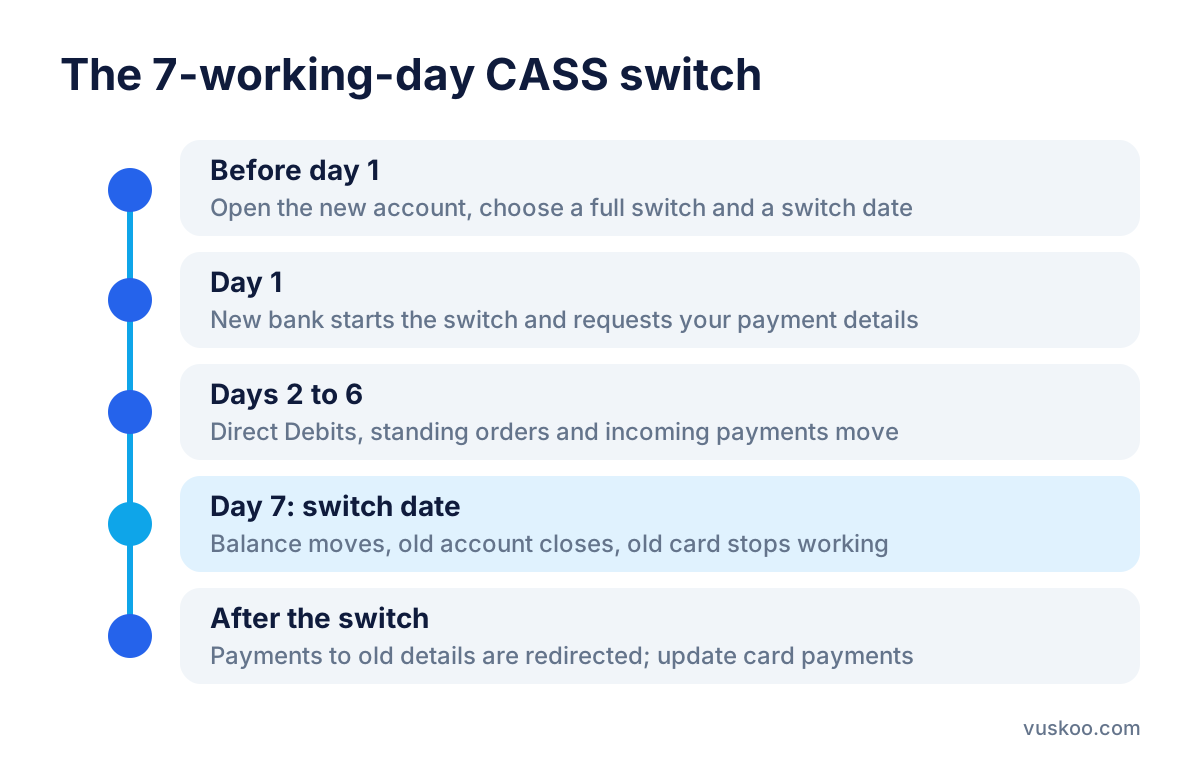
- Before day 1: open the new account, choose a full switch through CASS and set a switch date.
- Day 1: the new bank starts the switch and asks your old bank for details of your payment arrangements.
- Days 2 to 6: Direct Debits, standing orders and regular incoming payments are moved to the new account. You can keep using the old account during this time.
- Day 7, the switch date: your remaining balance moves across and the old account closes. Your old card stops working.
- After the switch: payments sent to your old details are redirected. Update any payers and recurring card payments that still use them.
If you change your mind, contact the new bank as soon as possible. Banks usually ask for notice well before the switch date to cancel.
What to check first before you switch
- Eligibility: some accounts need a minimum monthly deposit, a minimum age, UK residence or a credit check. Student and graduate accounts have their own rules.
- Your Direct Debit list: look at the last 12 months of statements so you know which payments to expect at the new bank.
- Card subscriptions: make a list of everything charged to your current debit card.
- Overdraft needs: if you depend on an arranged overdraft, check whether the new bank will offer one before you close the old account.
- Fees: monthly account fees, charges for using your card abroad and cash withdrawal limits.
- How you bank: app-only providers such as Monzo, Starling Bank and Chase UK work differently from banks with branches. Think about how you pay in cash or cheques.
How switch bonuses usually work
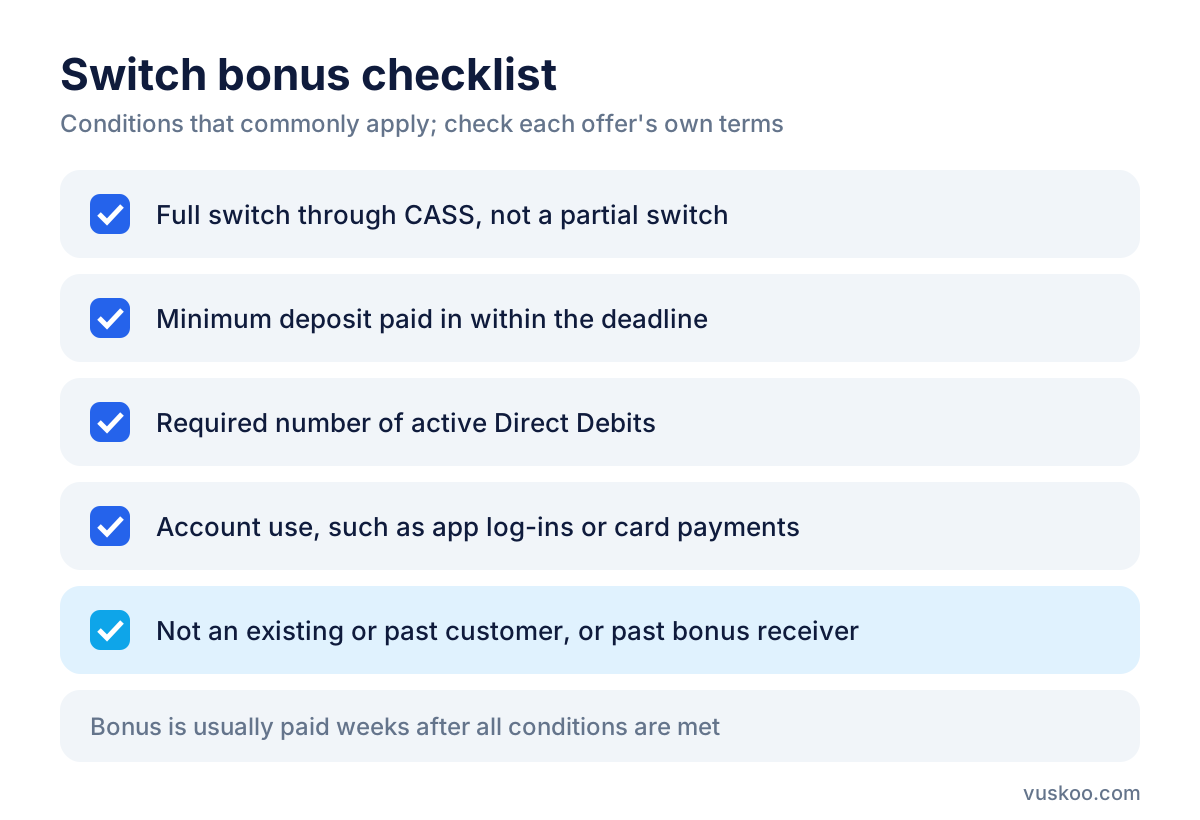
Some banks offer a cash payment when you switch through CASS. In the offer list on this page, Santander, Nationwide and first direct currently have switch offers. Live amounts and terms are shown in the offer boxes. The headline figure only matters if you can meet all the conditions, and they tend to follow a similar pattern.
Common bonus conditions
- A full switch through CASS: opening an account and moving money across yourself usually doesn't count, and neither does a partial switch.
- A minimum deposit: you pay in a set amount, often within a fixed period after opening. Some offers ask for it to be one payment, and money moved from your own accounts may not count.
- A minimum number of Direct Debits: a set number of active Direct Debits must move with the switch or be set up on the new account by a deadline.
- Using the account: some offers ask you to log in to the app or use the debit card a certain number of times.
- Excluded past customers: people who already hold an account with that bank, or who have received a switch bonus from it before, often can't qualify. Some banks extend this to sister brands in the same group.
- Deadlines and limited availability: offers can end without much notice. The bonus is usually paid weeks after you meet the conditions, not on the switch date.
Read the full terms on the provider's site before you apply. Note the deadlines in your calendar, because missing one by a day usually means no bonus.
No-fee accounts or salary-linked accounts: how to choose
Current accounts fall broadly into two groups, and the right one depends on how you receive and use your money.
No-fee, no-minimum accounts
These suit people with irregular income, more than one account, or anyone who doesn't want to commit to a monthly deposit. Basic tiers from app-based banks, such as Monzo's free account or the Starling Personal Current Account, are examples of this type. Check what the free tier includes and what costs extra. Monzo, for example, also offers paid tiers such as Extra, Perks and Max with added features.
Accounts linked to salary or a monthly deposit
Some accounts, and most switch bonuses, expect you to pay in a set amount every month. Some also tie extra features to that, such as in-credit interest or cashback. These can work well if all your income goes into one account. If you miss the monthly deposit, you may lose a feature or have to pay a fee, so compare:
- the monthly amount you have to pay in and whether transfers from your own accounts count;
- what happens if you miss a month;
- whether any interest or reward is capped or only lasts a set time;
- the overdraft terms, if you use one.
Frequently asked questions
How long does it take to switch bank account?
A full switch through CASS takes seven working days from the start of the switch to the switch date you choose. Weekends and bank holidays don't count.
Will I miss any payments while I switch?
Direct Debits, standing orders and incoming payments are moved for you, and payments to the old account are redirected. If a switching error causes charges or interest, the guarantee says they'll be refunded. Recurring card payments are the main thing you need to update yourself.
Do I need to tell my employer?
Not straight away, because your salary is redirected. It's still a good idea to give them your new details after the switch.
Can I switch if I'm overdrawn?
Yes, if the new bank agrees to give you an overdraft that covers the balance. Ask about this before you apply.
Can I get a switch bonus more than once?
Often not from the same bank. Many offers exclude people who have held an account with that bank or received one of its bonuses before. The exact rule is in each offer's terms.
Photo: Krasutskaya / Pixabay