In this article
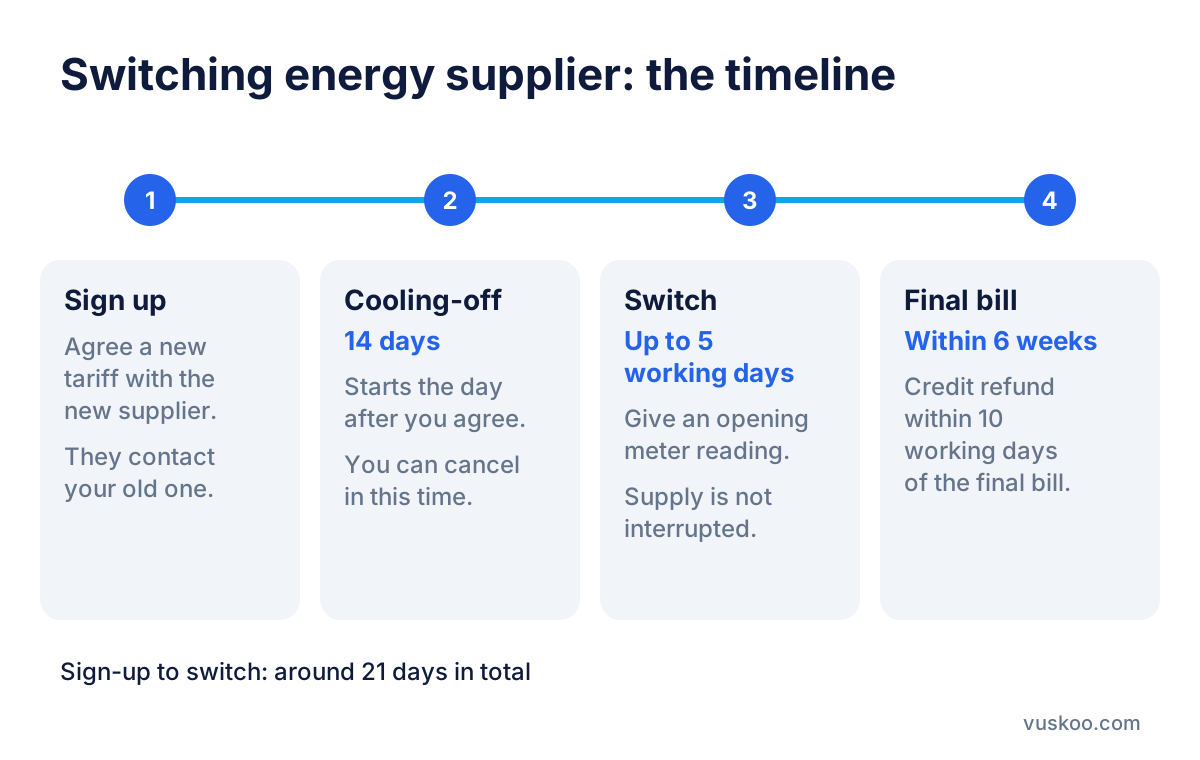
To switch energy supplier, choose a new tariff and sign up with the new supplier. They handle the move and tell your old supplier, so you don't need to cancel anything yourself. Once your 14-day cooling-off period ends, the switch usually takes up to five working days. That means it can be about three weeks from signing up. Your gas and electricity carry on as normal throughout. You won't usually pay an exit fee if you're on a variable tariff, or if you're within 49 days of the end of a fixed deal. Any credit on your old account has to be refunded after your final bill.
This guide covers each step, what happens to your meter readings and balance, and what to compare as the January price cap gets closer.
How to switch energy supplier, step by step
- Find your current details. You'll need your supplier's name, your tariff name, your tariff end date (if you're on a fixed deal) and your annual usage in kWh. All of these are on a recent bill or annual statement, or in your online account.
- Check for exit fees. If you're on a fixed tariff, look up your end date and any early exit fee in your contract.
- Compare tariffs using your own usage. Compare the unit rate and the standing charge, not only an estimated annual cost (see below).
- Sign up with the new supplier. You'll need your address, payment details and sometimes your meter numbers (MPAN for electricity, MPRN for gas).
- Use the cooling-off period if you need it. You have 14 days to change your mind, starting the day after you agree the contract.
- Give meter readings on switch day. Your new supplier will confirm the date and ask for an opening reading. Take a dated photo of each meter as well.
- Check your final bill and refund. Your old supplier sends a closing bill, and then refunds any credit.
How long does it take to switch energy supplier?
According to Citizens Advice, the switch itself can take up to five working days once your 14-day cooling-off period is over. From the day you agree the new contract, that adds up to about 21 days. You won't lose supply at any point. The pipes, cables and meter stay exactly the same, and only the company billing you changes.
Your old supplier has up to six weeks after the switch to send your final bill. After that bill, they have 10 working days to refund any credit. Ofgem's guaranteed standards mean suppliers that miss these deadlines must pay you compensation.
Can my supplier stop me switching?
Usually not. The main exception is debt. Ofgem's guidance says that on a credit meter, you can't switch if you've owed your supplier money for more than 28 days. You'll need to pay it off first. On a prepayment meter, you can still switch if you owe up to £500 for gas and up to £500 for electricity. The debt moves to the new supplier under the Debt Assignment Protocol, but only if the new supplier agrees to take it on.
When do exit fees apply?
Exit fees only apply to some fixed tariffs, and only if you leave early. Whether a fee applies, and how much it is, is set out in your contract. Some fixed deals have no exit fee at all. Variable tariffs, such as the standard variable tariffs from British Gas or flexible tariffs like Flexible Octopus, So Energy Flex or Next Flex from E.ON Next, don't normally have exit fees.
There is also a protected switching window. Ofgem's licence conditions don't allow suppliers to charge exit fees if you switch in the last 49 days of a fixed-term contract. Your supplier must contact you between 42 and 49 days before your deal ends to let you know you can leave without a fee. Ofgem has taken action against suppliers that charged or threatened fees during this window.
If you're thinking of leaving a fixed deal before that window opens, compare the exit fee with how much you'd save on the new tariff over the months that are left. Sometimes it's worth paying the fee and switching, and sometimes it isn't.
What happens to meter readings and your credit balance?
Meter readings
Your opening reading with the new supplier also becomes your closing reading with the old one. That's why an accurate reading matters: it stops you being billed twice for the same energy. If you have a smart meter that's working in smart mode, readings may be sent automatically. Still, it's worth taking your own photo. If you have a traditional meter, submit the reading when your new supplier asks for it, and keep the photo in case the two bills don't agree.
Credit balance
If you pay by Direct Debit, you may have built up credit, especially after summer. That money is yours. Your old supplier should refund it within 10 working days of your final bill. Make sure they have your current bank details. Ofgem has also pointed out that you can ask for a refund of credit at any time, not only when you switch. If the refund doesn't arrive, contact your old supplier. If the problem still isn't sorted, you can take it further through their complaints process.
Debit balance
If you owe money, it will show on your final bill and you pay it to your old supplier. As explained above, larger or older debts can affect whether you can switch at all.
What to compare before the January price cap
Ofgem reviews the energy price cap every quarter. The cap for January to March 2027 is due to be announced in late November 2026. The cap doesn't limit your total bill. It limits the unit rates and standing charges suppliers can charge on default and variable tariffs. So if you use more energy, you still pay more.
That affects what you should compare:
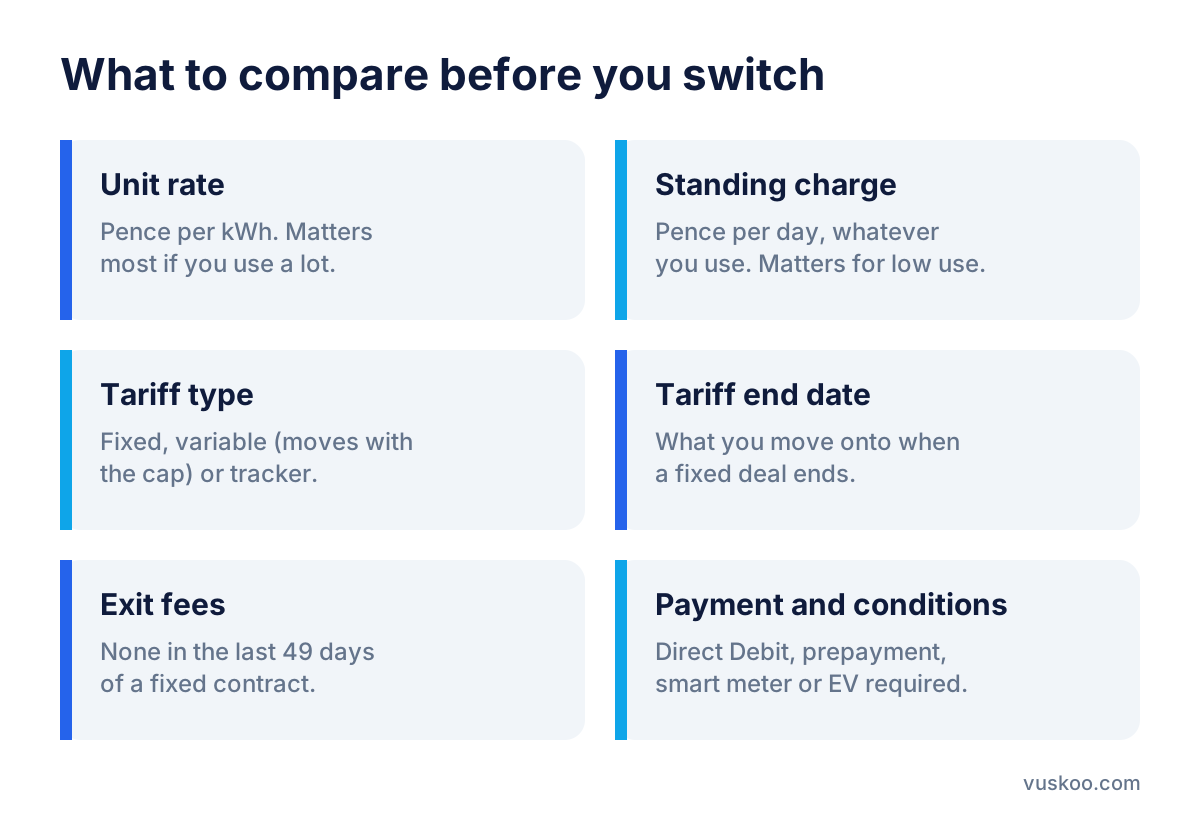
- Unit rate (pence per kWh). What you pay for each unit of gas and electricity. This matters most if you use a lot of energy.
- Standing charge (pence per day). A daily fixed charge that you pay however much you use. This matters most if you use little energy.
- Tariff type. Variable tariffs, such as British Gas Standard Variable or Flexible Octopus, change when the cap changes. Fixed tariffs, such as the E.ON Next Fixed 12-Month, OVO Energy 1-Year Fix, EDF Simply Fixed or Octopus 12M and 18M Fixed, keep the same rates for the length of the deal. Tracker tariffs, such as EDF Simply Tracker, follow wholesale prices or another benchmark set out in the terms.
- Tariff end date and what happens next. When a fixed deal ends, you'll usually be moved onto the supplier's standard variable tariff unless you choose something else. What you pay after that depends on the cap at the time.
- Exit fees. Whether there's a fee per fuel if you leave early, and how much.
- Payment method. Direct Debit, paying on receipt of a bill and prepayment can all have different rates. Prepayment options, such as Utilita Pay As You Go, are priced differently from Direct Debit.
- Extras and conditions. Some tariffs need a smart meter, an electric vehicle (for example E.ON Next Drive Smart) or online-only account management.
Fix now or wait?
No one can tell you for sure. A fixed tariff gives you certainty, but if the cap falls later, you could end up paying more than people on variable tariffs. A variable tariff goes up and down with each cap. One practical approach is to compare a fixed tariff's unit rate and standing charge with the current variable rates from your supplier. Work out the difference using your own annual usage, then think about how much price certainty matters to you. The live offers next to this article show current rates from providers including Octopus Energy, British Gas, EDF, E.ON Next, OVO Energy, So Energy and Utilita.
Switching gas, electricity or dual fuel
You can switch both fuels to one supplier on a dual fuel deal, or use a different supplier for each. Splitting them can sometimes cost less overall, but you'll have two accounts and two sets of readings to manage. If you only have electricity, compare electricity-only tariffs. Prices are worked out differently when there's no gas standing charge.
Frequently asked questions
Will my energy supply be cut off when I switch?
No. Your supply carries on without a break. Only the company that bills you changes.
Do I need to tell my old supplier I'm leaving?
No. Your new supplier arranges the switch. Do cancel your old Direct Debit once the final bill is settled, not before.
Can I switch if I rent?
If you pay the energy bills directly, you can usually choose your own supplier. Check your tenancy agreement for any terms about this.
How long will my credit refund take?
Your old supplier has up to six weeks after the switch to send the final bill. They then have 10 working days to refund any credit.
Can I change my mind after signing up?
Yes. You have a 14-day cooling-off period, starting the day after you agree the contract.
Photo: TBIT / Pixabay