In this article
- Lifetime vs time-limited pet insurance: the short answer
- What are the main types of pet insurance?
- How do vet fee limits work: per condition or per year?
- Excesses and co-payments for older pets
- How are pre-existing conditions treated?
- Why switching later can leave conditions uncovered
- Which pet insurance cover should you choose?
- Frequently asked questions
Lifetime vs time-limited pet insurance: the short answer
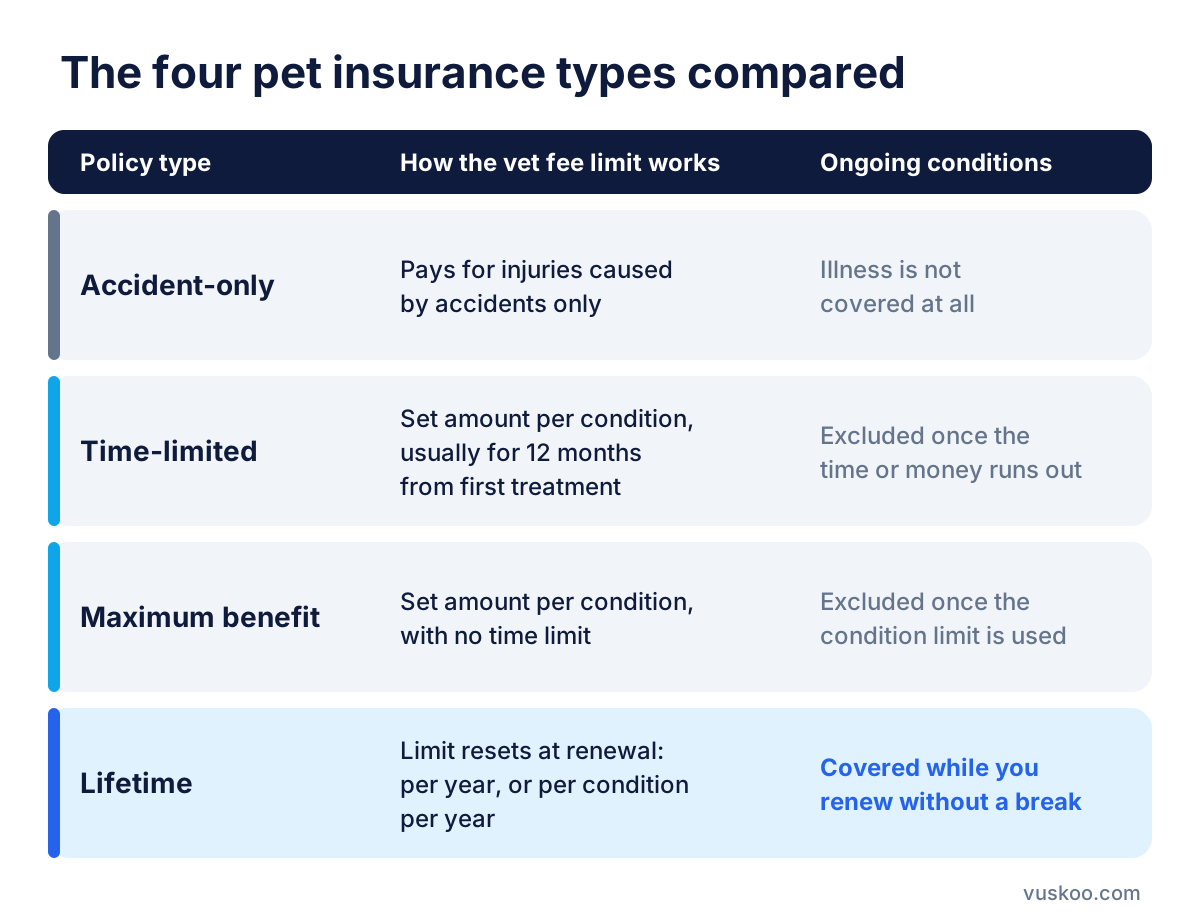
The main difference between lifetime and time-limited pet insurance is how long ongoing conditions stay covered. A lifetime policy keeps paying for a long-term illness, such as diabetes, arthritis or a skin condition, for as long as you renew the policy each year, up to an annual vet fee limit. A time-limited policy pays for each new condition for a fixed period, usually 12 months from the first treatment, or until a set amount is used up. After that the condition is excluded for good. Lifetime cover usually costs more, but it is the type built for dogs and cats that develop conditions needing treatment for years.
There are also two other common types, maximum benefit and accident-only. This guide sets out how all four work, which limits and costs to compare, and why changing insurer later can leave your pet without cover for conditions they already have.
What are the main types of pet insurance?
Most UK insurers sell some version of these four policy types. The names differ between providers, so check the policy wording instead of relying on the product name.
Accident-only
This pays vet fees for injuries caused by accidents, such as a road accident, a cut paw or swallowing something harmful. Illness is not covered. It is the most limited type and suits owners who mainly want help with a sudden, one-off bill.
Time-limited
This covers accidents and illness, but each condition is covered for a fixed period, usually 12 months from the date treatment starts, and up to a set amount. Whichever limit you reach first, time or money, the condition is then excluded. That works for a broken leg that heals. It works less well for a condition that needs medication for the rest of the pet's life.
Maximum benefit
Sometimes called per-condition cover, this pays up to a fixed amount for each condition with no time limit. Once that amount has been paid out, the condition stops being covered. A condition that costs little each year may stay covered for a long time. An expensive one may use up the limit quickly.
Lifetime
Lifetime policies give a vet fee limit that resets every time you renew. Depending on the insurer, that limit applies either to all claims in the policy year or to each condition in each year. As long as you renew without a break, ongoing conditions continue to be covered. The Financial Ombudsman Service describes lifetime policies in the same way: they cover ongoing conditions for as long as the policy is renewed each year. Petplan's Covered For Life range is an example of this type. Its current prices appear in the offer boxes on this page.
How do vet fee limits work: per condition or per year?
The vet fee limit is often the most important number in a pet insurance policy, and it can be set in different ways:
- Per condition: a cap on how much can be paid for one illness or injury, either in total or within the time limit.
- Per year: a cap on all vet fees in one policy year, whatever the number of conditions.
- Per condition, per year: a cap for each condition that resets at renewal. This is common on lifetime policies.
Think about how a realistic claim would play out. Treatment for a long-term condition, combined with referral to a specialist, scans and surgery, can add up quickly. A limit that looks generous for one minor claim may not stretch to a complex case or to two conditions in the same year. Many insurers offer the same policy type at several limit levels, and the price changes with the level you choose.
Check the separate sub-limits too. Policies often set their own, lower caps for things such as complementary therapies, behavioural treatment, dental work, prescribed diets or the cost of cremation.
Excesses and co-payments for older pets
The premium is only part of what you pay. When you claim, you usually pay part of the bill yourself as well:
- Fixed excess: a set amount you pay towards each claim. On many policies this applies to each condition in each policy year, so a long-term illness can mean paying the excess again every year.
- Co-payment (percentage excess): a share of the vet bill that you pay on top of, or instead of, the fixed excess.
Many insurers add a co-payment once a dog or cat reaches a set age, which is stated in the policy. Some apply it from the start for certain breeds. Because a co-payment is a percentage, it can matter more than the fixed excess on a large bill. When you compare quotes for an older pet, work out what you would pay on a typical claim, not just the premium.
Some insurers also have a maximum age for taking out a new policy, or offer only more limited cover to pets above a certain age. Taking out cover while your pet is young and healthy usually gives you more choice.
How are pre-existing conditions treated?
Most policies do not cover pre-existing conditions. These are any illness, injury or symptoms your pet had, or showed signs of, before the cover started. Most policies also exclude illnesses that first appear during an initial waiting period after the start date. The insurer will usually look at your pet's veterinary history when you claim, so declare everything when you apply.
Some insurers will cover a past condition again if your pet has been free of symptoms and treatment for a set period. Others exclude it permanently. The wording on this varies a lot, and disagreements over pre-existing conditions are a frequent reason for pet insurance complaints to the Financial Ombudsman Service.
Why switching later can leave conditions uncovered
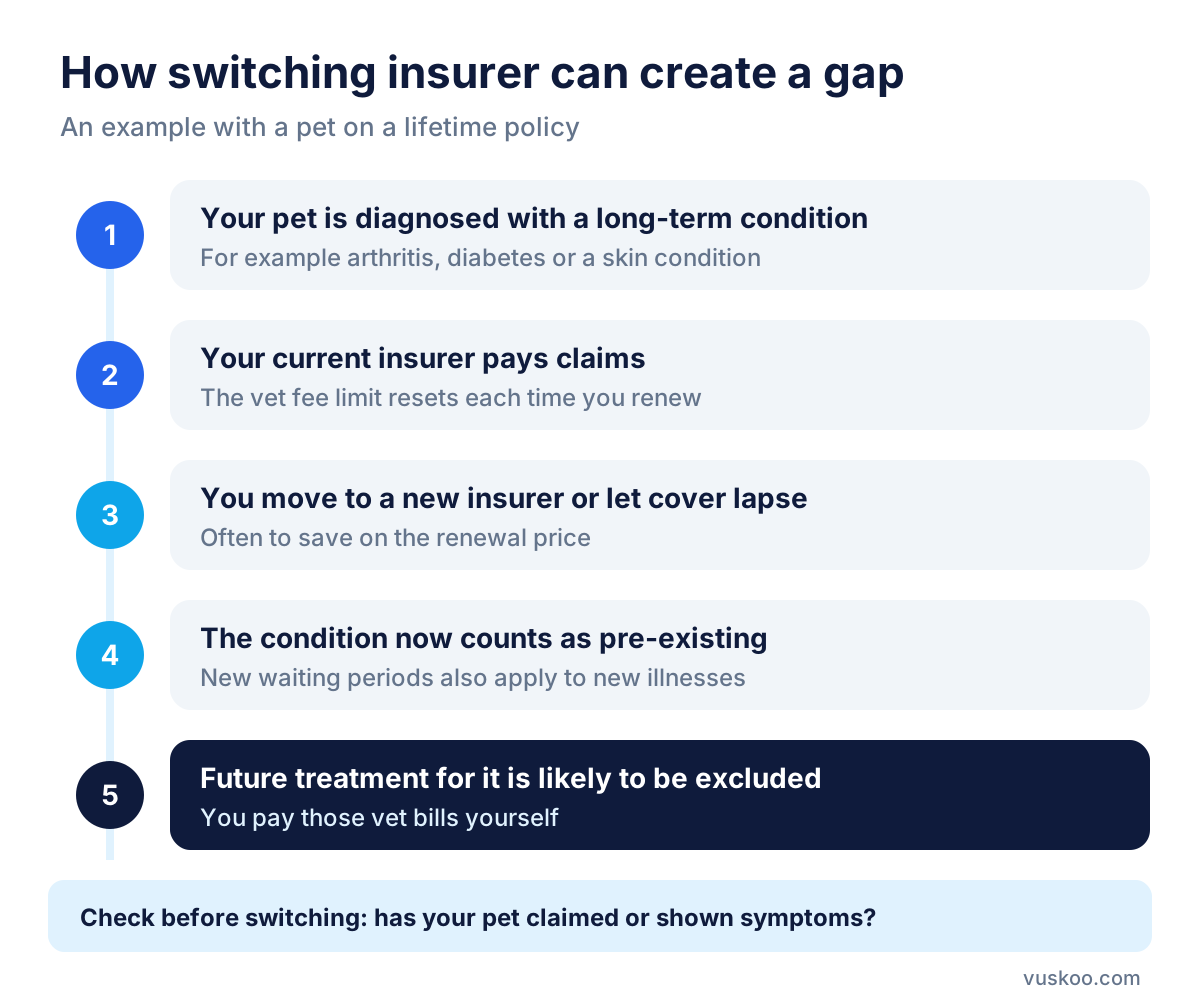
This is the main reason the choice of policy type matters at the start. Suppose your pet develops a condition while insured on a lifetime policy. At the next renewal, that condition is still covered. If you move to a new insurer, the condition counts as pre-existing and is likely to be excluded. You would save on the premium but lose cover for the very illness most likely to lead to claims.
The same applies if you let a lifetime policy lapse, even for a short time. A break in cover can reset the position, so set up continuous payments and check the renewal date.
Switching is usually less risky when your pet has never claimed or shown signs of illness. Even then, a new policy brings new waiting periods, and any symptoms in your pet's records may be excluded.
Which pet insurance cover should you choose?
There is no single right answer, but these points can help you decide:
- Breed and health risks: breeds prone to hereditary or long-term conditions are more likely to benefit from lifetime cover.
- Age: a young pet with a clean history has the widest choice. Older pets may face age limits, co-payments or fewer options.
- Savings: if you could pay a large or repeated vet bill yourself, a narrower policy may be enough. If not, a higher limit gives more protection.
- Long-term cost: lifetime premiums usually rise as your pet gets older and as vet fees go up, so expect renewal prices to change.
What to compare between quotes
- The policy type and whether the vet fee limit applies per condition, per year or both.
- The size of the limit and any sub-limits.
- The fixed excess, how often it applies, and whether a co-payment starts at a certain age.
- How pre-existing conditions and waiting periods are defined.
- Extras such as third-party liability for dogs, overseas travel cover, or boarding fees if you go into hospital.
- How the price after any introductory offer is set, and what usually drives renewal increases.
Pet insurance premiums include Insurance Premium Tax at the standard rate, which GOV.UK lists as 12% for pet insurance. It is already included in the quoted price.
Frequently asked questions
Is lifetime pet insurance worth it?
It costs more, but it is the only type designed to keep covering long-term conditions year after year. It tends to suit owners who could not easily pay ongoing treatment costs themselves.
What happens when a time-limited policy runs out for a condition?
Once the 12-month period or the money limit for that condition is reached, the insurer stops paying for it. The policy still covers new, unrelated conditions.
Can I switch from time-limited to lifetime cover?
You can, but any condition your pet has already had or shown symptoms of is likely to be treated as pre-existing by the new policy, and excluded.
Does lifetime cover mean unlimited vet fees?
No. Lifetime policies have a vet fee limit, either per year or per condition per year, and excesses or co-payments still apply.
Can I get insurance for an older dog or cat?
Often yes, but some insurers set a maximum age for new policies and many add a co-payment above a certain age. Conditions your pet already has will usually be excluded.
Photo: 12019 / Pixabay