In this article
- How much does public EV charging cost in the UK?
- Slow, fast, rapid and ultra-rapid: what you are paying for
- Why prices vary so much between networks
- How to work out the cost per 100 miles
- What the law says about public charger prices
- How to pay less for public charging
- Is public charging still cheaper than petrol?
- Frequently asked questions
How much does public EV charging cost in the UK?
The public EV charging cost in the UK depends mainly on three things: how fast the charger is, which network runs it, and how you pay. As a rule, slow and fast chargers (lamp posts, car parks, destination chargers) cost the least per kWh, while rapid and ultra-rapid chargers at motorway services and hubs cost the most. Paying by contactless at the charger is usually more expensive than paying through the operator's app or a membership plan. Because tariffs change often, the useful skill is knowing how to read a price in pence per kWh and turn it into a cost per 100 miles for your own car.
This guide is for drivers who cannot charge at home, or who rely on public chargers for longer trips.
Slow, fast, rapid and ultra-rapid: what you are paying for
UK public chargers are usually grouped by power output. The higher the power, the more expensive the equipment and grid connection, and that cost is reflected in the price per kWh.
- Slow (up to around 7 kW): lamp-post and on-street chargers. Best suited to overnight charging near home.
- Fast (around 7–22 kW): supermarkets, car parks, gyms, hotels and workplaces. Useful for topping up while you do something else.
- Rapid (roughly 50 kW and above): service stations, retail parks and charging hubs. A meaningful top-up in under an hour, depending on the car.
- Ultra-rapid (around 100–150 kW and above): motorway hubs and dedicated sites. The fastest option for cars that can accept the power, and typically the highest price per kWh.
Paying for ultra-rapid power only makes sense if your car can use it. A car with a lower maximum charging rate will charge at its own limit on an ultra-rapid unit, so you may pay the higher tariff without getting the extra speed. Check your car's maximum DC charging power before choosing a charger.
Why prices vary so much between networks
Two chargers of the same speed in the same town can have very different prices. The main reasons are:
- Location costs: motorway sites pay for land, grid connections and 24-hour facilities.
- Business model: some networks offer lower prices to members or app users, while others use one simple price for everyone.
- Time of day: some operators use off-peak pricing, with lower rates overnight or outside busy hours.
- Extra charges: parking fees, connection fees or overstay fees (charged when you stay plugged in after the session ends) can add to the bill.
- VAT: public charging is generally charged at the standard 20% VAT rate, while home electricity is taxed at a lower rate. A March 2026 tribunal decision found that some public charging could qualify for the reduced rate, but HMRC is appealing, so the standard rate still applies for now.
How to work out the cost per 100 miles
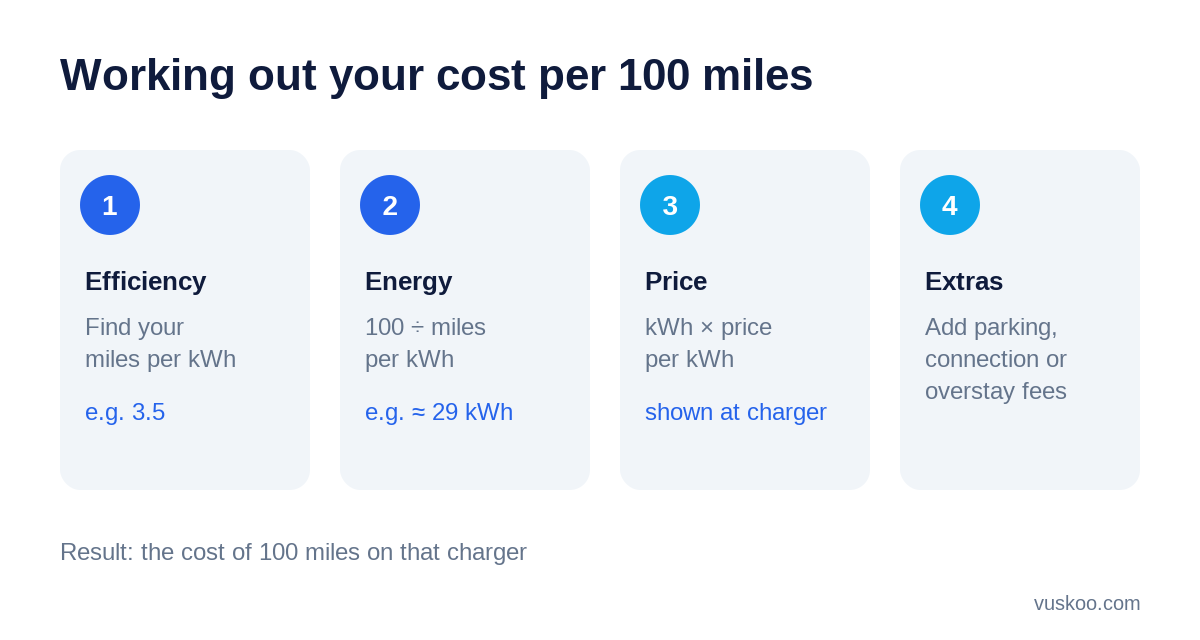
The price per kWh only tells half the story. To compare public charging with petrol or with home charging, convert it into a cost per 100 miles using your car's efficiency, measured in miles per kWh (shown in most EV trip computers).
- Find your real-world efficiency, for example 3.5 miles per kWh.
- Divide 100 by that figure to get the energy needed: 100 ÷ 3.5 ≈ 29 kWh.
- Multiply by the charger's price per kWh to get the cost of 100 miles.
- Add any connection, parking or overstay fees for that session.
Efficiency changes a lot with the car and the conditions. A large SUV, motorway speeds and cold weather all use more energy per mile, and charging in winter can be slower. That is why the same charger can give two drivers quite different costs per 100 miles. A compact model such as the Suzuki e Vitara, a saloon like the Tesla Model 3 or the Polestar 2, and a larger crossover such as the Kia EV6 will each have their own real-world figure.
What the law says about public charger prices
The Public Charge Point Regulations 2023 set rules that help you compare costs:
- Price in pence per kWh: operators must show the maximum price of a session in pence per kWh, either on the charger or through an app or website, before you start.
- No mid-session increases: the price cannot rise above the advertised price once charging has started.
- Contactless payment: new chargers of 8 kW and above, and rapid chargers of 50 kW and above, must accept contactless card payment, so you do not need an app to use them.
- Reliability: operators must keep their rapid networks 99% reliable on average over a year and publish their performance.
- Help when things go wrong: operators must provide a free 24/7 helpline.
The pence-per-kWh rule is especially useful: it means you can compare networks like for like, instead of working through per-minute or per-session pricing.
How to pay less for public charging
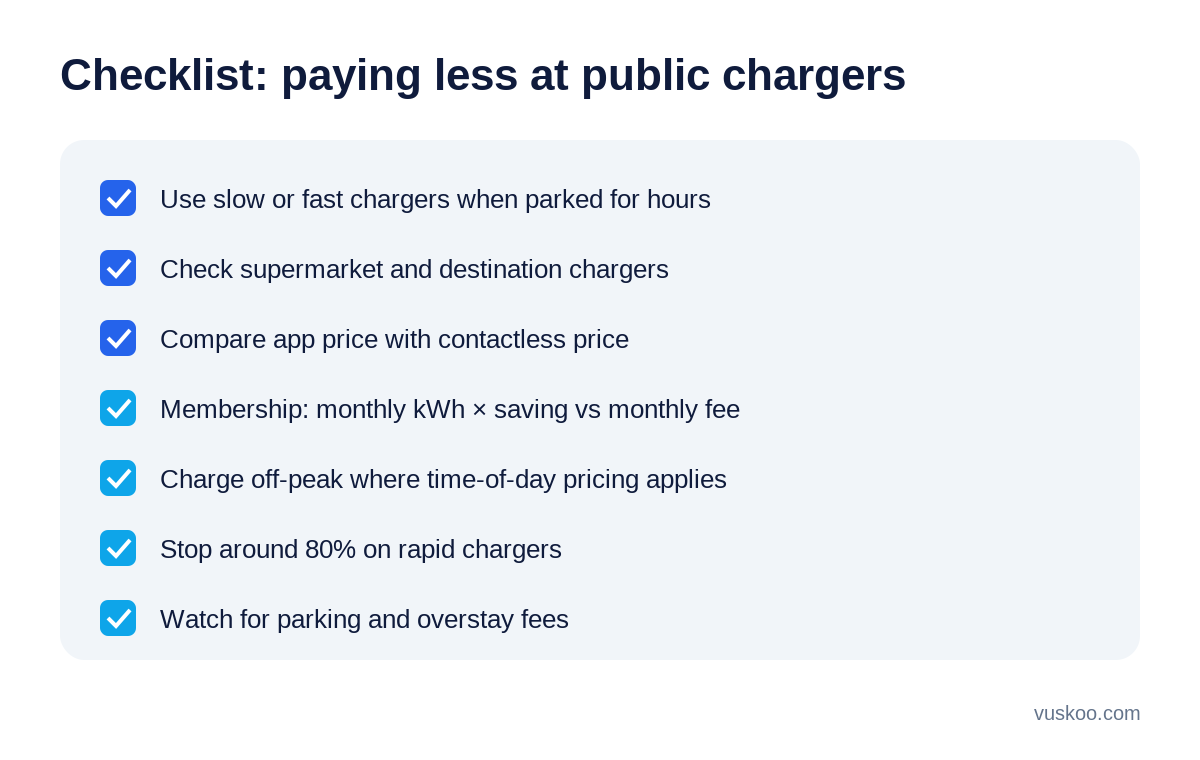
Use slower chargers where you can
If your car will be parked for hours anyway, at the supermarket, overnight on your street or at work, a slow or fast charger is usually cheaper than a rapid one. Save rapid and ultra-rapid charging for long journeys.
Look at supermarket and destination chargers
Many supermarkets and retail parks have fast or rapid chargers, and some prices are competitive. Combining charging with a shop also saves time.
Consider a membership or subscription
Some networks offer a monthly plan that lowers the price per kWh. Whether it pays off depends on how much you charge on that network. Work out your typical monthly kWh, multiply by the saving per kWh, and compare it with the monthly fee. If you use several networks, a plan with one of them may not cover enough of your charging.
Pay through the app rather than contactless
App prices are often lower than the ad hoc contactless price on the same charger. Check both before plugging in.
Charge off-peak
Where networks use time-of-day pricing, charging at quieter times can lower the rate.
Charge to around 80% on rapid chargers
Charging speed usually drops sharply above about 80%. Stopping there saves time and, where idle or overstay fees apply, money.
Use a map app to compare
Charging map apps show locations, charger speeds and, increasingly, live prices and availability. Filter by the connector your car uses and compare prices on your route before you set off.
Is public charging still cheaper than petrol?
It depends on your mix of chargers. Drivers who mainly use slow, fast or supermarket chargers and pay through apps or memberships often have relatively low running costs. Drivers who depend almost entirely on ultra-rapid motorway charging at ad hoc prices can find the cost per mile close to, or above, that of an efficient petrol or hybrid car such as the Toyota Yaris Hybrid or Toyota Corolla Hybrid. If you are choosing between an EV and a petrol or hybrid model, estimate where you will realistically charge before deciding.
Frequently asked questions
Why is rapid charging more expensive than slow charging?
Rapid and ultra-rapid chargers cost more to install, need stronger grid connections and are often in high-cost locations such as motorway services. Operators recover those costs through a higher price per kWh.
Do I need an app to use public chargers?
Not always. Rapid chargers of 50 kW and above, and new chargers of 8 kW and above, must accept contactless payment. However, an app or membership can sometimes give you a lower price.
Can the price change while I am charging?
No. Under the 2023 regulations, the price cannot go above the price advertised when you started the session.
Is a charging subscription worth it?
Only if you charge enough on that network. Compare the monthly fee with the saving per kWh multiplied by the energy you usually use there each month.
How do I find my car's efficiency in miles per kWh?
Most EVs show it in the trip computer or app. Use an average over several weeks, as it changes with weather, speed and journey type.
Photo: AKrebs60 / Pixabay