Rural broadband in the UK: your options compared for 2026
A guide to rural broadband in the UK. We compare full fibre, part fibre, 4G and 5G home broadband, satellite and fixed wireless, and explain how to choose the right connection for your address.
Living in a village or out in the countryside no longer has to mean putting up with a slow connection. Rural broadband in the UK has improved a lot in recent years, as full fibre networks spread beyond towns and cities and mobile networks extend 4G and 5G coverage. Even so, some scattered communities and isolated homes still can't get fibre, so it helps to know every alternative. This guide covers the rural broadband options available today, what they typically cost and how to pick the right one for your home.
What rural broadband is and why it has changed
Rural broadband means broadband for small villages, hamlets, farms, holiday homes and hard-to-reach areas. In these places, traditional infrastructure arrived later, or providers did not find it worthwhile to build at all. For many years, rural homes relied on ADSL over long copper telephone lines. Speeds were often slow and unreliable, especially for properties a long way from the exchange or street cabinet.
That is changing. The UK is moving away from the old copper telephone network towards digital services, and full fibre is becoming the standard fixed-line technology. Where fibre has not yet arrived, 4G and 5G home broadband, satellite and fixed wireless services can fill the gap.
Rural broadband technologies available in the UK
There is no single solution for rural broadband. What suits you depends on the coverage at your exact address. These are the main options, starting with the one to check first.
Full fibre (FTTP)
Full fibre, also called fibre to the premises (FTTP), is generally the strongest option when it is available. It offers fast, stable speeds and low latency, and in many rural areas it costs the same as in towns. Several providers sell full fibre packages, including TalkTalk, BT, Plusnet, Shell Energy, Sky and EE, at speeds from around 100 Mb to 900 Mb. Before ruling it out, always check availability for your exact address: coverage can change from one street, or even one house, to the next.
Part fibre (FTTC)
Many villages have part fibre, also known as fibre to the cabinet. Fibre runs to the street cabinet, and the old copper line covers the last stretch to your home. Speeds depend heavily on how far you are from the cabinet. Entry-level fibre packages such as NOW Fab Fibre (36 Mb) can be a practical choice where full fibre is not yet available.
4G and 5G home broadband
Home broadband over the mobile network is often the main alternative when there is no fibre. A router picks up a mobile signal and turns it into Wi-Fi for your home. There is no engineer visit or installation work: you plug it in and connect. Mobile networks such as Three, EE, Vodafone and O2 offer home broadband over 4G or 5G, and with a good signal, speeds can be comparable to fibre.
It suits homes and holiday properties with strong mobile coverage. Before signing up, check the signal at your address and whether the plan includes unlimited data.
Satellite broadband
Satellite is the option for the most remote locations, where neither fibre nor a usable mobile signal reaches. Low Earth orbit (LEO) satellite services have changed this market. Their latency is much lower than that of traditional geostationary satellites, which can feel sluggish for video calls and gaming.
There are drawbacks:
- you need a clear view of the sky
- there may be equipment costs
- heavy rain or snow can cause brief interruptions
Fixed wireless
In some areas, local providers offer fixed wireless broadband. A small antenna on your home links to a nearby mast, which connects to the wider network. Speeds and availability vary a great deal, and services are usually very local, but it can be a reasonable option where a regional provider operates.
Comparing rural broadband options
Here is how the technologies generally compare:
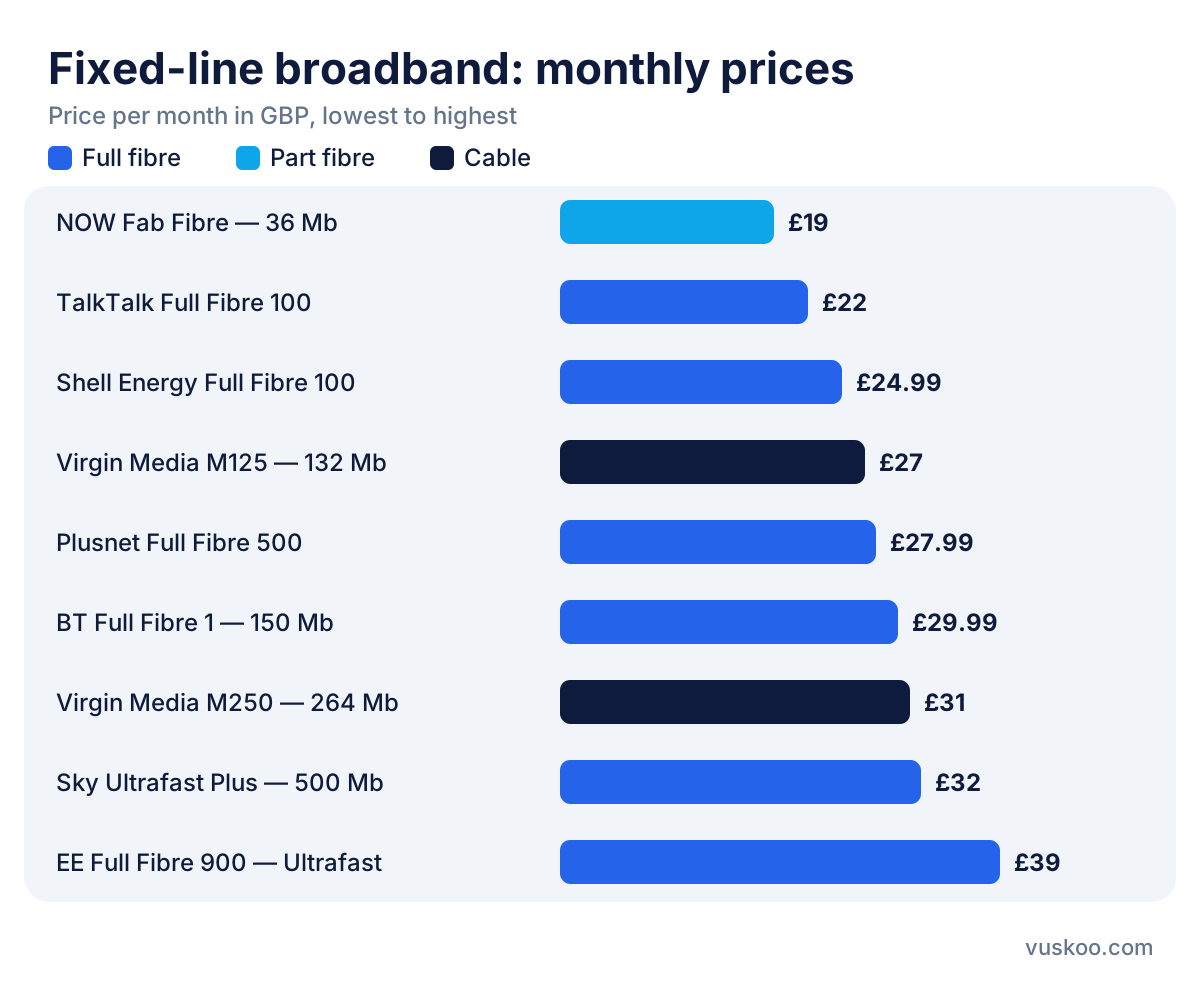
- Full fibre (FTTP): fast and stable, with very low latency. Packages in our comparison start at £22 a month (TalkTalk Full Fibre 100) and go up to £39 a month for 900 Mb (EE Full Fibre 900). Suits villages with full fibre coverage.
- Part fibre (FTTC): moderate speeds that fall the further you are from the cabinet, with low latency. NOW Fab Fibre 36 Mb costs £19 a month in our comparison. Suits areas where full fibre has not yet arrived.
- Cable: Virgin Media offers broadband on its own network in some areas, from £27 a month for M125 (132 Mb). Rural coverage is limited, so check your address.
- 4G / 5G home broadband: speeds vary with signal strength, with low to moderate latency. Suits areas with good mobile coverage.
- LEO satellite: moderate latency, and depends on the weather and a clear view of the sky. Suits isolated homes with no fibre or mobile signal.
- Geostationary satellite: high latency. Suits remote areas with no other option.
- Fixed wireless: variable speeds and moderate latency. Suits areas with a local provider.
The chart below shows the monthly prices of the fixed-line deals in our comparison, from part fibre to 900 Mb full fibre.
Government support for rural broadband
The UK government and the devolved administrations have funded programmes to bring fast broadband to rural areas that commercial providers would not otherwise reach. Depending on where you live, there may be schemes that help pay for a fibre connection to your home or community, or a right to request a minimum level of broadband service.
Eligibility, funding and rules vary across England, Scotland, Wales and Northern Ireland, and they change over time. Check with your local council or your national government's website to see what applies to your address.
How to choose rural broadband
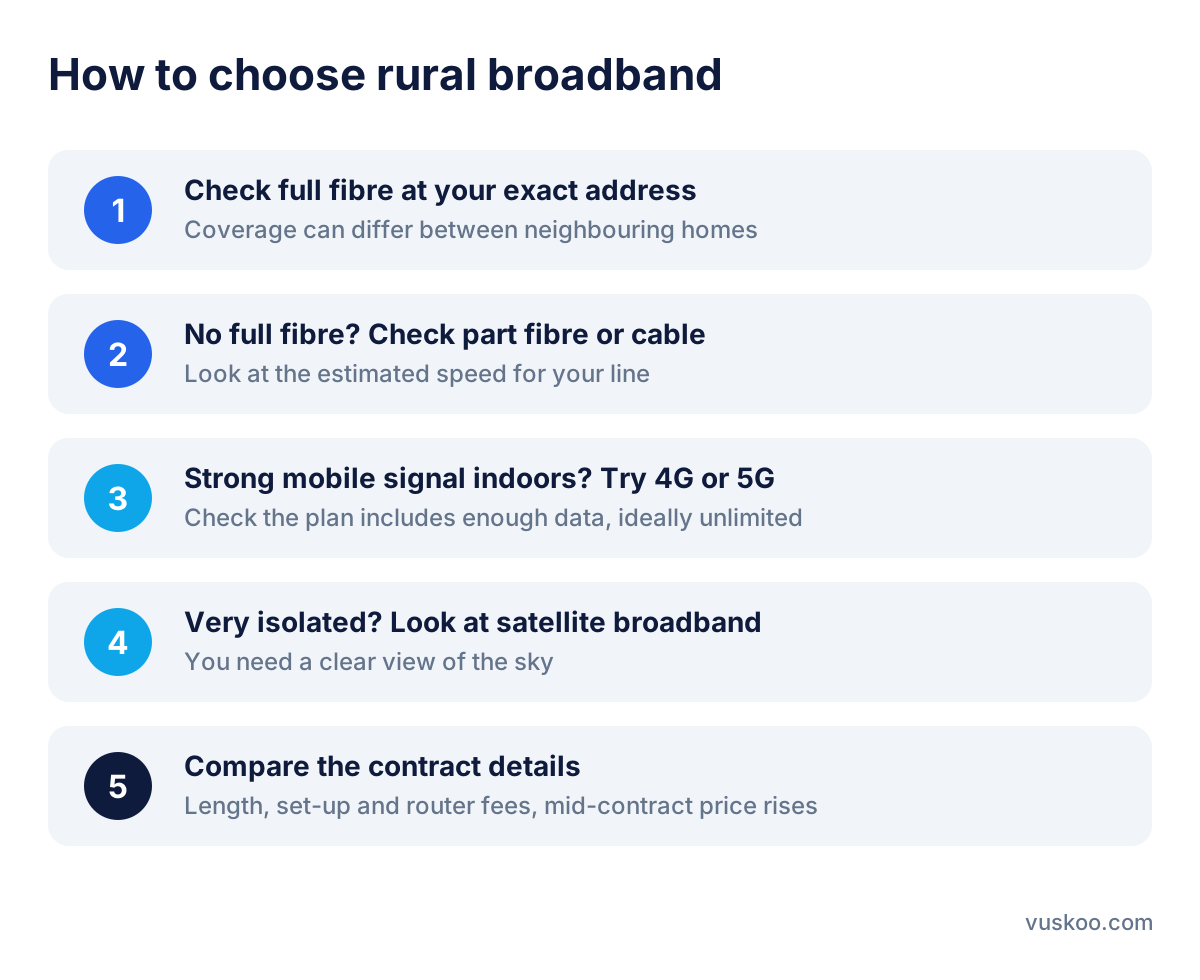
To find the right connection, follow these steps:
- Check full fibre availability for your exact address, not just your postcode. This is usually the first option to consider.
- If there is no full fibre, see whether part fibre or cable is available and what speeds are estimated for your line.
- Consider 4G or 5G home broadband if you have a strong mobile signal indoors.
- If you are truly isolated, look at satellite broadband.
- Compare contract length, set-up fees, router costs and any mid-contract price rises, and decide whether you need a landline or TV.
Comparing all of these deals by hand takes time. Vuskoo brings together broadband offers from UK providers so you can see which ones match your address and budget without visiting each provider's website.
Rural broadband FAQs
Can I get full fibre in my village?
It depends on your exact address. Full fibre coverage in rural areas keeps growing, but it can differ between neighbouring properties on the same road. Check availability using your full address.
What can I do if fibre doesn't reach my home?
If you can't get fibre, the main alternatives are 4G or 5G home broadband (if you have good mobile coverage) and, in very isolated areas, satellite broadband. Neither needs building work: you install a router or a dish.
Is 4G or 5G home broadband good enough for working from home?
With a strong, stable signal it can handle video calls and everyday use well. Performance depends on your location and how busy the local mast is, so check coverage at your address and look for a plan with enough data for your household.
Will my old copper phone line keep working?
The UK is moving landline services from the old copper network to digital technology. Your provider should contact you about any changes to your service. If you rely on a landline, ask your provider how the move affects you.
Is there public funding for rural broadband?
Yes, there are government-backed schemes to improve rural connectivity, but what is available depends on where you live. Your local council or national government website can tell you which schemes cover your area.
Compare the broadband options available at your address on Vuskoo and choose the connection that suits your home and your budget.
← Back to blog
Subscribe to our newsletter
The best deals and money-saving tips, straight to your inbox. No spam.