In this article
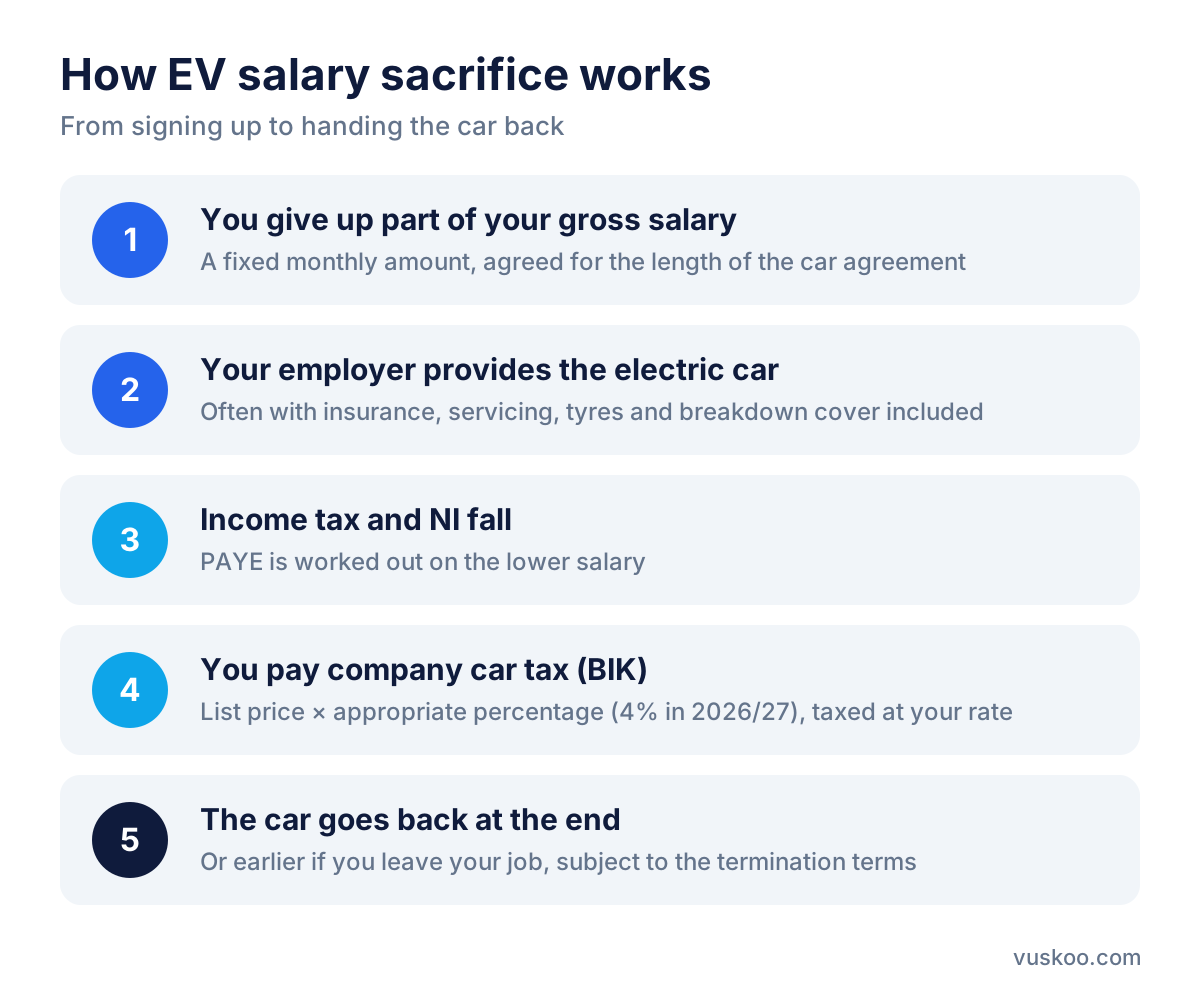
A salary sacrifice electric car is a car your employer leases and provides to you in exchange for a reduction in your gross salary. Because the payment comes out before income tax and National Insurance (NI), you pay less of both. In return, you pay company car tax (benefit-in-kind, or BIK) on the car, which for fully electric cars is set at 4% of the list price in 2026/27 and is scheduled to rise each year to 9% in 2029/30 and 10% in 2030/31. For most employees the scheme still works out cheaper than paying for the same car from take-home pay, but the gap narrows as BIK rises and the details of your contract matter.
How does salary sacrifice for an electric car work?
You agree a new employment contract term: your gross salary goes down by a fixed monthly amount, and your employer provides a car for that period. The employer usually arranges the car through a leasing or salary sacrifice provider, and the monthly amount often bundles in insurance, servicing, tyres, breakdown cover and road tax.
Because your salary is lower, your PAYE income tax and employee NI are calculated on the smaller figure. The car itself is a taxable benefit, so HMRC adds a BIK value to your taxable income. For a fully electric car that value is the car's list price multiplied by the "appropriate percentage" for the tax year.
Fully electric cars also sit outside the optional remuneration arrangement (OpRA) rules. HMRC's guidance says cars with CO2 emissions of 75g/km or less are excluded, so the normal BIK charge applies rather than a charge based on the salary given up. For petrol cars and most conventional hybrids above that threshold, the OpRA rules usually remove most of the tax advantage.
What are the BIK rates for electric cars to 2030?
The government has published the appropriate percentage for zero-emission cars several years ahead:
- 2026/27: 4%
- 2027/28: 5%
- 2028/29: 7%
- 2029/30: 9%
- 2030/31: 10%, announced at Budget 2026
A car leased today on a three or four-year agreement will cross several of these steps, so it is worth working out the cost in each year rather than only the first.
What do you really save? Worked examples
The figures below are illustrative. They use a hypothetical electric car with a £40,000 list price and a hypothetical gross sacrifice of £6,000 a year (£500 a month). They assume rest-of-UK income tax rates (20% basic, 40% higher) and employee NI of 8% on earnings between the primary threshold and upper earnings limit, and 2% above it. Scottish taxpayers have different income tax bands, so their numbers will differ.
Basic-rate taxpayer earning £35,000
- Tax and NI saved on the £6,000 sacrificed: 20% + 8% = £1,680
- Reduction in take-home pay before BIK: £4,320 a year
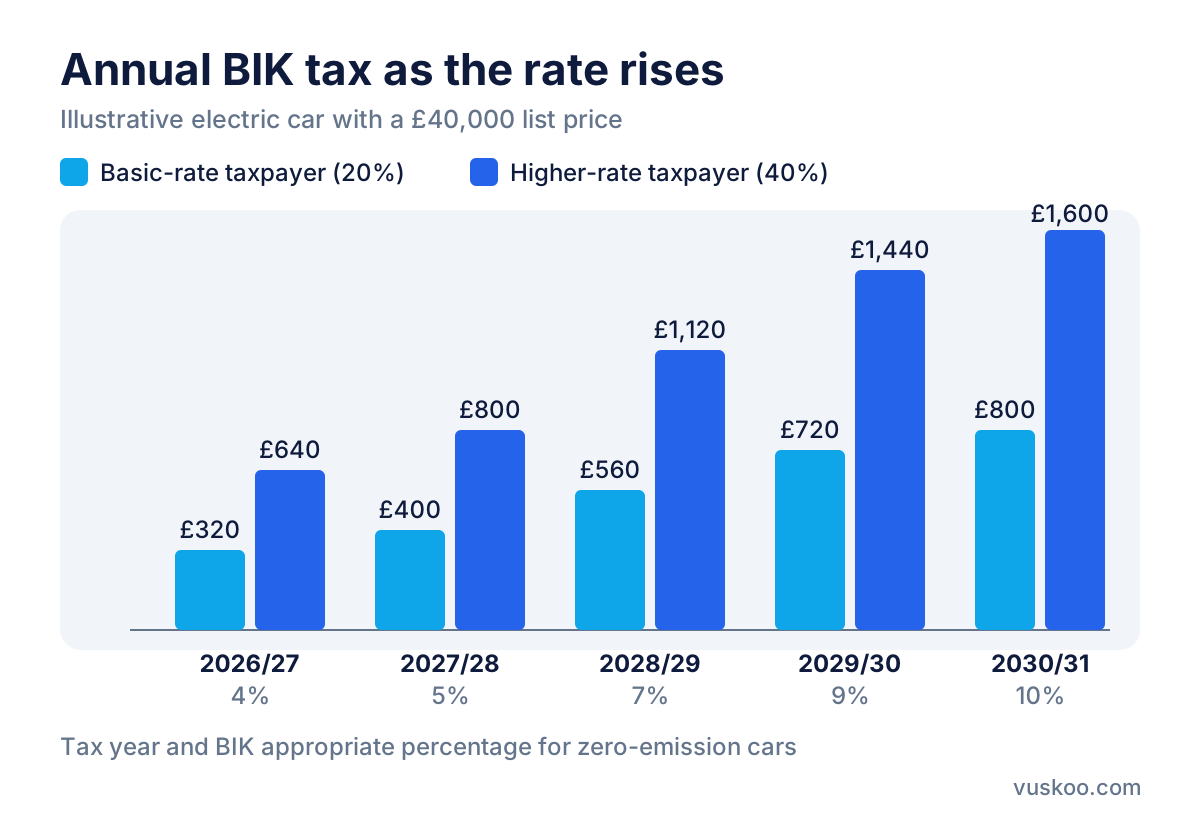
- BIK tax at 4% (£1,600 taxable benefit × 20%): £320
- Net cost in 2026/27: £4,640 a year, about £387 a month
As BIK rises, the extra tax is £400 at 5%, £560 at 7%, £720 at 9% and £800 at 10%. At 9% the net cost becomes £5,040 a year, about £420 a month.
Higher-rate taxpayer earning £70,000
- Tax and NI saved: 40% + 2% = £2,520
- Reduction in take-home pay before BIK: £3,480 a year
- BIK tax at 4% (£1,600 × 40%): £640
- Net cost in 2026/27: £4,120 a year, about £343 a month
The BIK tax rises to £800 at 5%, £1,120 at 7%, £1,440 at 9% and £1,600 at 10%. At 9% the net cost is £4,920 a year, about £410 a month.
Compare both with paying £6,000 a year from net pay for the same car and package: the basic-rate employee is around £1,360 a year better off in 2026/27 and the higher-rate employee around £1,880. By 2029/30 those gaps shrink to about £960 and £1,080. Higher-rate taxpayers gain more per pound sacrificed, but they also feel each BIK rise twice as hard.
Your employer also saves employer NI on the salary you give up. Some pass part of that saving into the monthly price, which is worth asking about. For people near the £100,000 point where the personal allowance is withdrawn, or within the £60,000 to £80,000 range of the High Income Child Benefit Charge, a lower salary can have knock-on benefits, but get the figures checked against your own payslip.
What to check before you sign
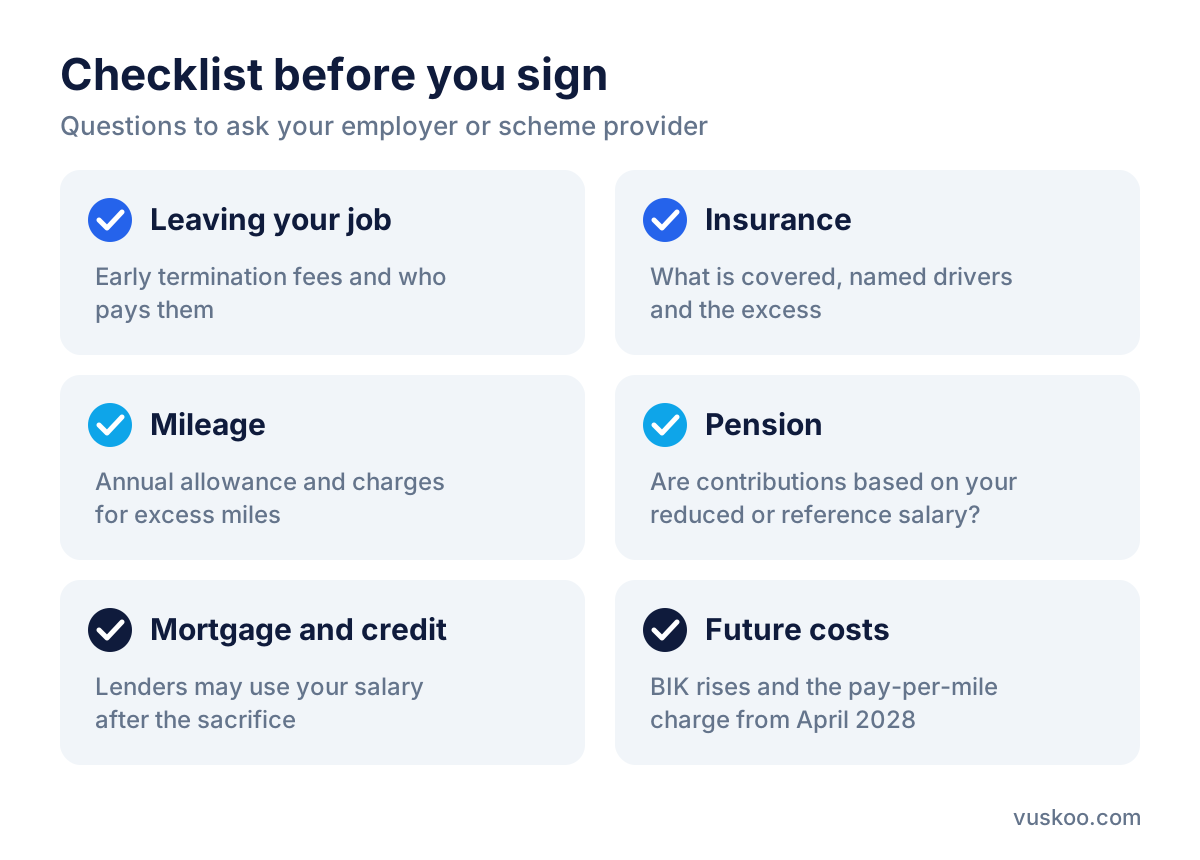
The tax saving is only part of the picture. These points decide whether the scheme suits you:
- Leaving your job: the car is tied to your employment. Check what happens if you resign, are made redundant or are dismissed, and whether early termination fees apply or are covered by the employer or provider.
- Long-term sickness and parental leave: ask whether there is protection if your pay drops, and how the sacrifice interacts with statutory pay.
- Insurance: find out what is included, who can be added as a named driver, the excess, and whether your no-claims history is used or built.
- Mileage: agreements set an annual mileage allowance with charges for excess miles. Estimate honestly, including any change in commute.
- Pension: if your employer calculates pension contributions on your reduced salary, both you and your employer may pay in less. Many employers use a reference salary instead; ask which applies.
- Mortgage and credit applications: lenders may look at your post-sacrifice salary, and some treat the commitment like a regular outgoing. If you plan to remortgage or buy, check with a broker first.
- Minimum wage: employers cannot reduce cash pay below the National Minimum Wage through salary sacrifice, which can limit access for lower earners.
- Future running costs: a pay-per-mile charge for electric cars, set at 3p per mile from April 2028 at Budget 2025, will add to costs. Ask whether it is included in the monthly amount or charged to you.
Salary sacrifice or personal lease?
A personal lease is paid from your take-home pay, so there is no tax or NI saving, but there is also no BIK charge, no link to your job and no effect on your pension or declared salary. Insurance and servicing are usually separate, so compare like for like: add the cost of insurance and maintenance to a personal lease quote before setting it against a salary sacrifice package.
A practical way to compare is to convert the salary sacrifice offer into net monthly cost for each year of the agreement using your own tax band, then compare that with the personal lease monthly payment plus extras. Look at the same car, term and mileage. Among the electric models in the offers alongside this article are the Kia EV6, Suzuki e Vitara, Polestar 2 and Tesla Model 3; hybrids such as the Toyota Yaris and Corolla generally fall within the OpRA rules, so salary sacrifice is rarely the right comparison for them.
For a personal lease, the monthly price depends on the initial payment, the term, the annual mileage and whether maintenance is included, so check all four when comparing quotes.
Frequently asked questions
Is salary sacrifice for an electric car worth it?
For most basic and higher-rate taxpayers it costs less than paying for the same car and package from net pay, because the tax and NI saving is larger than the BIK charge. The advantage shrinks as BIK rises towards 9% and 10%, and job security and mileage needs can outweigh it.
Does salary sacrifice affect my pension?
It can. If contributions are based on your reduced salary, less goes into your pension. Ask your employer whether they use your pre-sacrifice salary for pension purposes.
What happens if I leave my job?
The car usually has to be returned, and early termination charges may apply unless your employer or the provider covers them. Read the termination terms before you sign.
Can plug-in hybrids be used for salary sacrifice?
Plug-in hybrids with CO2 emissions of 75g/km or less are outside the OpRA rules, but their BIK rate is higher than for fully electric cars, so the saving is smaller.
Will the BIK rate change again?
The published rates run to 10% in 2030/31. Rates are set by the government at fiscal events, so check the current figures before committing to a long agreement.
Photo: geralt / Pixabay