In this article
- How to choose a SIM-only deal
- Why switch to SIM-only when your handset contract ends?
- How much data do you really need?
- How do annual price rises work since January 2025?
- Which kinds of provider keep prices fixed?
- Rolling 30-day plan or 12- to 24-month contract?
- How to switch without losing your number
- Frequently asked questions
How to choose a SIM-only deal
SIM-only deals give you calls, texts and data without a handset. That makes them a cheaper option once your phone is paid off, or if you're on a plan you no longer need. To choose one, check three things: how much data you really use, whether the price can go up during the contract (and by how much), and whether a rolling 30-day plan suits you better than a 12- or 24-month contract. Get those right and comparing the deals on this page becomes much easier.
This guide goes through each one in turn. It's written for people coming to the end of a handset contract or paying more than they need to.
Why switch to SIM-only when your handset contract ends?
A handset contract bundles two costs: paying off the phone and the airtime (your minutes, texts and data). Once the phone is paid off, some older contracts keep charging the same monthly amount unless you act. Ofcom rules mean your provider has to tell you when your minimum term is ending and show you its best available deals. Use that reminder as a cue to shop around rather than staying put.
Before you switch, check that your phone is unlocked. Most phones sold in the UK in recent years are unlocked as standard, but older ones may not be. Your phone's settings or your current network can tell you.
How much data do you really need?
Many people pay for more data than they use, while others keep running out and buying add-ons. The way to find out which group you're in is to look at your own usage, not to guess.
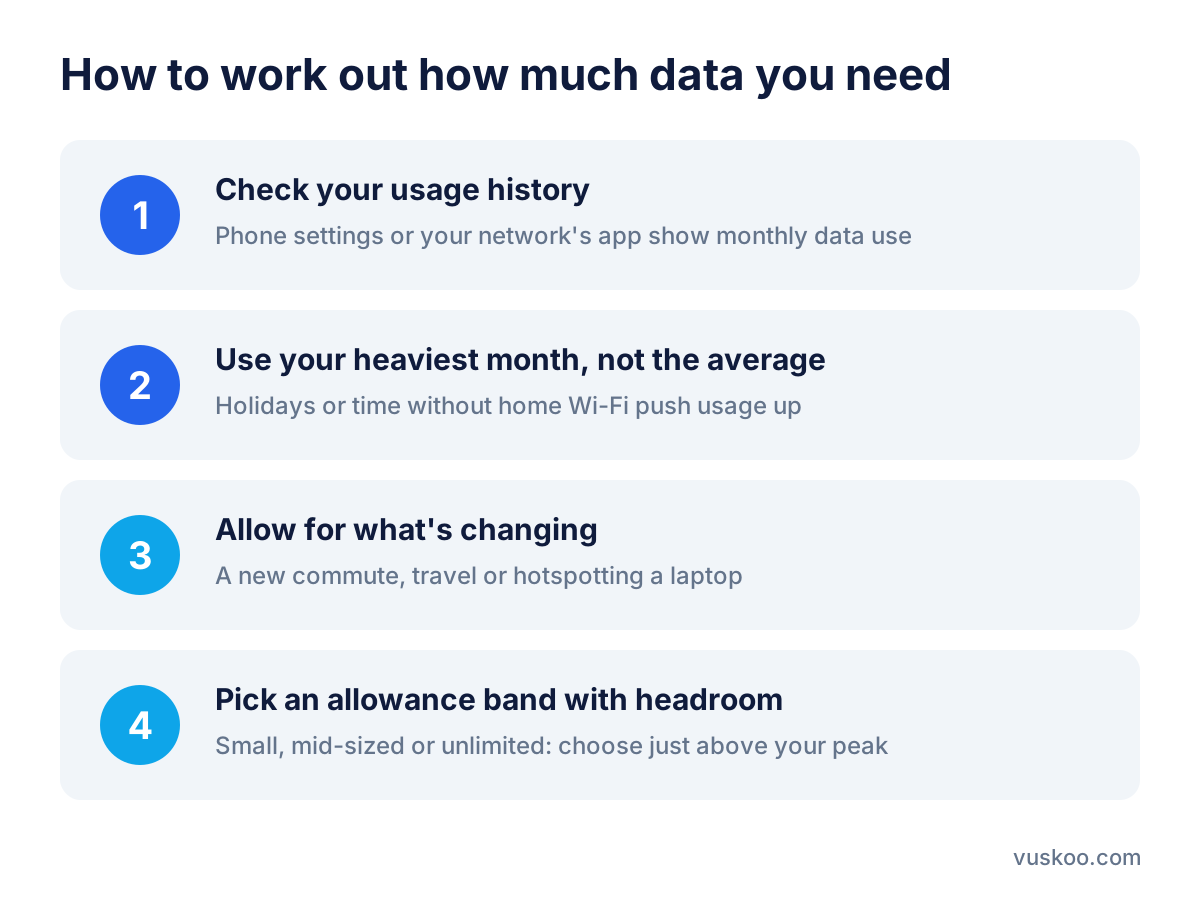
- Check your usage history. On most phones, the mobile data (or cellular) section of the settings shows how much you've used. Your network's app or online account usually shows a monthly breakdown too.
- Look at your heaviest month, not the average. A holiday, a house move or a stretch without home broadband can push usage up. Plan for those months so you don't hit your limit.
- Think about what's changing. Starting a commute, working away from home or using your phone as a hotspot for a laptop can increase usage a lot.
- Pick a band with some headroom. Plans broadly fall into small allowances, mid-sized ones and unlimited. Choose the band just above your heaviest realistic month.
What uses the most data?
Streaming video uses far more data than anything else on a typical phone, followed by video calls and music streaming. Messaging, email and web browsing use comparatively little. If you mostly stream on Wi-Fi at home and at work, a smaller allowance may be enough. If you watch video on the move or tether other devices, an unlimited plan is often worth comparing. Check the fair-use terms and any limits on tethering or speed, because "unlimited" doesn't always mean the same thing on every network.
How do annual price rises work since January 2025?
For years, many mobile contracts went up every April by an amount linked to inflation (CPI or RPI) plus a fixed percentage. You couldn't know in advance what you'd pay later in the contract. Ofcom banned this approach for new contracts, and from January 2025 any price rise written into a contract has to be stated upfront in pounds and pence.
In practice, this means:
- The rise is a fixed amount. Your contract summary should tell you exactly how much the monthly price will go up, and when (usually each April).
- You can work out the full cost. Add the scheduled rises to the starting price to get the real cost over the whole term, not just the first few months.
- Unplanned rises come with an exit right. If a provider raises prices in a way that wasn't set out in your contract, it has to give you notice, and you can leave without paying an early termination charge.
When you compare deals, don't just look at the headline monthly price. Check whether a rise applies, how much it is in pounds and pence, and how many times it'll kick in during the contract. On a 24-month plan that started just before April, you could pay two rises.
Which kinds of provider keep prices fixed?
Providers broadly fall into two groups. The large networks that own their own infrastructure (EE, O2, Three and Vodafone) generally include a fixed annual rise in their pay-monthly contracts. Their SIM-only deals may still come with perks, such as bundled extras or roaming options, so it's worth weighing these against the scheduled increase.
Many smaller brands that run on those networks take a different approach. At the time of writing, SMARTY, Voxi and iD Mobile say their SIM-only plans don't carry annual mid-contract rises. giffgaff offers a no-rise guarantee on some longer SIM-only plans, depending on when you sign up. Tesco Mobile freezes the price of its Clubcard Price deals for the minimum term, while its standard plans can rise each year. These policies change, so check the contract summary before you sign up. It must say whether the price can go up.
Which network does each brand use?
Smaller brands use the coverage of a host network, so coverage where you live and work depends on that network rather than on the brand. Check the coverage checker for the host network at your home and work postcodes before you commit.
Rolling 30-day plan or 12- to 24-month contract?
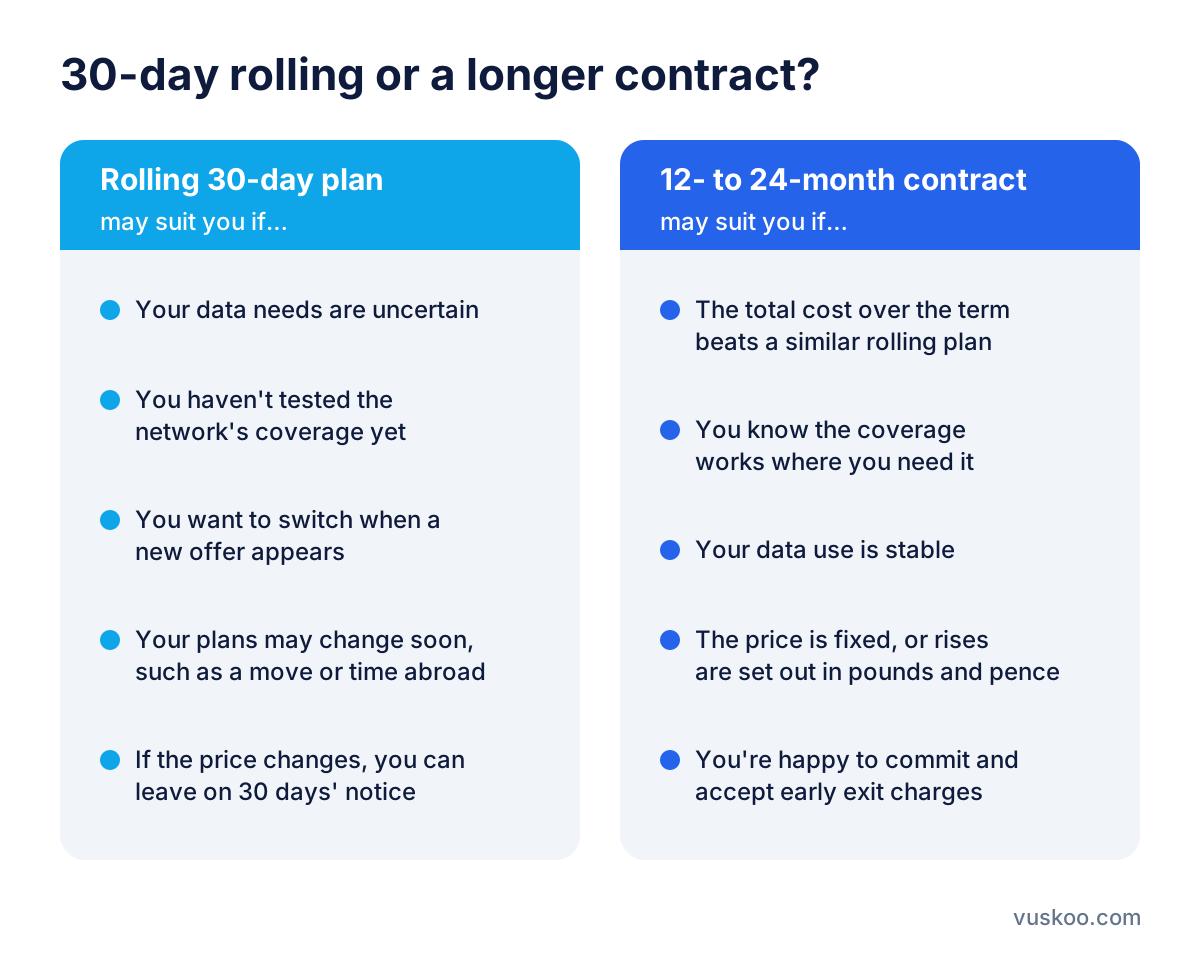
A rolling plan runs month to month, and you can usually cancel with 30 days' notice. A fixed-term contract ties you in for a set period, and leaving early usually means paying a charge for the remaining months.
When a 30-day plan makes sense
- You're not sure how much data you need and want to adjust it later.
- You haven't tried the network's coverage in your area yet.
- You like moving to a new offer whenever one appears.
- Your circumstances may change soon, for example a move or a long stay abroad.
When a longer contract makes sense
- The total cost over the term, including any scheduled rises, is lower than an equivalent rolling plan.
- You know the coverage works for you and your data use is stable.
- The price is fixed for the term, or the rises are small enough that the deal still comes out ahead.
Rolling plans can also change price, but because you're not tied in, you can simply leave if they do. That flexibility is often what makes them worth considering, even when a 12- or 24-month contract looks slightly cheaper on day one.
How to switch without losing your number
- Text INFO to 85075 to check whether you're still in contract and whether any early exit charge applies.
- To keep your number, text PAC to 65075. To get a new number, text STAC to 75075. The code arrives by text and is valid for 30 days.
- Order your new SIM and give the code to your new provider, which arranges the switch.
- Your old service ends when the switch happens. You don't need to cancel it separately.
Frequently asked questions
Are SIM-only deals cheaper than a handset contract?
Usually, if you already own a phone you're happy with, because you're not paying off a handset. To check, compare the total cost of a new SIM-only plan with what you'd pay staying on your current contract.
Can my SIM-only price still go up mid-contract?
Yes, if your contract includes a scheduled rise. Since January 2025, new contracts have to state it in pounds and pence. If a provider raises prices outside those terms, you can leave without penalty.
Is unlimited data really unlimited?
It depends on the provider. Some plans have fair-use policies, limits on tethering or speed caps. Read the plan details before you choose.
Will my phone work with any SIM-only provider?
It will if it's unlocked and supports the network's bands. For 5G, check that both your phone and the plan include it.
Can I keep my number if I switch?
Yes. Text PAC to 65075, then give the code to your new provider.
Photo: tomekwalecki / Pixabay