
In this article
A student bank account is a current account for people starting or already in higher education. Its main feature is usually an interest-free arranged overdraft, which often goes up as you move through your course, and there's usually some kind of sign-up perk too. Before you pick one, check three things. Is the overdraft limit guaranteed, or only "up to" a figure? How long does it stay interest-free after you graduate? And is the perk worth more to you than the account's long-term terms?
What is a student bank account?
It works much like any other current account. You get a sort code and account number, a debit card, a banking app and somewhere for your student loan, wages and other money to go. The difference is that the bank knows you'll be on a low income for a few years and hopes you'll stay as a customer after you graduate. That's why student accounts usually come with an interest-free overdraft and a perk when you sign up.
Three providers in our comparison offer a dedicated student account: HSBC (Student Bank Account), NatWest (Student Account) and Barclays (Student Additions Account). App-based providers such as Monzo, Starling Bank and Chase UK offer standard personal current accounts instead. Many students use one of these alongside a student account for budgeting tools, savings pots and spending alerts. Nationwide, Santander and first direct are also in our comparison, but the accounts listed for them are standard current accounts and switching offers, not student products.
How do interest-free overdraft tiers work?
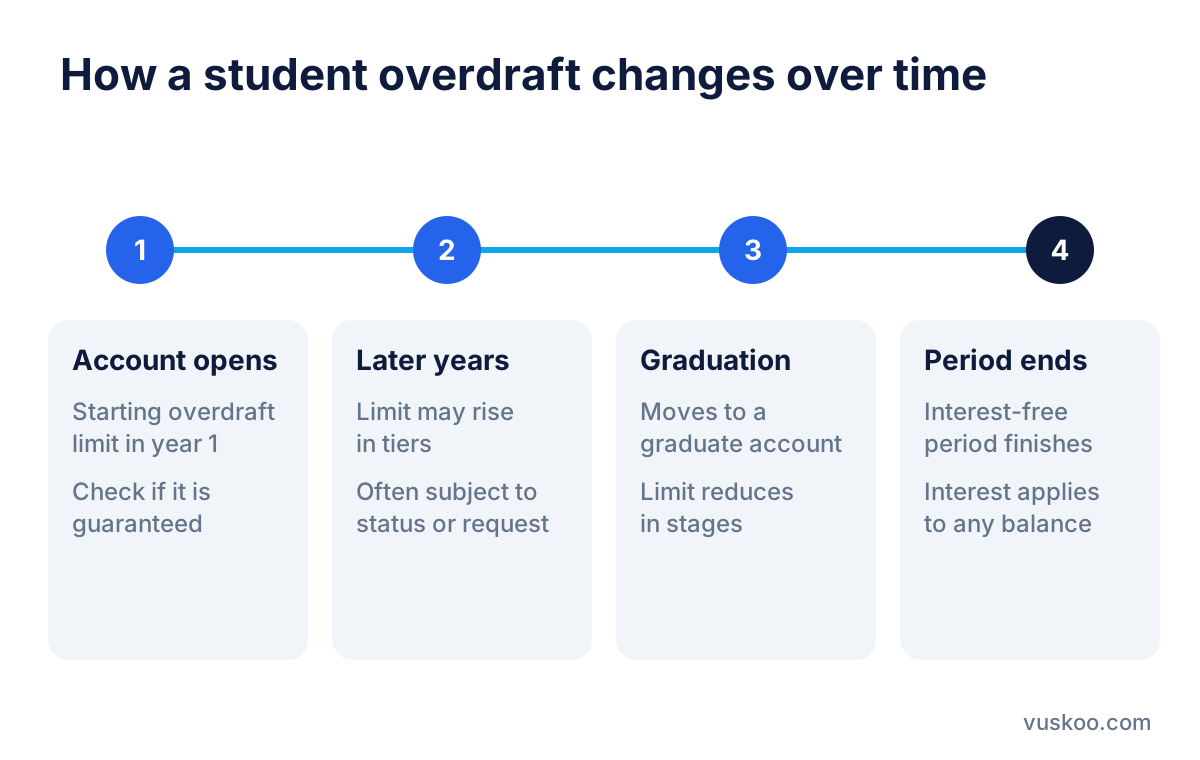
Most student accounts don't give you the full overdraft on day one. The limit is usually set in tiers: a starting amount when you open the account, with the possibility of more in later years of study. Two points matter here.
- Each increase is often "subject to status". The bank can look at how you've run the account, your credit history and whether you've paid money in regularly before it raises your limit. Some banks also expect you to apply for each increase rather than getting it automatically.
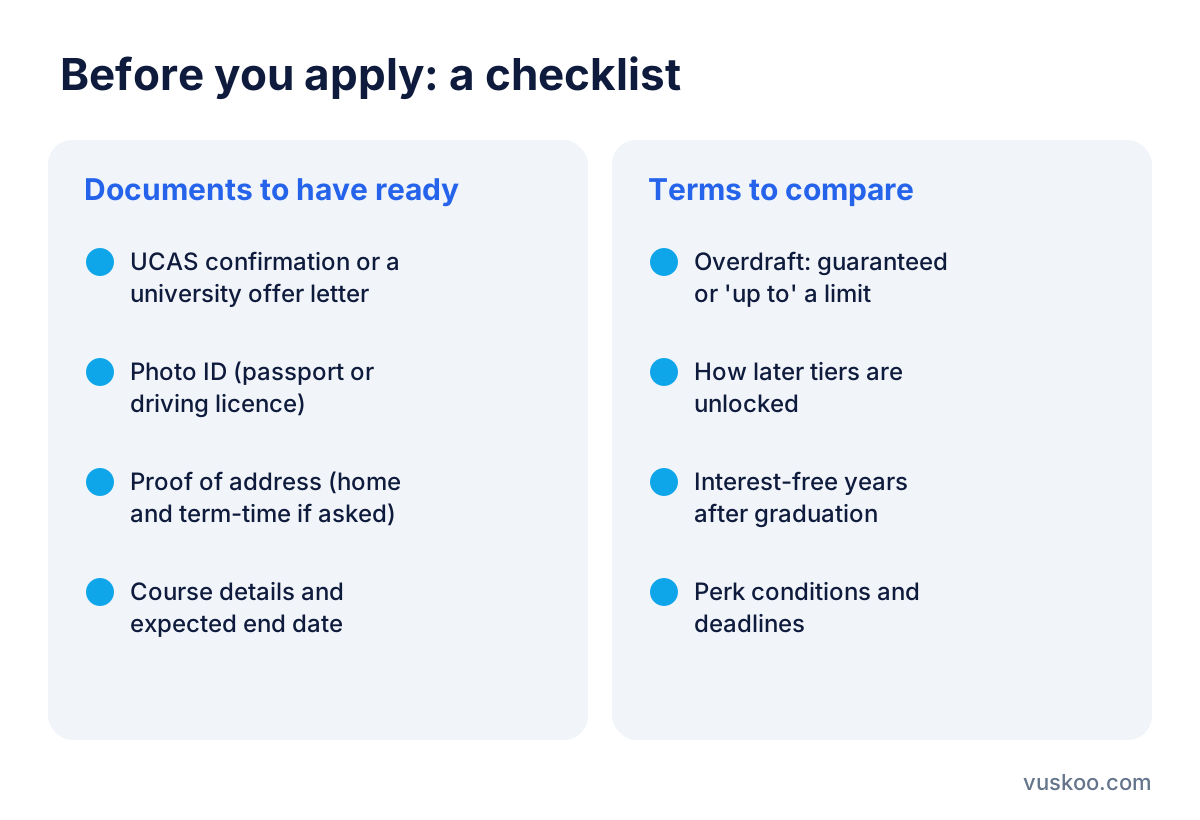
- "Guaranteed" and "up to" mean different things. A guaranteed limit means you get the advertised amount as long as you meet the account's conditions. An "up to" limit is the most you might get, and the bank decides the actual figure.
When you compare accounts, look past the headline number. Check the limit you can count on in your first year, what you have to do to unlock the next tier, and whether the bank says the amounts are guaranteed.
An overdraft is still borrowing
An interest-free overdraft costs nothing while you're a student, but you still have to pay it back. Using an arranged overdraft shows up on your credit file. Going beyond your agreed limit, or leaving a balance outstanding after the interest-free period ends, can lead to charges and make it harder to borrow later. A sensible approach is to treat the overdraft as a safety net and keep track of how much of it you've used.
What happens to a student account after graduation?
When your course ends, most banks move you onto a graduate account. Usually the interest-free overdraft doesn't disappear straight away. Instead, it shrinks in stages over a set number of years, so you have time to pay it off once you're earning. How long you get, and how quickly the limit comes down, varies between banks, so check this before you open the account rather than after you graduate.
Questions worth asking:
- How many years does the interest-free period last after the course ends?
- By how much does the limit drop each year, and is that automatic?
- What interest rate applies to any balance left when the interest-free period ends?
- Do you have to tell the bank your graduation date, or does it work it out from the details you gave at sign-up?
If you'd rather move to a different bank after graduating, an overdraft balance can complicate switching. That's because the new bank has to agree to take on that borrowing. Paying the overdraft down first gives you more options.
Who can open a student bank account, and what documents do you need?
Eligibility rules differ between banks, but they usually involve:
- Being over a minimum age, usually 17 or 18.
- Living in the UK, often for a minimum period.
- Starting or studying a full-time undergraduate course (some banks also accept certain postgraduate or other courses) lasting a set minimum number of years.
- Not already holding a student account with another bank. Most banks only let you have one at a time.
Common documents and details:
- Proof of student status, such as your UCAS confirmation (often the 16-digit UCAS code) or a letter from your university or college confirming your place.
- Photo ID, such as a passport or driving licence.
- Proof of address, sometimes your home address and your term-time address.
Many banks let you apply once your place is confirmed, so the account can be ready when your first student loan payment arrives. International students may face different rules and should check with each bank which documents it accepts.
How to weigh sign-up perks against long-term terms
Student accounts often come with a sign-up incentive, such as cash, a railcard, vouchers or a subscription. These perks are designed to catch your attention, and they're a one-off. The overdraft and graduate terms will affect you for several years. A practical way to compare:
- Work out how much overdraft you're likely to need. If you don't expect to use one, the perk and the app features may matter more to you. If you do, the guaranteed overdraft limit and the length of the post-graduation interest-free period matter most.
- Read the perk conditions. Some perks require you to pay in a set amount, use the card, or register online within a time limit. Missing a step can mean missing out on the perk.
- Check what the perk is worth to you. A railcard is only useful if you travel by train, and a subscription you wouldn't otherwise pay for isn't really a saving.
- Compare the graduate terms side by side. A long, gradual run-down period can be worth more than a bigger perk if you expect to graduate with an overdraft balance.
- Look at the everyday features. Think about the app, spending notifications, savings pots, fees for using your card abroad and how easy it is to reach customer support.
Is your money protected?
Money held with UK-authorised banks and building societies is covered by the Financial Services Compensation Scheme (FSCS). Since 1 December 2025, the limit has been £120,000 per person, per banking licence. Some brands share a licence, so if you hold accounts with more than one brand in the same group, the limit applies once in total. Few students hold balances anywhere near that figure, but it's worth knowing that the cover applies to app-based banks as well as high street ones, as long as they're authorised.
Frequently asked questions
Can I have more than one student bank account?
Banks usually only let you open a student account if you don't already hold one elsewhere, mainly because of the interest-free overdraft. You can still open standard current accounts, such as those from Monzo, Starling Bank or Chase UK, alongside a student account.
Is the interest-free overdraft guaranteed?
That depends on the bank and the wording. Some limits are guaranteed if you meet the account's conditions. Others are "up to" a figure and subject to status, especially the increases in later years. Read the overdraft section of the terms before you apply.
Do I need a student bank account to receive my student loan?
No. Your student loan can be paid into any UK current account in your name. A student account is optional, and its main appeal is the interest-free overdraft.
What happens if I leave my course early?
Banks generally expect you to tell them if you leave your course. The account may be moved onto different terms and the bank may ask you to pay back the overdraft over a set period. Check the terms and speak to the bank early if this applies to you.
Will opening a student account affect my credit score?
Applying for an account with an overdraft usually involves a credit check, and how you manage the overdraft is recorded on your credit file. Staying within your limit and paying the overdraft back on time helps build a positive history.
Photo: nattanan23 / Pixabay