
In this article
A student credit card is a credit card designed for people in higher education who have little or no credit history. It usually comes with a low credit limit and a representative APR higher than many mainstream cards. Used carefully, by spending small amounts and clearing the full balance every month, it lets you build a credit history without paying any interest. It is a different product from the interest-free overdraft that often comes with a student bank account, and the two suit different needs.
This guide explains what limits and rates to expect, who tends to be accepted, how to use a card to build your credit score and what to check before you apply. Current offers from providers such as HSBC, TSB and Zable are shown in the boxes next to this article.
What is a student credit card?
Lenders design these cards for applicants with what they call a "thin" credit file: no mortgage, no loans and no previous cards. Because the lender has little information about how you handle borrowing, it reduces its risk by setting a modest limit and pricing interest accordingly.
Some cards are marketed specifically to students, for example HSBC's Student Credit Card or the TSB Student Card. Others, such as Zable's card for students, are aimed at people with limited credit history in general. Mainstream cards like the Halifax Clarity Card, the Chase Credit Card or American Express cards are open to a wider range of applicants, but they often have income or credit history requirements that a first-year student may not meet.
Credit limits and APRs: what to expect
Credit limits
Student cards usually start with a low limit. That is partly the lender managing risk and partly a safeguard for you: a small limit makes it harder to run up a balance you cannot repay. Some lenders review the limit after a period of on-time payments.
You can control this. Under the Financial Conduct Authority's rules, you can ask your card provider not to offer you limit increases, and you can turn down or reduce any increase you are offered. Providers must give you notice before raising your limit unless you asked for the increase.
APR
The representative APR is the rate that at least 51% of accepted applicants get, so the rate you are offered may be different. For a student card the APR matters less than you might think. If you pay the full statement balance by the due date each month, you normally pay no interest on purchases. The APR becomes important as soon as you carry a balance from one month to the next.
When comparing cards, look beyond the headline rate:
- Purchase rate: what you pay on any balance you do not clear.
- Cash withdrawal rate and fee: cash advances are usually charged interest from the day you take the money out, with no interest-free period.
- Foreign transaction fees: relevant if you study abroad or travel.
- Late and over-limit fees: these also go on your credit file as negative markers.
- Annual fee: most student cards have none, but some reward cards do.
Who gets accepted for a student credit card?
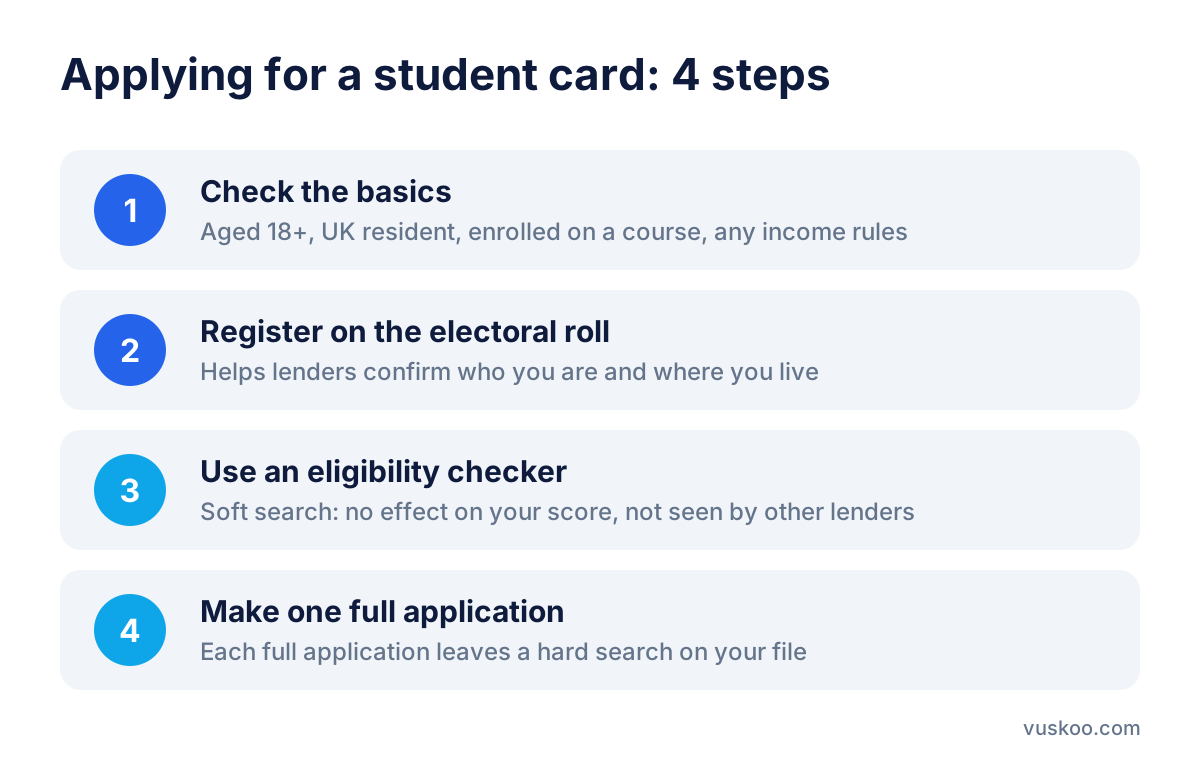
You must be at least 18 to get a credit card in the UK. Beyond that, the usual criteria are:
- being a UK resident, sometimes for a minimum number of years;
- being enrolled on a university or college course;
- in some cases, holding a student current account with the same bank (HSBC's card has required this);
- in some cases, having a regular income, even if small (TSB has listed this);
- having no serious negative markers on your credit file, such as defaults or county court judgments.
Criteria change, so read each provider's current requirements before applying. Two things can improve your chances: register on the electoral roll at your term-time or home address, and use the lender's eligibility checker first. Eligibility checkers use a soft search, which does not affect your credit score and is not visible to other lenders. They do not guarantee acceptance, but they help you avoid several full applications in a short period, each of which leaves a hard search on your file.
How to build your credit score with a student credit card
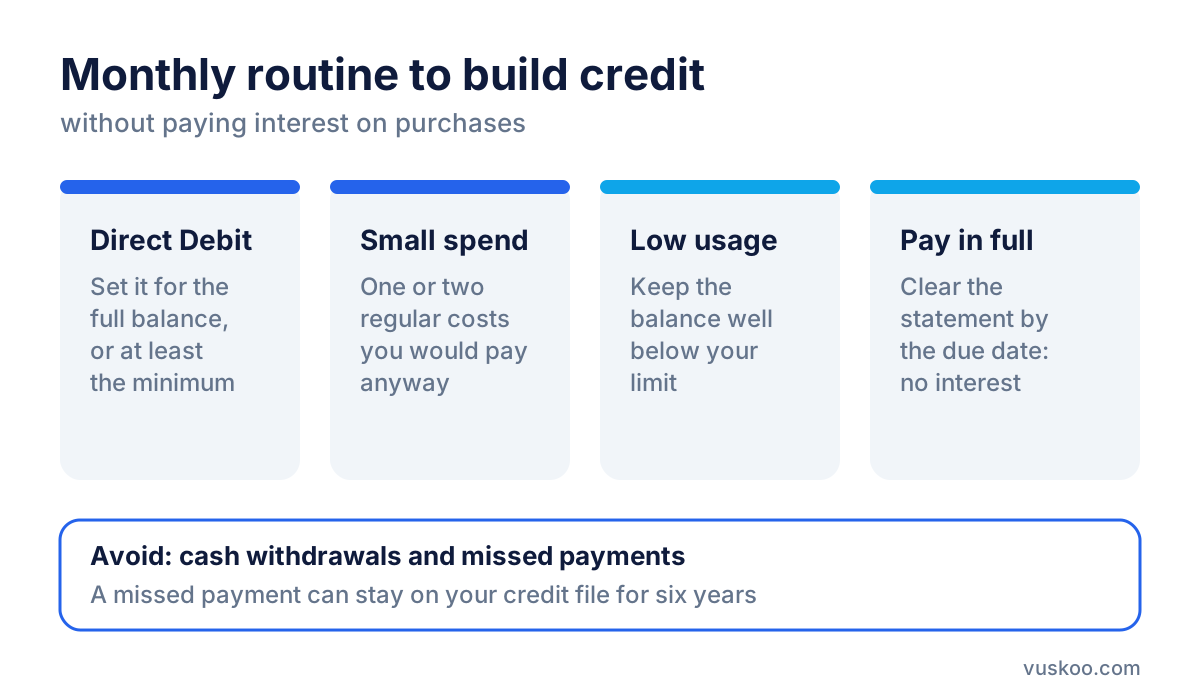
Lenders build a picture of you from your credit report, held by the credit reference agencies. A card helps that picture only if the account shows steady, on-time payments. A simple routine works well:
- Set up a Direct Debit for the full balance. If you cannot commit to the full balance, set it for at least the minimum payment so you never miss one. A missed payment can stay on your credit file for six years.
- Use the card for one or two small, regular costs you would pay anyway, such as a phone bill or a weekly shop.
- Keep your balance well below the limit. Using a large share of your available credit can count against you.
- Clear the full statement balance by the due date so no interest is charged on purchases.
- Avoid cash withdrawals, which are charged straight away and can look like a sign of financial stress.
- Check your credit report occasionally to make sure the account is being reported correctly.
Paying only the minimum keeps the account in good standing, but interest builds on the rest and the balance can take years to clear. If, over 18 months, you pay more in interest, fees and charges than you repay of the amount borrowed, the FCA treats this as persistent debt and your provider must contact you about repaying faster. If nothing changes after 36 months, the provider must offer a way to pay off the balance within a reasonable time, and it may suspend the card.
Student credit card or student account overdraft?
Many student current accounts come with an arranged overdraft that is interest-free up to a set amount while you study. This is often the first borrowing students use, and it works differently from a card.
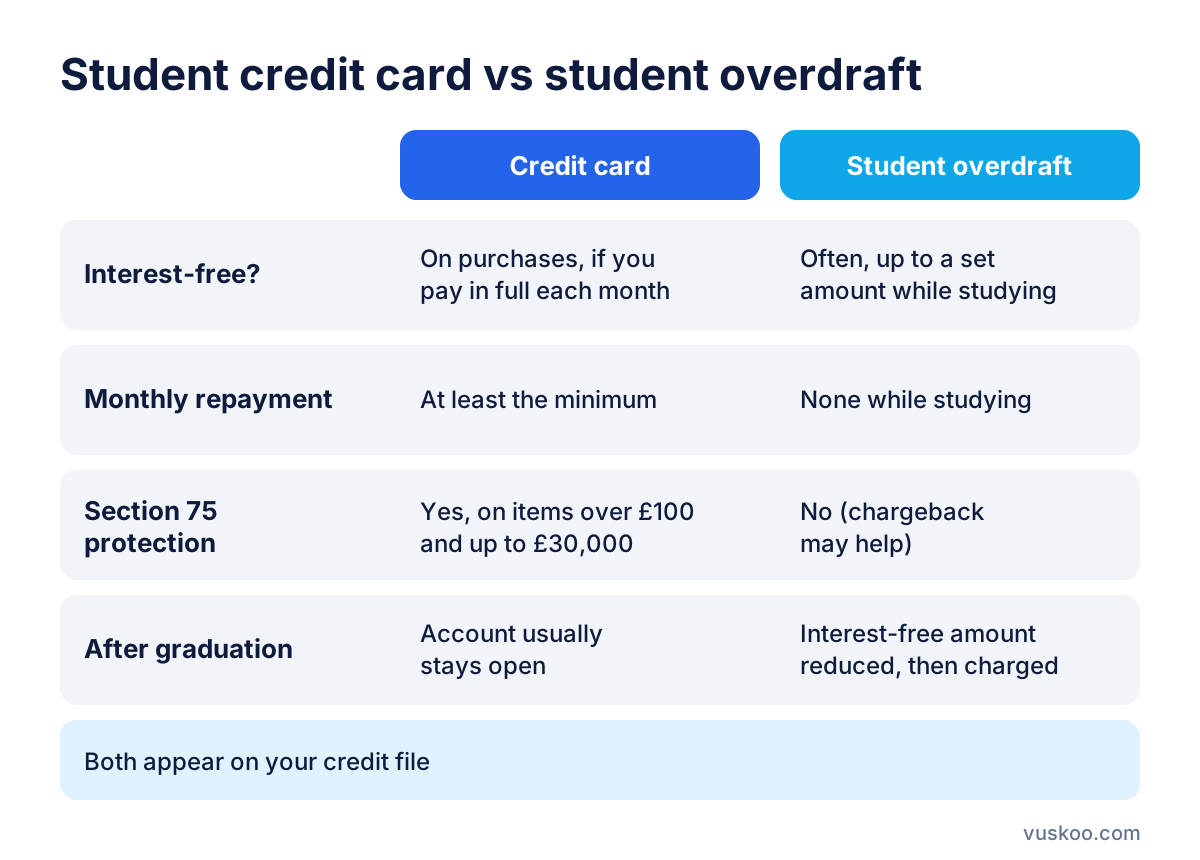
- Cost: an interest-free student overdraft costs nothing within its limit. A credit card costs nothing only if you clear the balance in full each month. Since April 2020, standard overdrafts must be charged with a single interest rate shown as an APR, with no fixed daily or monthly fees, so check what applies once you go over the interest-free amount or after you graduate.
- Repayment: an overdraft has no monthly repayment while you are a student. A card has a minimum payment every month.
- Credit history: both appear on your credit file, but a card that you pay on time each month creates a clear record of regular repayments.
- Protection on purchases: buying something costing over £100 and up to £30,000 with a credit card can give you Section 75 protection under the Consumer Credit Act. The card provider is jointly liable with the seller if the goods or service are faulty, misdescribed or never arrive. Debit card and overdraft spending does not have this protection, although chargeback may help.
- After graduation: the interest-free overdraft is usually reduced in stages and eventually charged. A credit card carries on, with the same terms unless the provider changes them.
For many students the two work together: the overdraft as a buffer for emergencies, and the card for small planned spending that is cleared every month.
What to check before applying
- Whether you meet the eligibility rules, including residency, course and income requirements.
- The representative APR and the purchase, cash and foreign transaction rates.
- Any annual, late payment or over-limit fees.
- Whether the card has an interest-free period on purchases if you pay in full.
- How the lender reviews limits, and whether you can opt out of increases.
- Whether rewards such as cashback or points come with a fee or stricter conditions.
- How easy it is to set up a Direct Debit and payment alerts in the app.
Frequently asked questions
Can I get a student credit card with no credit history?
Yes. Student cards are designed for people with little or no history. You still need to meet the lender's criteria, and being on the electoral roll helps lenders confirm your identity.
Does applying for a student credit card hurt my credit score?
A full application leaves a hard search on your file, which other lenders can see. Using eligibility checkers first, which use soft searches, reduces the number of applications you make.
Will I pay interest on a student credit card?
Not on purchases if you pay the full statement balance by the due date every month. Interest applies to any balance carried over and usually to cash withdrawals from the day they are made.
What happens to my student card when I graduate?
Usually the account stays open. Some providers move graduates onto a different card or review the limit. Check your terms or ask your provider.
Is a student credit card better than an overdraft?
Neither is better in general. An interest-free overdraft costs nothing within its limit, while a card paid in full each month builds a repayment record and offers Section 75 protection on qualifying purchases.
Photo: naassomz1 / Pixabay