
In this article
A travel rewards credit card gives you points or miles when you spend, and you can swap them for flights, hotel nights or other rewards. Whether one is worth having comes down to three numbers: how many points you earn per pound, what each point is worth in pence when you spend it, and what the card costs each year. Once you have those three numbers you can put an airline card, a hotel card and a flexible-points card side by side, and check whether a card with a fee beats a free one for the way you spend.
How does a travel rewards credit card work?
Each eligible purchase earns points in the card's loyalty scheme. Most UK cards fall into three groups:
- Airline cards earn the airline's own currency. The British Airways American Express® Credit Card, the British Airways American Express® Premium Plus Card and the Barclaycard Avios Plus all earn Avios, for example.
- Hotel cards earn points with one hotel group. The Marriott Bonvoy® American Express® Card is an example.
- Flexible-points cards earn the card issuer's own currency, which you can move to a partner scheme later. American Express Membership Rewards points, earned on cards such as the American Express® Preferred Rewards Gold Credit Card and The American Express® Rewards Credit Card, can be moved to airline and hotel partners, including British Airways Club and Marriott Bonvoy.
Some cards earn a different type of reward. The Nectar Credit Card earns supermarket points, and cashback cards such as the Amex® Cashback Credit Card or the Chase Credit Card pay cash. They are useful benchmarks because cash has a fixed value. A travel card is only worth choosing if its points beat that value once you redeem them.
How do you work out what a point is worth in pence?
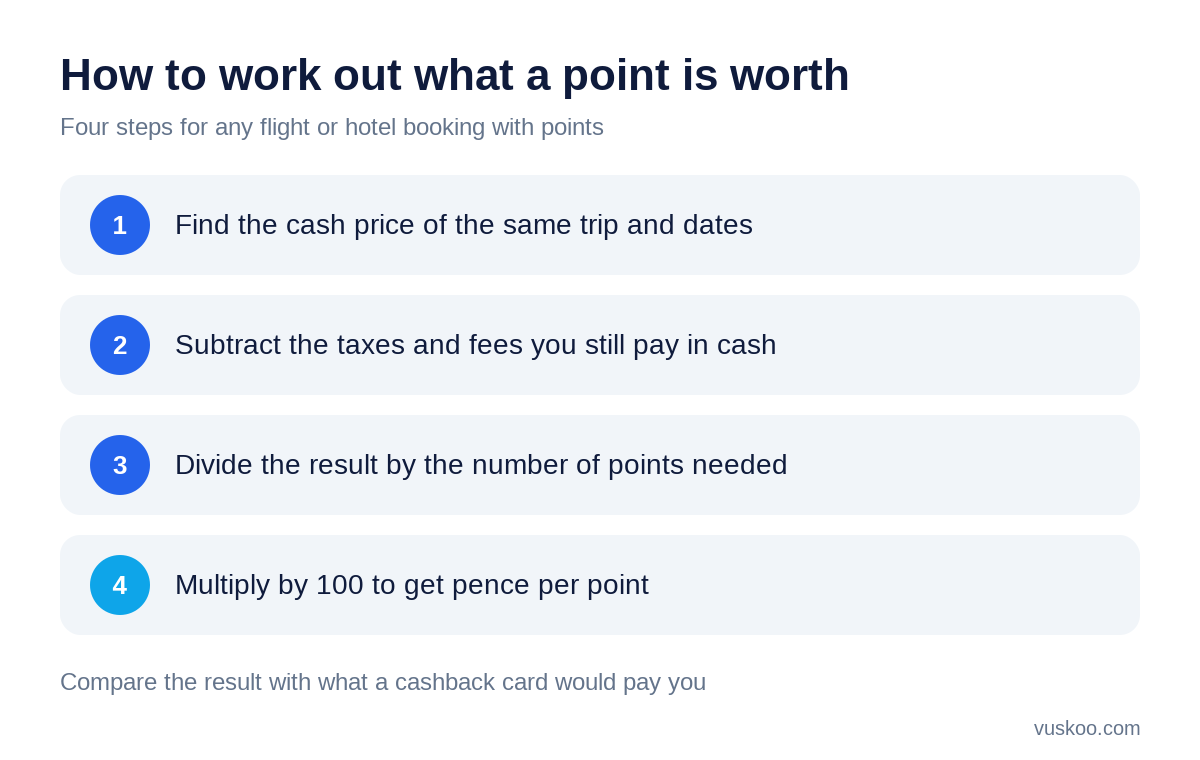
A point has no fixed value. What it is worth depends on what you swap it for. To check a particular redemption:
- Find the cash price of the same flight or room on the same dates.
- Take away any cash you still have to pay when using points, such as taxes, fees and carrier charges.
- Divide what is left by the number of points needed.
- Multiply by 100 to get the value in pence per point.
Here is a made-up example. A flight costs £400 in cash. The points booking needs 20,000 points plus £100 in taxes and charges. You save £300 for 20,000 points, which is 1.5p per point. If the same points only got you a £100 shopping voucher, they would be worth 0.5p each. The points are the same in both cases. The value is not.
Two points to keep in mind:
- Only count trips you would actually take. Points used on a premium-cabin seat you would never pay cash for can look very valuable on paper, but the real saving is only what you would otherwise have spent.
- Points have an opportunity cost. A booking made with points earns no points or cashback of its own, and points can lose value if a scheme changes its award charts.
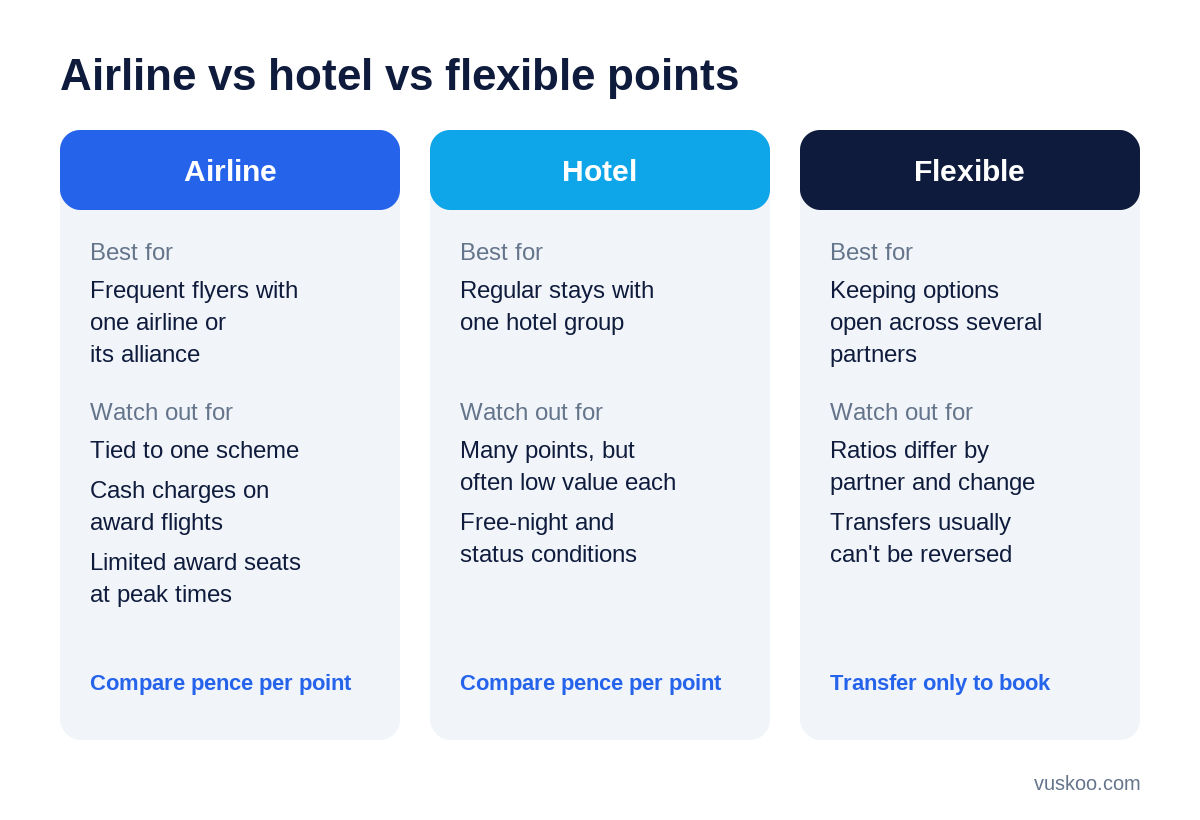
Airline vs hotel vs flexible points: which suits you?
Airline cards
These suit people who mostly fly with one airline or its alliance partners. Earning is simple and points go straight into the frequent-flyer account. Some airline cards also give a perk once you reach a spending threshold, so check what it is and whether you would use it. The downsides are that you are tied to one scheme, the cash charges on award flights can be high on some routes, and seats bookable with points are limited at busy times.
Hotel cards
These suit people who regularly stay with one hotel group. Hotel points tend to be earned in larger numbers but are often worth less each, so compare the pence-per-point value, not the headline earn rate. Some hotel cards give elite status or a free night after a set level of spending. Check the conditions, and whether the night can be used at the hotels and on the dates you want.
Flexible-points cards
These suit people who don't want to commit to one airline or hotel group yet. You hold the issuer's currency and move it to whichever partner gives the best value when you book. Before you transfer, check the conversion ratio for each partner, because it varies and can change. A transfer usually can't be undone: once points are in a partner scheme, they follow that scheme's rules. For most people, the sensible approach is to transfer only when you have a specific booking ready.
How do sign-up bonuses and spending thresholds work?
Many travel cards give extra points if you spend a set amount within a set number of months after opening the account. Before you count on a bonus:
- Check the spend and the time limit. Only aim for it if your normal spending reaches it. Buying things you don't need to hit a target wipes out the benefit.
- Check eligibility rules. Issuers often exclude people who have held the same card, or a card from the same family, recently.
- Check which spending counts. Balance transfers, cash withdrawals and some payment types usually earn no points and don't count towards the target.
- Check annual thresholds. Some perks only arrive if you spend a set amount within the card year. Work out whether your spending will really get there.
When does an annual fee pay off?
A card with a fee only makes sense if what you get from it beats the best free card you could have. The rough sum is:
- Value from the fee card = annual spend × points per £1 × pence per point, plus perks you would actually use and pay for otherwise.
- Value from the free alternative = the same spend on a free travel or cashback card.
- Net gain = value from the fee card − value from the free card − annual fee.
If the net gain is below zero at your normal spending, the fee doesn't pay for itself. To find the break-even spend, divide the fee by the extra value you get per pound compared with the free card. Count the sign-up bonus in year one only. After that the card has to justify its fee on everyday spending and perks alone. Be honest about perks such as lounge access, travel insurance or companion rewards. Only count them if you would have paid for them anyway.
Other costs to check before you apply
- Interest. Points rarely cover the cost of interest. A travel rewards card works best if you clear the balance in full every month.
- Spending abroad. Check the non-sterling transaction fee and cash withdrawal charges. Some cards suited to travel, such as the Halifax Clarity Card, are built around overseas use rather than points.
- Acceptance. American Express is accepted at fewer places than Visa or Mastercard, so a backup card can help.
- Card type. Section 75 of the Consumer Credit Act makes the provider jointly liable for credit card purchases priced over £100 and up to £30,000. It does not apply to charge cards or debit cards, so check which type you are getting.
Frequently asked questions
Is a travel rewards credit card better than a cashback card?
Only if you redeem points at a value higher than the cashback rate, after counting any fee. If you rarely travel or don't want the effort of planning redemptions, cashback is simpler.
Can I move Avios between cards?
Avios from different cards that earn British Airways Club Avios go into the same Club account. Membership Rewards points can be transferred to British Airways Club, but check the current ratio first.
Do points expire?
That depends on the scheme. Some points expire after a period with no account activity, and others are kept while the card is open. Check the scheme's terms, and use or transfer points before you close a card.
Does applying affect my credit score?
A full application leaves a hard search on your credit file. Use an eligibility checker first if one is available, and avoid making lots of applications close together.
Photo: Sinousxl / Pixabay