In this article
Are solar panels with a battery worth it in the UK? For many homeowners they are, but it depends on when you use electricity. A battery stores the daytime solar power you'd otherwise export cheaply, so you can use it in the evening. If you're out at work all day, can use a time-of-use tariff, or have an electric car or heat pump, a battery usually adds more value. If you're home all day and your budget is tight, solar on its own can give a shorter payback. In homes with a heavily shaded roof, or where you plan to move soon, it may be worth waiting.
The timing matters as well. Solar panels and batteries fitted in homes are zero-rated for VAT until 31 March 2027. From 1 April 2027 the rate goes up to 5%. The government's new Warm Homes Loan Scheme also offers cheaper finance for both.
What does solar with a battery cost in the UK?
The Energy Saving Trust, an independent advice body, puts the average solar panel installation at around £6,100. It puts an average 5 kWh battery at around £4,600. These are only averages. Your quote will depend on:
- System size: the number of panels and the total output in kilowatt-peak (kWp).
- Battery capacity: a battery with more usable kWh costs more but can cover more of your evening use.
- Inverter set-up: a hybrid inverter runs both the panels and the battery. Separate inverters can make it easier to add a battery later.
- Roof and access: scaffolding, roof type, cable runs and where the battery and inverter go.
- Extras: bird protection, an EV charger, a backup power function or monitoring apps.
Package offers from suppliers such as E.ON Next, EDF, British Gas and Octopus Energy are built around set panel counts or system sizes, and some include a battery. Their current prices are shown next to this article. Check whether a package price is fixed or a starting price that can rise after a survey.
How does a battery change your savings?
Solar panels produce most of their power around midday. Many households use most of theirs in the morning and evening. Without a battery, any electricity you don't use when it's generated goes to the grid. With the Smart Export Guarantee you're paid for that power, but usually less than you'd pay to buy electricity back.
A battery closes that gap by storing surplus solar for later. You use more of your own generation and buy less from the grid. Research by the Energy Saving Trust found that solar panels cut bills in every scenario it modelled. It found the largest reductions in homes that combined solar, a battery and a heat pump on a suitable tariff. It also warned that, at current prices, a battery doesn't always pay for itself.
Time-of-use tariffs
Time-of-use tariffs charge less for electricity at certain hours, usually overnight. A battery can charge during the cheap hours, especially in winter when solar output is low, and power the house when rates are higher. That gives the battery value all year round, not just in summer. Compare how many cheap hours each tariff gives you, the gap between peak and off-peak rates, and whether you need a smart meter.
The Smart Export Guarantee
Under the Smart Export Guarantee (SEG), you're paid for the electricity you send to the grid. There is no fixed SEG rate. Each supplier sets its own, and the only rule is that the rate must be above zero. The payments don't start automatically. You have to sign up for an export tariff, and you need a smart meter that records your exports. Ofgem's guidance also requires an installation certificate, normally from MCS, the Microgeneration Certification Scheme. You don't have to take your export tariff from the supplier that fitted your panels, so compare tariffs.
Solar alone, solar with a battery, or neither?
Use the guide below to see which set-up fits how your household uses energy.
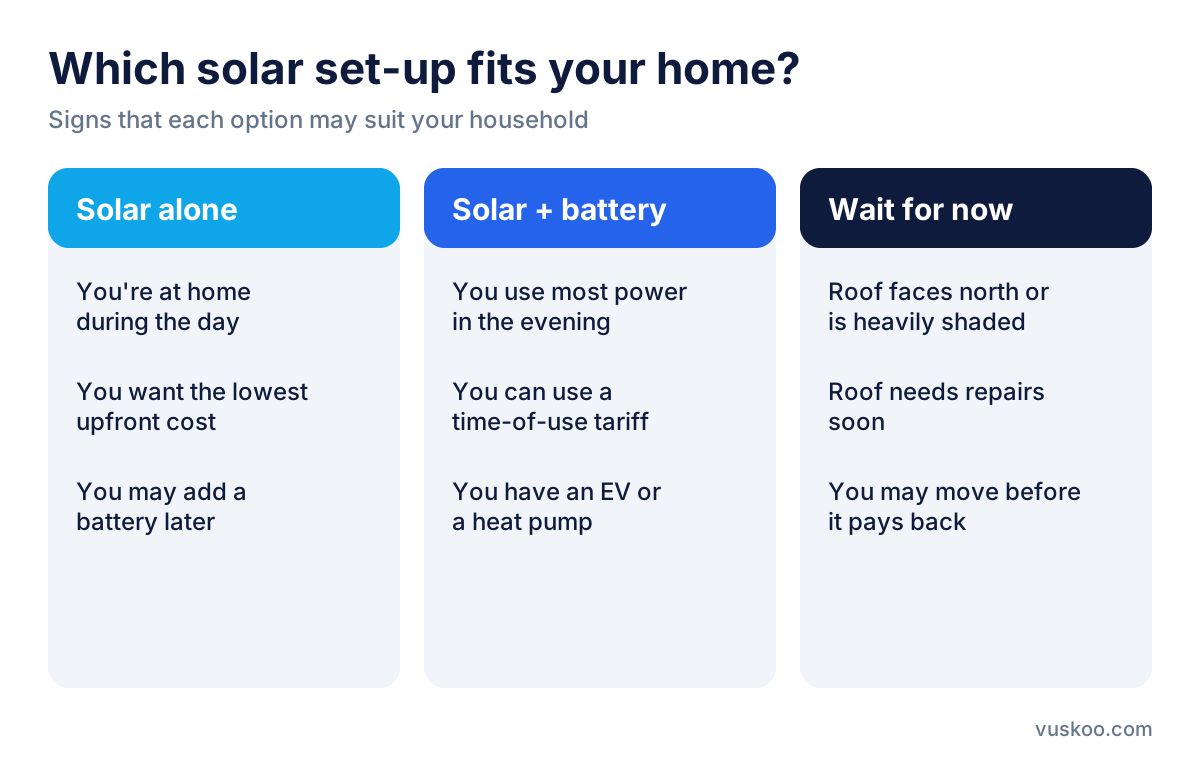
- Solar alone often suits households that are at home in the daytime, such as retired people or people who work from home. It also suits anyone who wants the lowest upfront cost.
- Solar with a battery tends to suit households that use most of their electricity in the evening, run an electric car or heat pump, or can use a time-of-use tariff.
- Waiting can make sense if your roof faces north, is heavily shaded or needs repairs soon, or if you expect to move before the system has paid for itself.
You can add a battery later. If you think you will, ask for an inverter that can take one, so you don't have to replace it.
How to work out the payback time
Payback time is the number of years it takes for your savings and export income to cover the cost of the system. No single figure fits every home, so work out your own:
- Start with the total installed cost from the quote, including VAT and any extras.
- Estimate how many kWh of solar power you'll use each year, with and without a battery, and multiply by your electricity unit rate.
- Add your estimated yearly export income under the SEG.
- If you have a time-of-use tariff, add the saving from charging the battery at off-peak rates.
- Divide the total cost by the total yearly benefit. Then compare the result with the warranty periods, as a battery may need replacing before the panels do.
Run the sums twice: once for solar alone and once for solar with a battery. If the battery adds a lot to the cost but only a little to the yearly saving, it will lengthen your payback, even though you use more of your own power.
What 0% VAT and Warm Homes loans mean for you
0% VAT until 31 March 2027
Solar panels and batteries installed in homes are currently zero-rated for VAT. This covers both the equipment and the labour. Since February 2024 it has also covered batteries fitted on their own, for example to an existing solar system. Under current law the 0% rate ends on 31 March 2027, and installations from 1 April 2027 will be charged 5%. Installers can get busy as deadlines approach. If you're getting quotes now, ask how VAT will be charged if your installation slips past the deadline.
Warm Homes Loan Scheme
The Warm Homes Loan Scheme is part of the government's Warm Homes Plan. It offers loans for solar panels, batteries and heat pumps at rates kept low with government funding. The scheme rules set separate loan caps for solar and for batteries. You apply through a participating lender, not the government, and you can do this directly, through an installer or through your mortgage provider. You need to own the property, the installer must be MCS certified, and the lender will run credit and affordability checks. These are loans, so you have to repay them. Compare the interest rate, the term and the total amount you'll repay with your expected savings.
What to check in an installer quote
Get more than one quote and compare them on the same points.
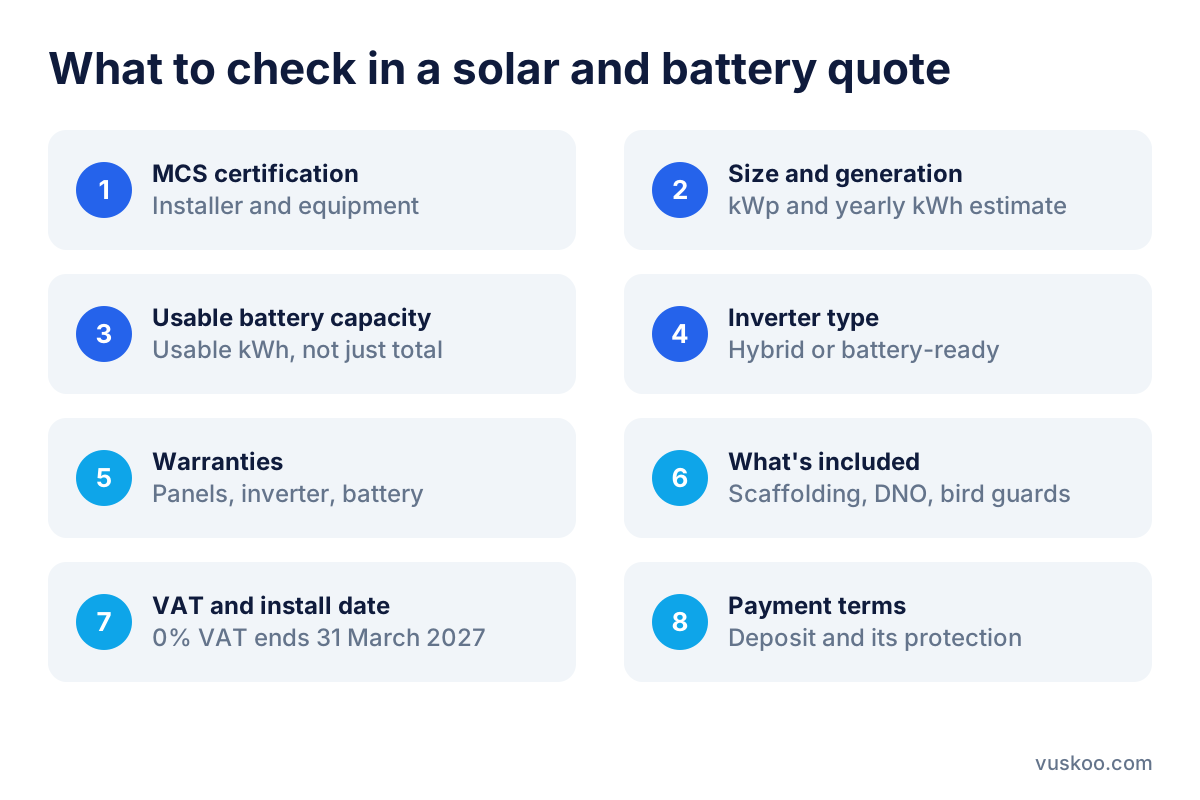
- Certification: the installer and the equipment should be MCS certified. You need this for SEG payments and the Warm Homes loans.
- Generation estimate: a yearly kWh figure based on your roof's direction, pitch and shading.
- Usable battery capacity: the usable kWh, not just the total.
- Warranties: separate terms for the panels, the inverter and the battery, plus a workmanship guarantee.
- What's included: scaffolding, bird protection, the network operator (DNO) notification, monitoring and removing waste.
- VAT and timing: VAT shown at 0%, with a clear installation date.
- Payment terms: the deposit, staged payments and whether your deposit is protected.
FAQ
Can I add a battery to solar panels I already have?
Yes. Batteries fitted to existing systems also qualify for 0% VAT until 31 March 2027. Check whether your current inverter is compatible or whether you'll need a hybrid or battery inverter.
Do I need a battery to get Smart Export Guarantee payments?
No. The SEG pays for the electricity you export, with or without a battery. You need an MCS certificate (or an equivalent) and a smart meter that records exports.
Will a battery keep my power on during a power cut?
Not always. Many systems switch off when the grid goes down. Backup power needs a compatible set-up, so ask the installer about it before you sign.
Are Warm Homes loans grants?
No. They are loans you repay, with interest kept low by government funding. Free upgrades for eligible low-income households come through a separate grant scheme.
Photo: RoyBuri / Pixabay