
In this article
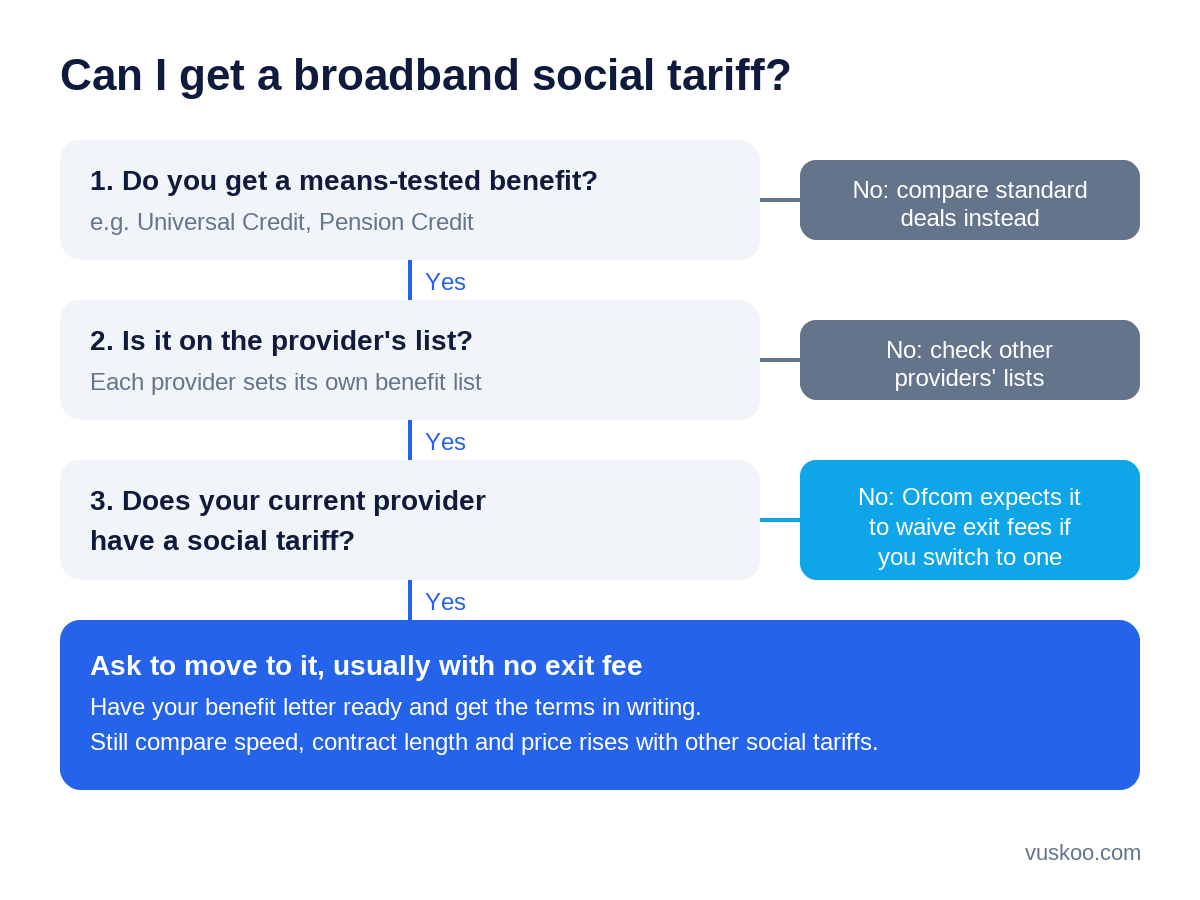
Broadband social tariffs are cheaper home broadband packages for people who receive Universal Credit, Pension Credit or certain other means-tested benefits. They give you the same kind of connection as a standard deal, usually at a modest speed, for a much lower monthly price. If you are on a social tariff with the same provider you already use, you can often move to it without paying an exit fee. And if your provider doesn't offer one, Ofcom expects it to waive early termination charges when you leave for another provider's social tariff.
The problem is that many eligible households don't know these tariffs exist. Ofcom's research found that only around 9% of eligible households were on a social tariff in mid-2025, and that most were unaware of them. This guide explains who qualifies, what you can expect and how to compare the options.
What are broadband social tariffs?
A social tariff is a discounted broadband (and sometimes phone or mobile) package that a provider offers only to customers who meet certain conditions, usually receiving a means-tested benefit. They are not a government scheme, and the government doesn't set the price. Each provider decides whether to offer one, how fast it is and what it costs. Ofcom monitors them and publishes a list of the tariffs available.
The choice has grown quickly. According to Ofcom, the number of broadband social tariffs rose from three in 2020 to more than 30 by December 2025. They range from tariffs run by national providers to ones from smaller full fibre networks that only cover certain areas.
Who qualifies for a social tariff?
Ofcom says almost all fixed broadband social tariffs are open to people receiving means-tested benefits such as Universal Credit and Pension Credit. Beyond that, every provider sets its own list. Depending on the provider, accepted benefits can include:
- Universal Credit (some providers accept it whether or not you have earnings, others have separate rules)
- Pension Credit
- Income-related Employment and Support Allowance
- Income-based Jobseeker's Allowance
- Income Support
Some providers accept a wider range of benefits, while others are stricter. Some only offer their social tariff to existing customers, or only where their own network reaches your address. Before you apply, read the provider's eligibility list and check that the person whose name is on the broadband account is the person receiving the benefit.
How do providers check eligibility?
Some providers can check your benefit status directly with the Department for Work and Pensions if you agree to it. Others ask for a recent benefit letter or a screenshot from your online Universal Credit account. Keep a copy of your latest award letter to hand before you start, as it speeds things up.
What speeds and prices can you expect?
Social tariffs are designed to cover everyday use, not to match the fastest packages. Speeds vary a lot between providers. Some entry-level tiers are enough for browsing, email, online forms and streaming on one or two devices. Higher tiers can handle several people streaming or on video calls at the same time. A few full fibre providers offer considerably faster social tariffs where their network is available.
Prices are fixed by each provider and change from time to time. Ofcom has noted that some providers have recently raised their social tariff prices, so don't rely on figures you've seen in older articles. The live offer boxes next to this article show current prices for standard deals. For social tariffs, check the provider's own page or Ofcom's list on the day you apply.
What to compare beyond the monthly price
- Average speed: look at the average download speed the provider quotes, and check what speed your address can actually get.
- Contract length: some social tariffs run on rolling monthly terms, others for 12 or 18 months or longer. A shorter term makes it easier to leave if your circumstances change.
- Price rises: check whether the tariff is affected by the provider's annual price change, and by how much.
- Set-up and equipment: ask whether there is an activation charge, a router delivery fee or a charge to return equipment.
- Landline: some social tariffs are broadband only, others include a phone line or call package.
- What happens if you stop claiming: find out whether you would be moved to a standard tariff and what that would cost.
Can you leave your current contract without paying an exit fee?
This depends on where you are switching from and to.
- Moving to your own provider's social tariff: providers that have a social tariff generally let eligible existing customers move to it without an early termination charge. For example, BT's social tariff is open to eligible BT, EE and Plusnet broadband customers, who can move to it without an exit fee.
- Your provider has no social tariff: Ofcom's stated position is that providers without their own social tariff should waive early termination charges for customers who are struggling to pay and want to move to another provider's social tariff.
- Leaving one provider's social tariff for another provider's: check the terms of your current social tariff, especially if it has a fixed term.
Always ask your current provider to confirm in writing that no early termination charge will apply before you place a new order. Under the One Touch Switch process, your current provider must also tell you about any exit charges and how the switch will affect other services, such as a landline or TV, when you start a switch.
Why social tariffs can be hard to find
Providers aren't required to put social tariffs alongside their regular deals, and many don't show them on comparison pages or main product pages. Ofcom has asked providers to promote them more clearly, but you often have to look for a separate "essentials", "basics" or "support" page, or ask on the phone.
Ofcom's social tariffs page lists the main ones, but smaller networks aren't always included. If a local full fibre network covers your street, it's worth checking its website directly.
How to switch to a broadband social tariff
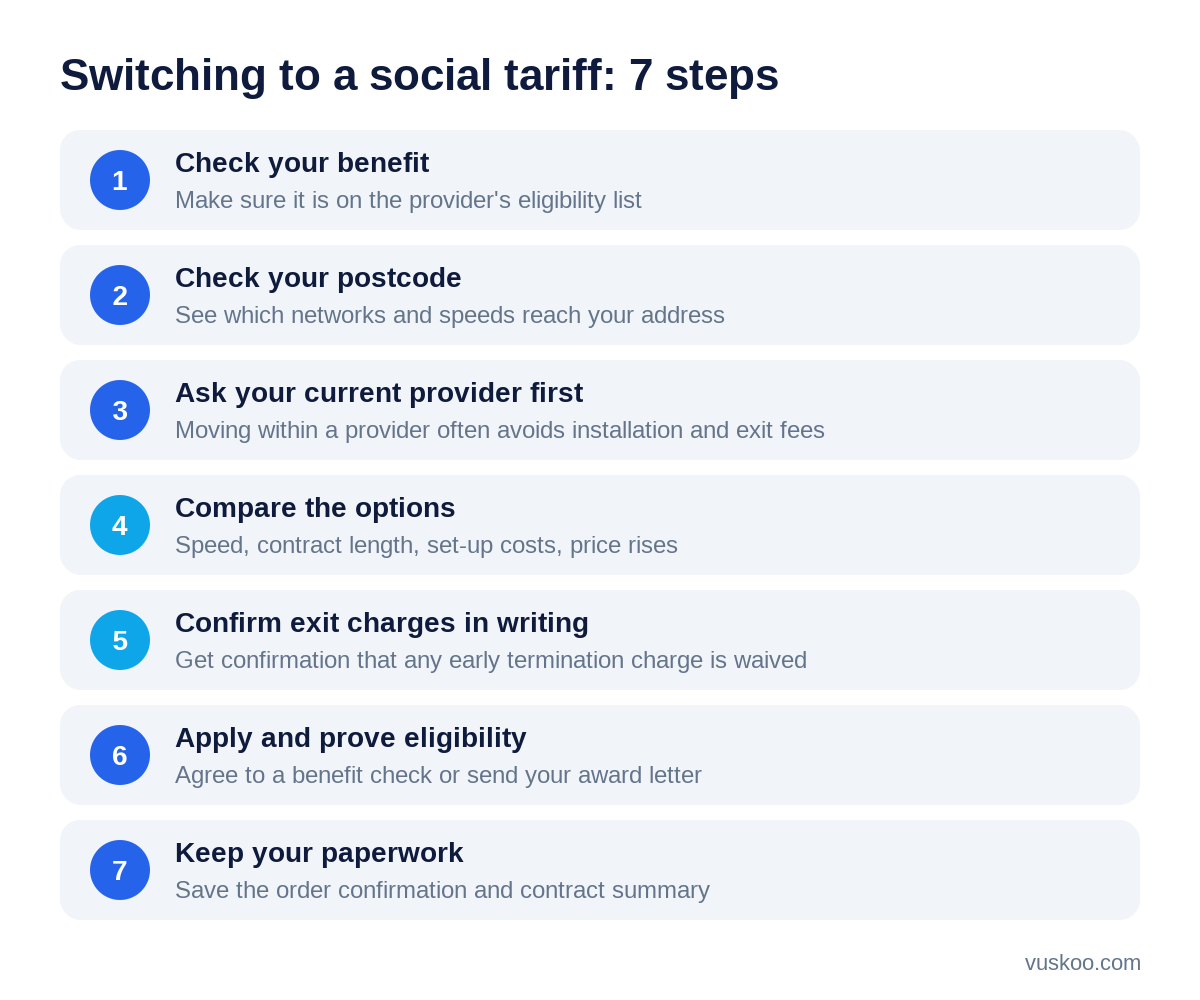
- Check your benefit: confirm that you, or the account holder, get a benefit on the provider's eligibility list.
- Find out what's available at your address: enter your postcode on provider sites to see which networks reach you.
- Ask your current provider first: if it has a social tariff, moving to it is often the simplest route, with no installation and no exit fee.
- Compare the alternatives: use the checklist above to weigh speed, contract length, set-up costs and price rises.
- Confirm exit charges: get written confirmation of any early termination charge, or that it has been waived.
- Apply and prove eligibility: give consent for a benefit check or send your award letter.
- Keep your paperwork: keep your order confirmation and contract summary in case of disputes.
Is a standard deal ever a better fit?
Sometimes. Introductory offers on standard broadband, or on a broadband and SIM bundle, can occasionally cost less in the first months than a social tariff. But the price usually rises when the promotion ends, and the contract is often longer. Ofcom has also noted that some low-cost standard SIM-only deals cost less than mobile social tariffs. If you mainly use mobile data, compare SIM-only options from providers such as SMARTY, GiffGaff, iD Mobile, Voxi or Tesco Mobile alongside any mobile social tariff. Work out the total cost over the whole contract, not just the first month.
Frequently asked questions
Do I have to be a new customer to get a social tariff?
No. Many providers offer their social tariff to existing customers, and some only to existing customers. Ask your current provider before looking elsewhere.
Will my credit score affect whether I can get a social tariff?
Providers may still run a credit check, as they do for other contracts. Policies differ, so ask before applying if this is a concern.
What happens if I stop receiving benefits?
Providers may check your eligibility again during the contract. If you no longer qualify, you could be moved to a standard tariff. Check the terms so you know what would happen.
Is a social tariff slower or lower quality than normal broadband?
It uses the same network and connection type as the provider's other packages. The main difference is usually a lower speed tier, not lower reliability.
Can I get a social tariff for mobile as well as broadband?
Some providers offer mobile social tariffs. EE, for example, has a mobile-only social tariff. Compare these with standard SIM-only deals, as these can sometimes cost less.
Photo: ricardorv30 / Pixabay