In this article
- What does a fee-free bank account actually cover?
- Where do costs still appear on a 'no fees' current account?
- Fee-free account or basic bank account: what is the difference?
- Leaving a packaged account: what to check first
- How to compare fee-free bank accounts: a checklist
- How switching works
- Frequently asked questions
A fee-free bank account is a current account with no monthly fee for everyday banking. In the UK that usually means paying nothing to receive your salary, pay by card at home, set up Direct Debits and standing orders, send Faster Payments and take cash out of free-to-use machines. "Free" does not mean every service costs nothing. Borrowing through an overdraft, using your card abroad, sending a CHAPS payment or ordering a replacement card can all have a cost. This guide explains where the line sits and how to compare accounts before you choose one.
What does a fee-free bank account actually cover?
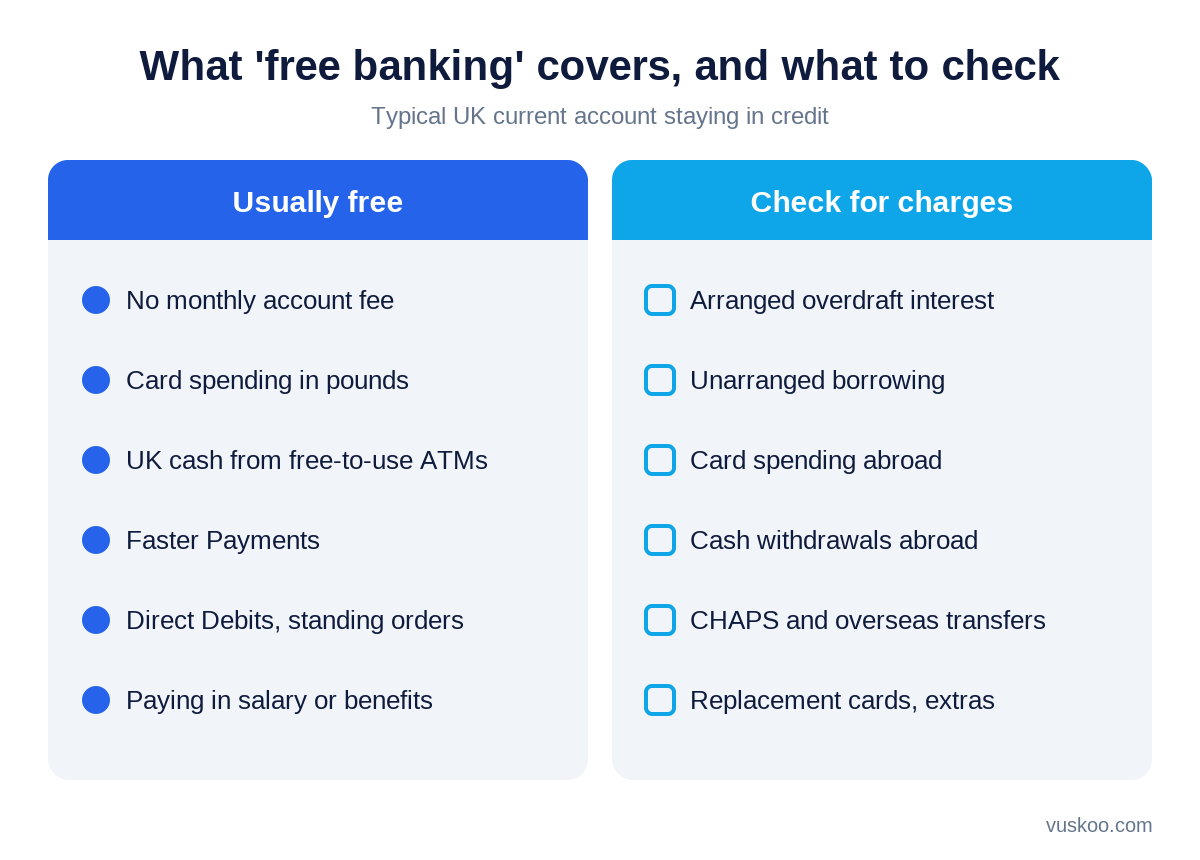
Most standard current accounts in the UK work on a "free if in credit" basis: as long as you stay above zero, the bank does not charge you for running the account. The everyday services usually included are:
- Opening and keeping the account, with no monthly fee
- A debit card for spending in pounds in the UK and online
- Cash withdrawals in the UK from free-to-use cash machines
- Faster Payments, Direct Debits and standing orders
- Paying in your salary or benefits
- Access through an app, online banking and, with some providers, branches
App-based accounts such as the Monzo Current Account, Starling Personal Current Account and Chase UK Current Account follow this model, as do high-street options like Nationwide FlexDirect, Santander's Everyday Current Account and first direct's 1st Account. Some providers also sell paid tiers on top of a free account. Monzo, for example, offers Extra, Perks and Max alongside its Free plan. If you only want a no-fee account, check that you are signing up for the plan without a monthly subscription.
Where do costs still appear on a 'no fees' current account?
Arranged overdrafts
An arranged overdraft is a borrowing limit agreed with your bank in advance. Since April 2020, Financial Conduct Authority (FCA) rules have required banks to charge for overdrafts through a single annual interest rate only. Daily or monthly overdraft fees are no longer allowed. The rate still matters, though. Overdraft interest is often high compared with other types of borrowing, and the rate can differ from one customer to another, depending on the bank's assessment of you. Some accounts include a small interest-free buffer or an introductory interest-free period, which is common on student accounts such as those from HSBC, NatWest and Barclays. Check how long any interest-free period lasts and what the rate becomes after it ends.
Unarranged borrowing and refused payments
Unarranged borrowing happens when you spend beyond your balance or your agreed limit. Under the same FCA rules, banks cannot charge a higher interest rate for unarranged borrowing than for arranged borrowing. Many banks now simply refuse payments that would take you over your limit. Banks are still allowed to charge a fee when they refuse a payment because there is not enough money in the account, so read the tariff for refused or returned payments, especially if your balance often runs close to zero.
Spending and cash withdrawals abroad
Overseas use is where accounts differ most. When you pay in a foreign currency, costs can come from several places:
- A non-sterling transaction fee, usually a percentage of each purchase
- The exchange rate used, and whether the bank adds a margin to the card network's rate
- Cash withdrawal fees abroad, which may be a percentage, a flat amount, or free up to a monthly limit
- Charges from the cash machine operator, which your bank does not control
If a shop or cash machine abroad offers to charge you in pounds, this is called dynamic currency conversion. It often uses a less favourable rate than your card provider would, so paying in the local currency is usually the better choice.
CHAPS and international transfers
Faster Payments are usually free and cover most everyday transfers within the UK. CHAPS is a same-day payment method used mainly for large sums, such as the final payment on a house purchase, and many banks charge a fee for each CHAPS payment. Some app-based accounts do not offer CHAPS at all, which matters if you are about to buy a property. Sending money abroad can also involve a transfer fee, an exchange rate margin and charges from other banks along the way.
Replacement cards and other extras
A first card is normally free. Replacement cards, faster delivery, a card sent abroad, paper statements, bank-drawn cheques or copy documents may cost extra, depending on the provider. These charges are small on their own, but it is worth knowing about them before you need them.
Fee-free account or basic bank account: what is the difference?
A basic bank account is a separate product. Under the Payment Accounts Regulations 2015, the UK's largest current account providers must offer one to people who do not have a bank account or do not qualify for a standard one. Basic accounts are fee-free for standard services, including failed payments, and they do not have an overdraft. Banks generally do not run the same credit checks as for a standard account. If you have been turned down for a current account, ask a provider whether you are eligible for a basic account.
Leaving a packaged account: what to check first
Packaged accounts charge a monthly fee in exchange for extras such as travel insurance, mobile phone insurance or breakdown cover. Before moving to a fee-free account:
- List the benefits you actually use, and look up what it would cost to buy them separately.
- Check whether the insurance policies would still cover you in your circumstances, for example your age, health conditions or the number of trips you take.
- Plan any replacement cover so there is no gap, particularly for travel insurance if you have a trip booked.
- Look at the new account's overdraft terms if you rely on borrowing, since your limit and rate may change.
How to compare fee-free bank accounts: a checklist
Once you know what you need, these are the points that separate one account from another.
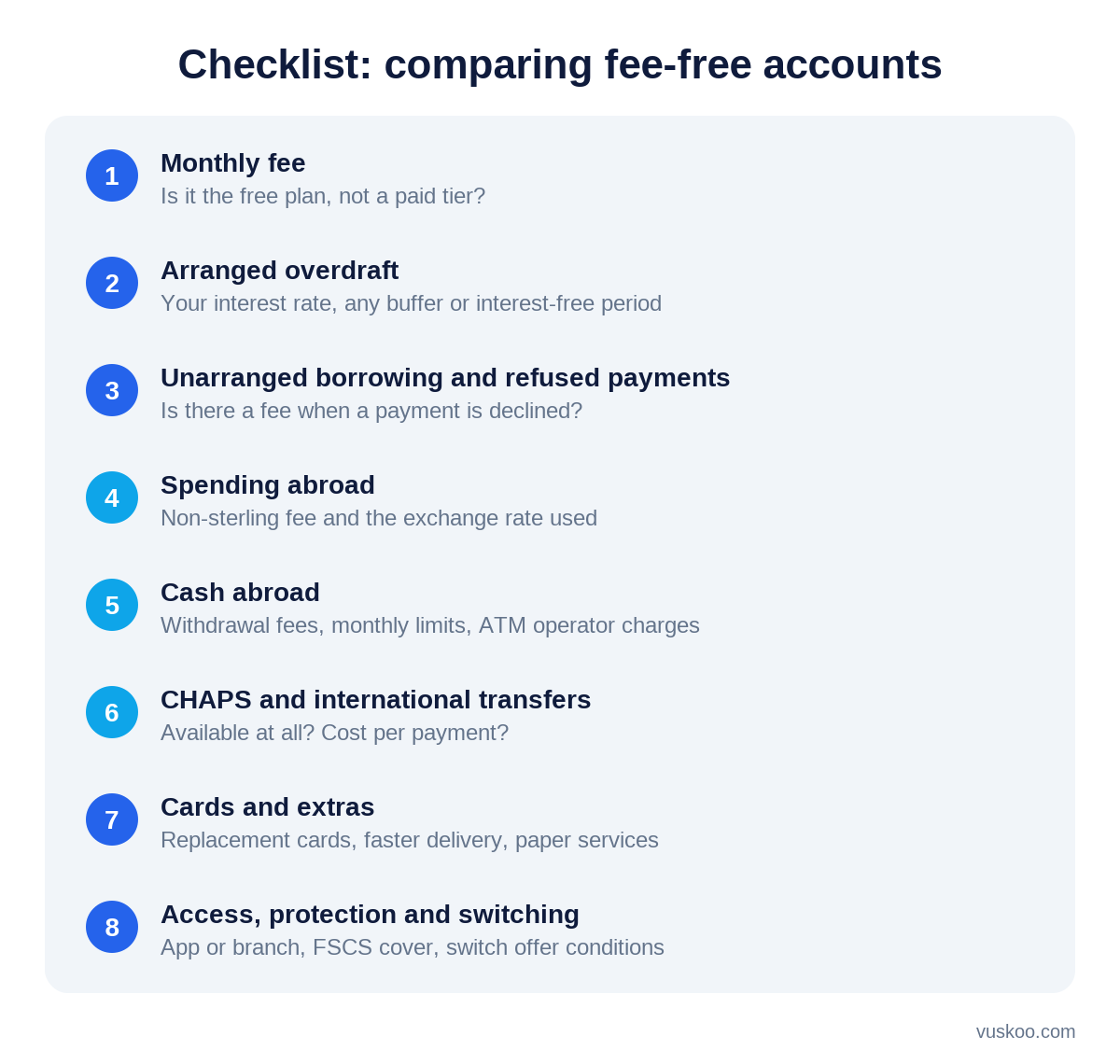
- Monthly fee: confirm the plan really has no monthly charge and is not a paid tier.
- Overdraft: the arranged rate offered to you, any buffer or interest-free period, and whether you need an overdraft at all.
- Refused payments: whether the account charges when it declines a payment.
- Use abroad: non-sterling fees, the exchange rate, and cash withdrawal fees or limits.
- CHAPS and international transfers: whether they are available and what each one costs.
- Cards and extras: charges for replacement cards, faster delivery and paper services.
- Access: app only, or branches and Post Office counters if you pay in cash or cheques.
- Protection: whether the provider is covered by the Financial Services Compensation Scheme (FSCS). Since 1 December 2025, eligible deposits are protected up to £120,000 per person, per banking licence.
- Switch incentives: some accounts, such as those from Santander, Nationwide and first direct, offer a payment for switching. Check the conditions, such as a minimum monthly pay-in or a set number of Direct Debits, and how long you must keep the account.
How switching works
Most UK banks and building societies take part in the Current Account Switch Service. Once your new account is open, the switch is completed in seven working days. Your balance, Direct Debits and standing orders move across, and payments that are still sent to your old account are redirected. Recurring card payments, such as subscriptions charged to your old debit card, are not moved automatically, so update those yourself. A partial switch, where you keep the old account open, is not covered by the switch guarantee and takes longer.
Frequently asked questions
Is a fee-free bank account really free?
Everyday banking in pounds is free on most standard current accounts as long as you stay in credit. Costs can come from overdraft interest, refused payment fees, using the card abroad, CHAPS payments and some extras such as replacement cards.
Can a bank charge a daily fee for using my overdraft?
No. Since April 2020, FCA rules allow banks to charge for overdrafts through an annual interest rate only, and unarranged borrowing cannot be charged at a higher rate than arranged borrowing.
Will opening a fee-free account affect my credit file?
Applying for a standard current account usually involves a credit check, and an overdraft request is a form of credit. A basic bank account usually does not involve the same checks.
Do I need to close my old account when I switch?
A full switch through the Current Account Switch Service closes the old account and redirects payments. Many switch incentives require a full switch, so check the conditions before you start.
Photo: Maria_Domnina / Pixabay