In this article
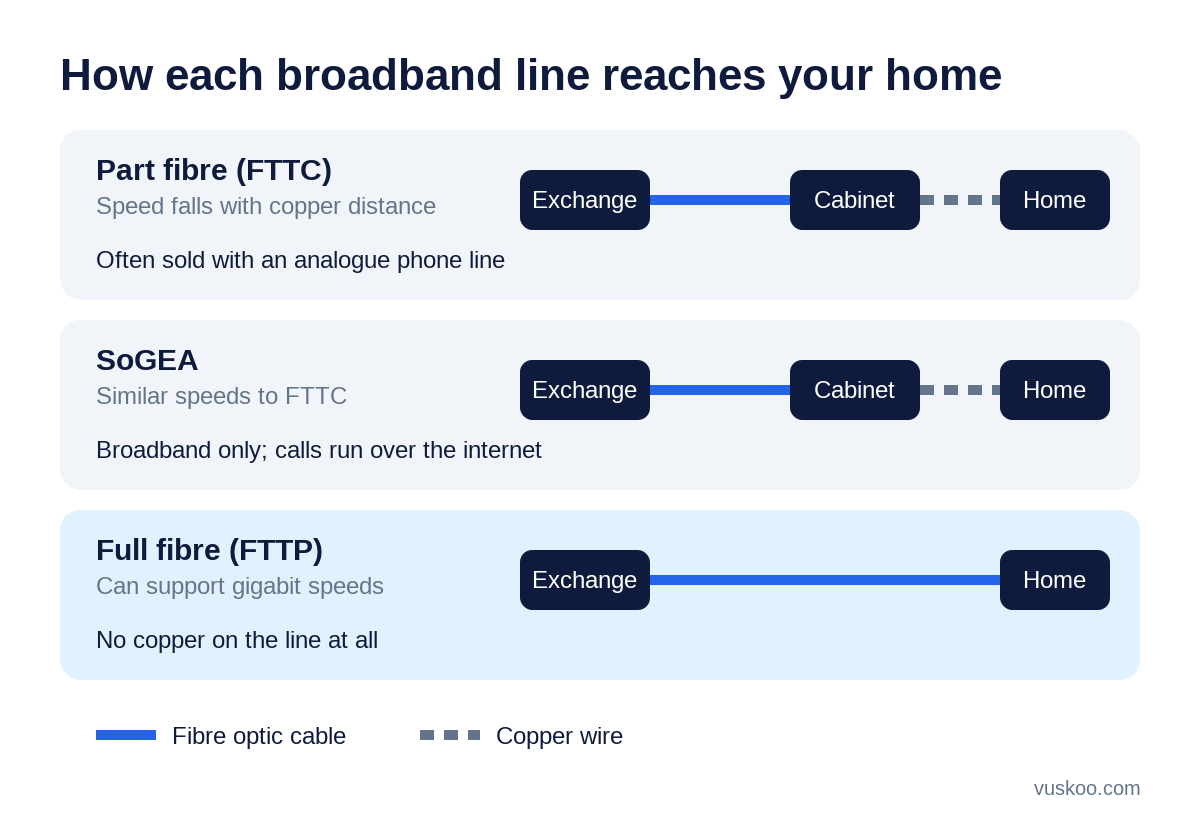
When people compare full fibre and fibre broadband, the difference comes down to the last part of the line. Full fibre (FTTP) runs fibre optic cable all the way into your home. What has usually been sold as "fibre" broadband is really part fibre (FTTC): fibre goes to the green cabinet in your street, and the old copper phone line covers the rest. That copper section caps your speed and gets slower the further you are from the cabinet. Full fibre has no copper section, so it can offer much higher speeds and they are steadier.
If your provider is asking you to upgrade, or you are choosing a new deal, this guide covers what each technology means, how to see what your address can get, what happens as copper is retired, and what to check before you sign a new contract.
Full fibre vs fibre broadband: the three line types explained
Part fibre (FTTC)
FTTC stands for fibre to the cabinet. Fibre optic cable connects the exchange to a street cabinet, and copper wire runs from the cabinet to your home. Ofcom points out that copper-based connections lose performance the longer the copper run is. Two neighbours on the same package can therefore get different speeds. FTTC is commonly sold at up to around 80Mbps download. Many homes get less than that.
SoGEA
SoGEA (Single Order Generic Ethernet Access) normally uses the same fibre-and-copper route as FTTC, but you get broadband only, without a traditional analogue phone service on the line. Speeds are about the same as FTTC, because the copper section has not changed. If you want home phone calls, they run over the broadband connection as a digital voice service. Many households now move to SoGEA as part of the landline switchover when full fibre is not yet available.
Full fibre (FTTP)
FTTP means fibre to the premises. The fibre optic cable reaches a small box inside your home and there is no copper anywhere on the line. Ofcom notes that full fibre and cable networks can support speeds of one gigabit per second or more. Packages range from entry-level tiers, such as BT Full Fibre 150, up to around 900Mbps, such as EE Full Fibre 900. Distance from the cabinet makes very little difference.
Where does cable fit in?
Virgin Media runs its own network. In many areas it uses cable (fibre to the street, then coaxial cable into the home), and in some newer areas it uses full fibre. Since late 2023, Ofcom guidance has required providers to tell you the underlying technology in plain terms, such as "full fibre", "part fibre" or "cable", before you buy. The word "fibre" on its own is not enough. Look for that description on the product page and in the contract summary.
What is the real speed difference?
The headline figures only tell part of the story. These points matter in day-to-day use:
- Download speed: FTTC is limited by the copper line, while full fibre tiers can go many times higher. The provider's estimate for your address is a better guide than the package name.
- Upload speed: this matters for video calls, sending large files and cloud backups. Full fibre packages usually have much faster uploads than FTTC.
- Consistency: copper is affected by distance, line quality and interference. Fibre is far less affected, so speeds hold up better at busy times and in bad weather.
- Several users at once: streaming, gaming and working from home at the same time is where the extra capacity of full fibre shows.
If one or two people mostly browse and stream in HD, a good FTTC line may still be enough. Households with several heavy users, or anyone who uploads a lot, will see the bigger difference.
How to check what your address can get
- Use Ofcom's broadband and mobile checker. Enter your postcode and choose your address. It shows which speed categories and providers are available. According to Ofcom's Spring 2026 Connected Nations update, full fibre reached about 82% of UK homes.
- Check with providers directly. Each provider's address checker shows the packages it can actually sell you, the technology used and an estimated speed range.
- Check more than one network. Your address may have full fibre from Openreach (used by BT, EE, Plusnet, Sky and others), from Virgin Media, or from an independent network. One provider saying "not available" does not mean nobody can connect you.
- If you are in England or Wales and nothing is listed, the government's gigabit address checker shows whether your address is included in a publicly funded upgrade plan.
What happens when copper products stop being sold?
There are two separate changes going on.
The landline switchover. The old analogue phone network (PSTN) is being closed, with a final deadline of 31 January 2027. Ofcom says industry made this decision, and BT's timetable sets the date for providers that use its network. Home phone calls move to digital services that run over broadband. If you have a personal care alarm, a security alarm or another device that uses the phone line, check with its supplier that it will still work.
Openreach's "stop sell". Once about 75% of premises served by an exchange can get full fibre, Openreach gives notice and providers then stop selling older copper-based products to addresses that can get FTTP. You are not cut off. Your existing service carries on, but if you move house, switch provider or change package, you are likely to be offered full fibre. By November 2026, stop sell was active at more than 1,600 exchanges.
Does it cost more to upgrade to full fibre?
Not necessarily. At the same speed, full fibre is often priced close to part fibre, and the faster tiers cost more. You can compare current packages from BT, EE, Plusnet, Sky and Virgin Media in the live offer boxes on this page. When you compare, look past the monthly price you see first:
- The price after the introductory period. Many deals switch to a higher standard price, so check what you will pay once the offer ends and for the rest of the contract.
- Annual price rises. Since 17 January 2025, Ofcom has required new contracts to state any mid-contract price rise in pounds and pence, not as a percentage or linked to inflation. Contracts signed before that date may still have inflation-linked rises.
- Upfront and installation costs. These include set-up or activation fees, router delivery and any engineer visit.
- Contract length and exit fees, particularly if you are still in a contract now.
- Bundles. Some providers offer TV or a mobile SIM discount with broadband. Only count these if you will actually use them.
What to check before re-contracting
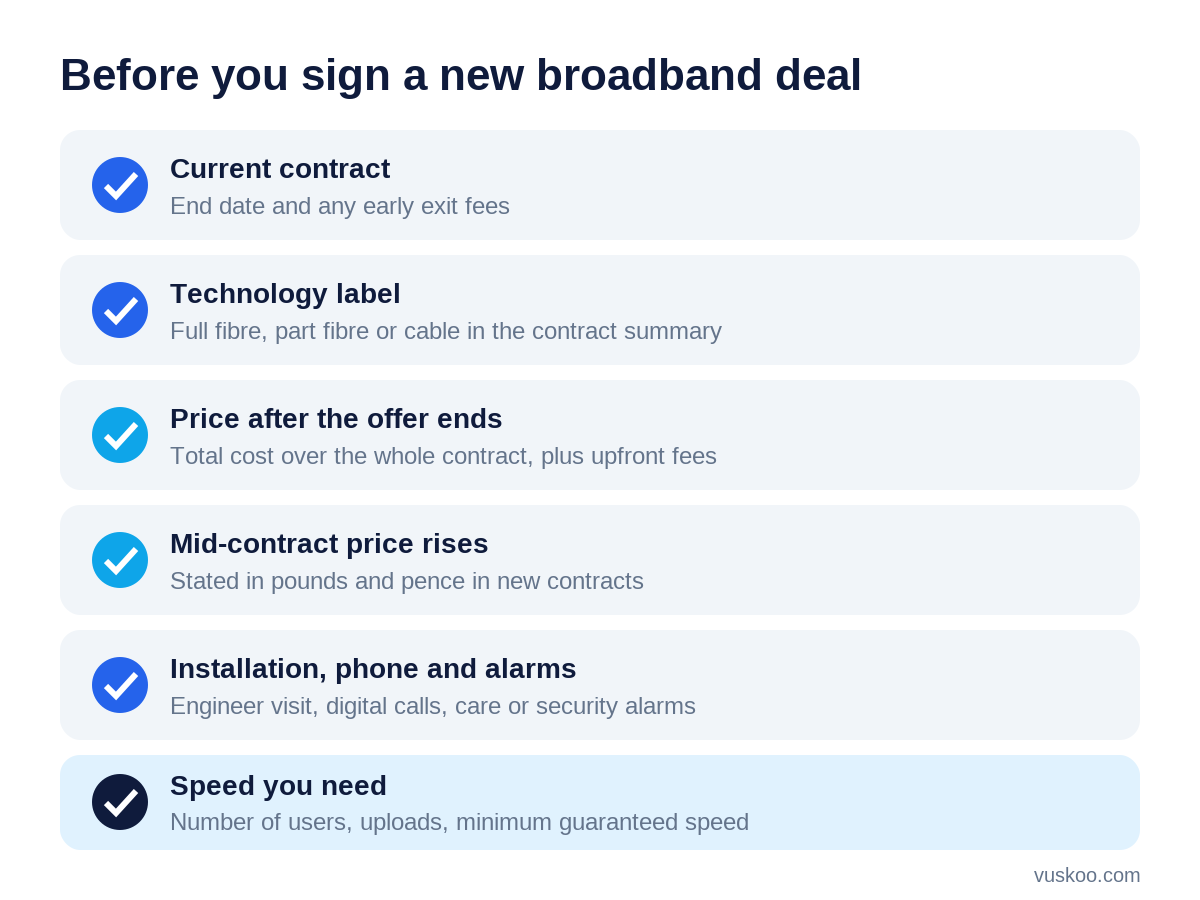
- When your current contract ends, and whether leaving early costs anything.
- The technology label in the contract summary (full fibre, part fibre or cable).
- The minimum guaranteed speed and what you can do if your speed falls below it.
- How home phone calls will work, and whether your phone handset or alarm needs an adaptor.
- What installation involves. Full fibre may need a new connection box inside your home and an engineer visit.
- Whether you need the speed you are paying for, or whether a lower tier would be enough.
Frequently asked questions
Is "fibre broadband" the same as full fibre?
No. Fibre broadband often means FTTC, which uses copper for the last part of the line. Full fibre means fibre runs all the way into your home.
Will I be forced to switch to full fibre?
Your current service carries on. In stop-sell areas, providers stop selling copper-based products to addresses that can get full fibre, so a new contract or a house move is likely to mean full fibre.
Do I still need a landline for broadband?
No. SoGEA and full fibre do not need an analogue phone line. If you want home phone calls, they run over your broadband.
Does full fibre installation involve drilling?
Often there is some work, because an engineer may need to bring the fibre into your home and fit a small box inside. Check what your provider's installation includes when you order.
Will my phone work in a power cut?
Digital phone services need power to the router, so in a power cut you may need to use a mobile instead. If you rely on your landline, for example for a care alarm, ask your provider what support it offers.
Photo: PawinG / Pixabay